

Introduction: Separating Legitimate Strategy from Casino Mythology
The search for a winning baccarat strategy guide consumes countless players—many convinced that hidden patterns or betting systems hold the key to profitability. Yet most approaches conflate entertainment techniques with genuine mathematical advantage, misunderstanding what constitutes legitimate strategy versus psychological comfort.
A comprehensive baccarat strategy involves two distinct layers: recognizing what genuinely affects outcomes versus what merely feels significant. Pattern spotting, scorecard reading, and complex betting progressions appeal psychologically. Yet mathematically rigorous analysis reveals which elements actually optimize results.
This reality disappoints those seeking magical systems. Baccarat doesn’t offer concealed advantages—its mathematical framework is transparent and well-documented. What does exist are strategic frameworks that maximize entertainment value while minimizing losses within that the underlying math.
This guide breaks down legitimate baccarat strategy: distinguishing between genuine advantages and psychological illusions, exploring pattern recognition’s actual limitations, detailing bet sizing methodology, implementing bankroll discipline, and providing actionable frameworks separating informed play from superstitious gambling.
By mastering these distinctions, you’ll abandon illusions chasing impossible advantages and instead focus on legitimate optimization within mathematical constraints.
The Foundation: What Baccarat Strategy Actually Is
Before exploring specific approaches, defining legitimate baccarat strategy requires distinguishing between what affects outcomes and what merely influences perception.
Defining Legitimate Strategy
Legitimate strategy involves decisions that mathematically affect long-term expected value or optimize engagement within fixed mathematical constraints.
Illegitimate pseudo-strategy involves actions that feel purposeful despite having zero mathematical impact on outcomes. These are often called “entertainment techniques” rather than genuine strategy.
What Doesn’t Work in Baccarat
Unlike blackjack (where hitting/standing decisions modify outcomes) or poker (where fold/raise choices affect relative position), baccarat offers minimal strategic decisions because:
- Automatic drawing rules govern both hands mechanistically
- No player discretion exists during gameplay (except Chemin de Fer)
- Independent outcomes mean previous results never influence future probability
- Fixed house edge cannot be reduced through any system
Understanding these constraints eliminates futile searching for nonexistent advantages.
What Does Work: The Framework
Legitimate baccarat strategy encompasses:
- Bet selection (choosing Banker over Player due to lower house edge)
- Bet sizing (determining appropriate wager amounts)
- Bankroll management (preserving capital across sessions)
- Session discipline (implementing stop-losses and profit targets)
These elements don’t beat baccarat—they optimize your experience within the underlying math.
Pro Tip: Any strategy claiming to overcome house edge or profit long-term is mathematically impossible and thus dishonest. Ignore it entirely and focus on legitimate optimization instead.
Pattern Spotting: Entertainment vs. Advantage
Pattern spotting represents baccarat’s most psychologically seductive pseudo-strategy—and simultaneously its most mathematically invalid.
Understanding Pattern Recognition
Pattern spotting involves tracking scorecard results (Big Road, Bead Plate, etc.) and betting based on identified sequences. Proponents believe previous hand results reveal predictive information about future outcomes.
Common pattern betting examples:
- “Banker has won 3 times, so Player is ‘due'”
- “Alternating pattern of B-P-B-P, so bet on B next”
- “Hot streak on Banker means continue betting Banker”
These approaches intuitively appeal to human pattern-recognition instinct.
The Mathematical Reality: Independence
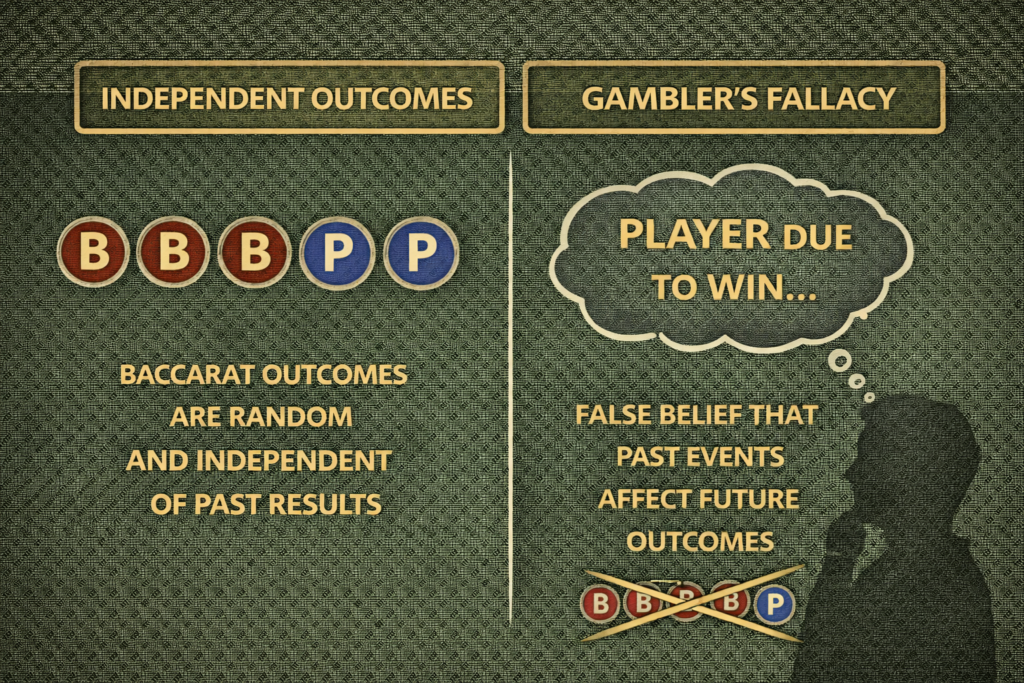
Each baccarat hand is completely independent. This scientific fact, proven through decades of probability research, renders all pattern-based predictions mathematically meaningless.
The Gambler’s Fallacy describes this exact error: believing past independent events influence future probability. In baccarat:
- Previous 10 hands all resulted in Banker wins
- Probability of next hand being Player: Still 44.62% (unchanged)
- Probability of next hand being Banker: Still 45.86% (unchanged)
- The 10 prior results have zero predictive value
Mathematical proof: Running computerized simulations across millions of hands confirms identical results: pattern streaks appear naturally through randomness, but patterns themselves have zero predictive power for future outcomes.
Why Pattern Spotting Appeals Despite Being False
Psychological reason #1: Pattern recognition is human instinct. Our brains evolved to identify patterns in nature—predators, prey, weather. This instinct makes pattern-seeking feel natural and meaningful.
Psychological reason #2: Patterns genuinely appear. Random sequences produce streaks, alternations, and apparent patterns. Seeing them isn’t delusional—recognizing patterns that exist in random data is universal human behavior.
Psychological reason #3: Cognitive confirmation bias. Players remember times patterns “worked” and forget times they failed, creating false confidence in pattern predictiveness.
Research Evidence: Why Patterns Fail
Industry experts studying millions of hands confirm: pattern streaks occur naturally in random data, but don’t predict future outcomes. A Python simulator tracking 81+ million hands found identical Banker (45.85%) and Player (44.63%) win rates regardless of observed streak patterns.
Quick Takeaway: Pattern spotting provides entertainment value through scorecard-watching, but offers zero mathematical advantage. Enjoy tracking patterns for psychological engagement, but don’t base betting decisions on them.
Bet Sizing: The Legitimate Strategy Element
Unlike pattern spotting, bet sizing represents genuine strategic optimization—not through beating the house, but through maximizing session duration and entertainment within fixed mathematical constraints.
The Fundamental Principle
Bet sizing determines how much of your bankroll you wager per hand. This seemingly simple decision dramatically affects session outcomes through variance management.
Extreme examples:
Example 1: Aggressive sizing ($50 per hand on $100 session bankroll)
- Only 2 consecutive losses end the session
- High volatility creates frequent total bankroll depletion
- Very short session duration
Example 2: Conservative sizing ($5 per hand on $100 session bankroll)
- Sustains 20 consecutive losses
- Dramatically extended session duration
- Lower psychological variance
- More hands played before mathematical house edge manifests
Both approaches lose money (1.06% on Banker bets), but conservative sizing extends the experience.
The Optimal Sizing Framework
Professional standard: Bet 1-2% of your session bankroll per hand.
Example calculation:
- Total bankroll: $1,000
- Session bankroll: 10% of total = $100
- Unit size: 1-2% of session = $1-2 per hand
- Typical range: $1-6 per hand for varied bet sizing
This framework enables:
- 50+ hands before 50% session loss threshold
- Variance management reducing catastrophic losses
- Extended entertainment duration per session
The Progressive Betting Question
Some players use progressive systems (Martingale doubling, 1-3-2-6 progressions, Fibonacci sequences). These claim to convert variance into profits.
Mathematical reality: Progressive systems don’t reduce house edge—they redistribute losses across hands differently. Over extended play, you still lose identical percentages regardless of progression.
However: Progressive systems DO manage psychological experience differently:
- 1-3-2-6 system concentrates risk during winning streaks
- Martingale concentrates risk during losing streaks
- Flat betting distributes risk evenly
Professional view: Progressions are psychological tools, not mathematical advantages. Choose based on personal psychology, not expecting edge reduction.
Pro Tip: If using progressions, ensure your starting bankroll supports complete sequences. A $10 Martingale starting bet requires $5,120 bankroll to survive 10 consecutive losses (2^10 doubling). Insufficient bankroll guarantees catastrophic failure.
Bankroll Management: The Critical Strategy Element
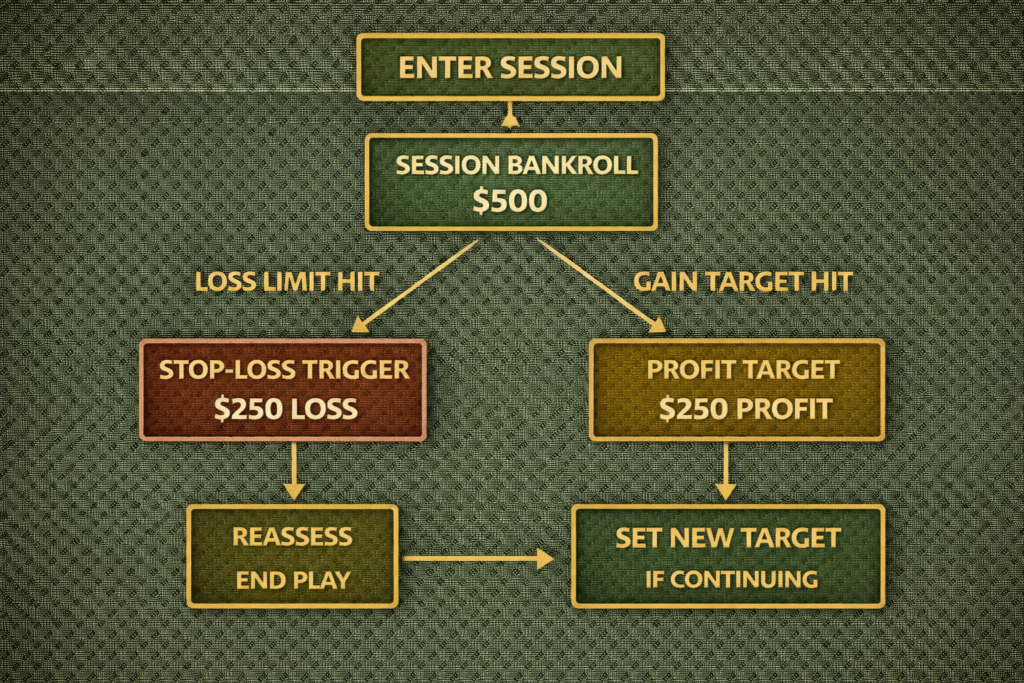
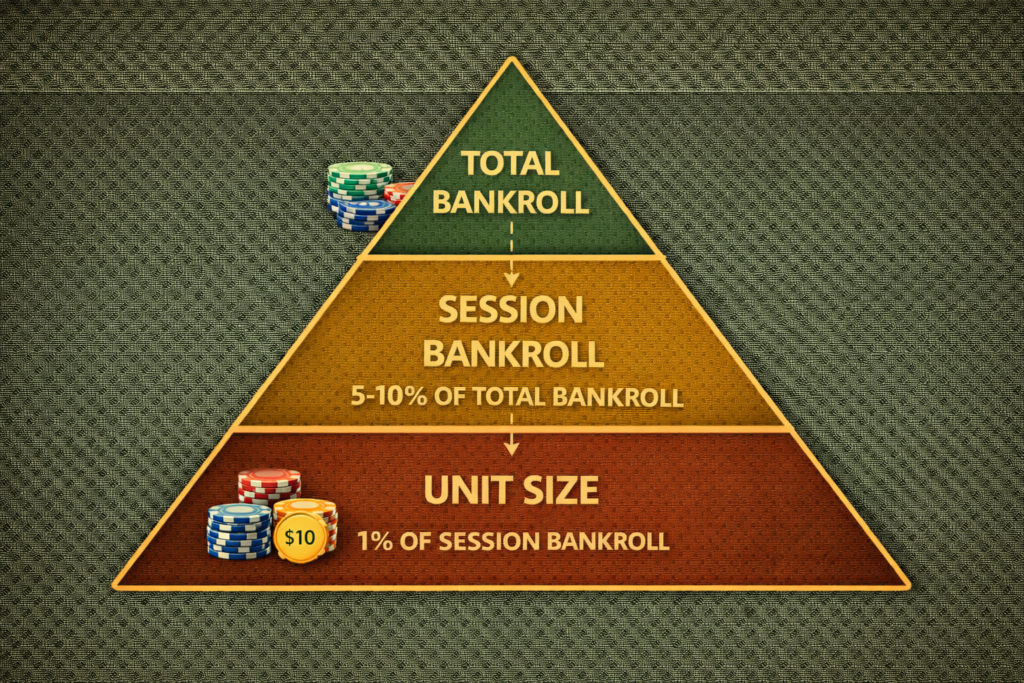
Bankroll management separates sustainable play from financial disaster. This framework determines session viability more than any betting system.
The Three-Tier Structure
Tier 1: Total Bankroll
- Money you can afford to lose entirely
- Allocated exclusively for gambling
- Example: $1,000 of entertaining money
Tier 2: Session Bankroll
- 5-10% of total bankroll per independent session
- Separated psychologically and physically from other funds
- Example: $100 per session on $1,000 total
Tier 3: Unit Size
- 1-2% of session bankroll per hand
- Adjusts based on session progression
- Example: $1-2 base unit, up to $6-12 maximum
Stop-Loss Implementation
Stop-loss threshold: Exit session at 50% session bankroll loss.
Practical example:
- Session bankroll: $100
- Stop-loss trigger: Reaching $50 remaining
- Action: Immediately cease playing regardless of circumstance
Purpose: Prevents emotional escalation after losses. Most catastrophic gambling failures occur when players violate predetermined stop-losses, chasing losses through increasingly desperate larger bets.
Reality check: Baccarat strategy is mostly about choosing the least expensive bet, understanding the commission or payout rules, and avoiding pattern-chasing. Those points can be checked from the paytable and shoe rules at the table.
Profit Target Strategy
Profit target: Exit when winning 50-100% of session bankroll.
Example:
- Session bankroll: $100
- Profit target: Reach $150 (50% gain)
- Action: Immediately cease playing upon reaching target
Purpose: Locks in winnings, prevents emotional decisions attempting to maximize short-term gains. Session discipline matters more than any strategy for long-term sustainability.
Betting Strategy: The Actual Optimal Approach
Amid hundreds of proposed strategies, one approach mathematically outperforms all alternatives.
The Optimal Strategy: Always Bet Banker

Mathematical foundation:
- Banker wins: 45.86%
- Player wins: 44.62%
- Difference: 1.24%
- 5% commission on Banker wins: Fair value for advantage
Long-term results with $1,000 total wagering:
- Banker betting: Lose $10.60 (1.06% house edge)
- Player betting: Lose $12.40 (1.24% house edge)
- Difference: $1.80 savings through Banker betting
Over extended play: This 0.18% difference compounds meaningfully, making Banker betting mathematically superior in all circumstances.
Pro Tip: About 51% of experienced players bet exclusively Banker for this mathematical reason. They recognize the 5% commission as fair price for superior odds rather than objectionable deduction.
The Never-Recommended Approach: Tie Betting
Tie bet statistics:
- Probability: 9.52%
- Payout: 8:1
- Fair payout: 9.52:1
- House edge: 14.36%
Tie betting is mathematically indefensible—costs 1,254% more per $100 wagered than Banker betting. Eliminate Tie betting entirely from any strategy.
Common Strategic Mistakes and Prevention
Mistake #1: Believing Patterns Predict Outcomes
Prevention: Accept each hand as mathematically independent. Track patterns for entertainment, not betting decisions.
Mistake #2: Betting Above Your Bankroll Capacity
Prevention: Never exceed 1-2% of session bankroll per hand. Insufficient sizing prevents proper sequence completion.
Mistake #3: Violating Stop-Loss Discipline
Prevention: Set stop-loss at 50% session loss. Enforce this immediately without exception, regardless of emotional desire to continue.
Mistake #4: Chasing Losses Through Escalated Betting
Prevention: Maintain consistent unit sizing regardless of outcomes. Emotional bet escalation is the fastest path to total bankroll depletion.
Mistake #5: Playing Exhausted or Emotionally Compromised
Prevention: Play only when mentally fresh and emotionally stable. Fatigue and frustration eliminate disciplined decision-making.
Advanced Considerations: Refining Your Approach
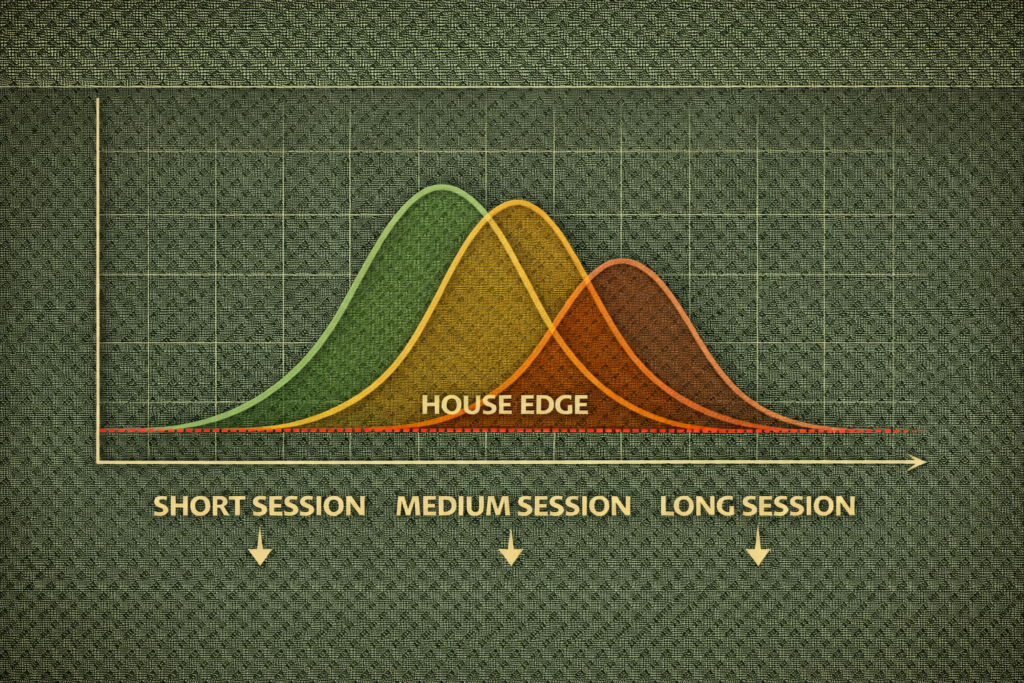
Bankroll Volatility and Session Length
Shorter sessions experience higher variance relative to mathematical edge. In a 10-hand session, luck dominates mathematics. In a 500-hand session, mathematics increasingly dominate luck.
Strategic implication: Longer sessions gradually reflect the underlying math while shorter sessions are purely variance-dependent.
Table Selection Criteria
Optimal table characteristics:
- Banker bet minimum matching your unit size (e.g., $5 minimum for $5 unit)
- Maximum bet supporting your progression (if using)
- Reasonable penetration before shuffle (if card-tracking interested)
Table selection doesn’t modify house edge but optimizes overall experience.
Solo Play vs. Group Dynamics
Solo play: Pure mathematics without social pressure
Group play: Social dynamics may introduce emotional decision-making. Recognize and resist peer pressure overriding your strategy.
Conclusion: Strategy Within Reality
Baccarat strategy isn’t about finding hidden edges or exploitable patterns. It’s about optimizing engagement within transparent mathematical constraints.
Accept these foundational truths:
- House edge is unchangeable through any system or betting pattern
- Pattern spotting is psychological entertainment, not mathematical advantage
- Optimal strategy = Always bet Banker (lowest house edge)
- Bankroll management determines sustainability, not beating odds
- Session discipline separates winning players from catastrophic losses
With realistic expectations, legitimate strategy turns baccarat from financial recklessness into managed entertainment. You won’t reduce the house edge—but you’ll play intelligently within the underlying math.
Bet Banker consistently, manage your bankroll strictly, implement stop-losses absolutely, and play only when mentally sharp. Within this framework, baccarat offers some of casino gaming’s best odds while providing engaging, mathematically honest entertainment.
Responsible Play Note
Casino strategy can reduce avoidable mistakes, but it cannot remove variance or guarantee profit. Set a budget before you play, keep gambling separate from income or bills, and stop when the session limit is reached. If gambling stops feeling recreational, take a break and use local support resources.