
Why “Strategy” Beats Luck, Hot Seats, and Dealer Superstitions
Ask ten casino regulars how to win at blackjack and you’ll collect folklore:
- “Sit at third base to control the shoe.”
- “Follow the hot seat—never cut the winning streak.”
- “Always take even money when you have blackjack.”
None of those change the math. Real strategy is a repeatable, data-driven system that:
- Shrinks the house edge or
- Shifts the edge in your favour
- Survives variance without bankroll ruin
This guide ties together six pillars that appear piecemeal across Google’s top results but rarely in a single, cohesive playbook:
- Basic Strategy—The decision matrix is solved by computers and verified with billions of simulated hands.
- Bankroll Management—Unit sizing, risk control, and session rules that keep you solvent during downswings.
- Table Selection & Rule Hunting—Because even perfect play dies on a 6:5 payout or H17 table.
- Card Counting—Still legal, still profitable, still misunderstood.
- Advanced Advantage Plays—Shuffle tracking, ace sequencing, hole-carding; high effort, high reward.
- Psychology & Time Management—The edge you control even when the cards hate you.
Read once for theory, bookmark for casino night, and practice until the wrong move literally feels unnatural.
What Makes a Strategy “Best” in Blackjack?
To deserve that label, a tip must hit all three benchmarks:
| Criterion | Test Question | Pass/Fail Example |
| Edge Reduction | Does it measurably lower the house edge or flip it positive? | Basic strategy cuts ~1 % edge—Pass |
| Repeatability | Can average players replicate it in most casinos? | Hi-Lo count in shoe games—Pass |
| Risk Control | Does it protect the bankroll and avoid casino heat? | Martingale progression—Fail (busts bankroll & draws pit attention) |
Every pillar below scores high on this rubric—validated by decades of live data, peer-reviewed studies, and pit-boss reality checks.
Pillar 1 – Basic Strategy: The Unbreakable Foundation
Even if you ignore every other pillar, basic strategy alone chops the house edge from roughly 1.5% to 0.50% (six-deck, S17, DAS). That’s a 66% improvement—identical to gaining a free 0.5% cashback on every wager.
1.1 How the Chart Was Born
In the early 1960s, mathematicians Baldwin, Cantey, Maisel, and McDermott punched a primitive mainframe (IBM 704) with every possible player/dealer combination. Later, Edward Thorp’s Beat the Dealer refined the math. Modern Monte Carlo sims—with billions of hands—confirm those decisions to six decimal places.
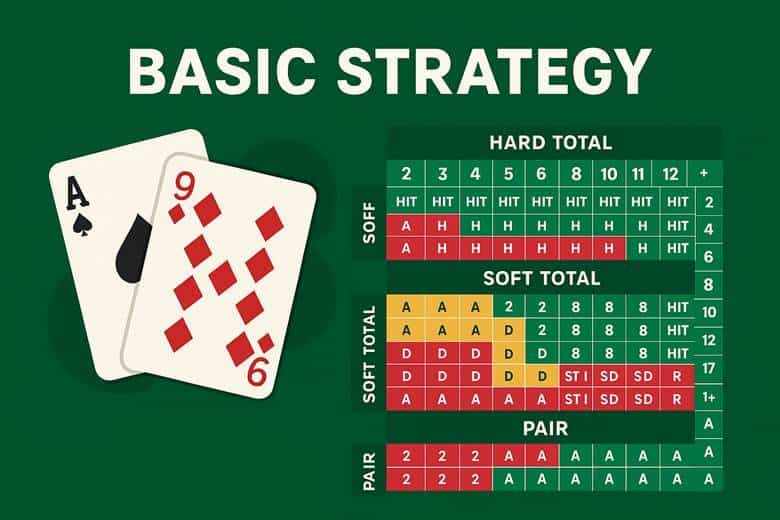
1.2 The Four Blocks of the Matrix
- Hard Totals (no Ace or Ace counted as 1)
- Soft Totals (Ace can still count 11)
- Pairs (splittable starting hands)
- Surrenders (if the rule exists)
Each block has green (Hit), red (Stand), yellow (Double), and blue (Split) squares. Memorize the chart, not the anecdotes.
1.3 Most Expensive Beginner Errors
| Player Hand | Dealer Up-Card | Wrong Play (Common) | Correct Basic Play | EV Hit to Bankroll /100 Hands |
| Hard 16 | 10 | Stand | Hit | –0.20 × bet |
| Soft 18 | 9 | Stand | Hit | –0.15 × bet |
| Pair 8-8 | 10 | Stand | Split | –0.25 × bet |
| Hard 12 | 3 | Hit | Stand | –0.12 × bet |
| Soft 17 | 6 | Stand | Double | –0.08 × bet |
Multiply those leaks by 100 hands an hour, and a weekend bankroll vanishes.
1.4 Seven-Day Mastery Drill
| Day | Focus | Method | KPI |
| 1-2 | Hard totals 5-17 | Flash-card app | ≤ 2 errors/200 |
| 3-4 | Soft totals A-2 … A-9 | Mnemonic phrases | ≤ 2 errors/200 |
| 5 | Pairs & surrender | Color printout review | ≤ 3 errors total |
| 6 | Mixed random quiz (500 hands) | BJ Trainer | ≤ 1% error |
| 7 | Live-play simulation (or $5 table) | Real pressure | Zero stall, crisp signals |
Target: ≤ 1 mistake per 100 hands before real money.
(Insert “Basic Strategy” image now.)
Pillar 2 – Bankroll Management: Staying Alive Long Enough to Win
Strategy only matters if you still have chips when the math swings your way.
2.1 Unit Sizing and Risk of Ruin
- Professional spread: 1× base unit when the count is cold; up to 8× when scorching.
- Capital rule: Bring 100× your top bet to keep the risk of ruin under 5%.
Firing $100 max? Bankroll $10 000.
2.2 Session Stop-Loss & Win-Cap
| Metric | Recommended Value | Why |
| Stop-Loss | 30 × base unit | Prevents emotional tilt; you’ll live to fight another shoe. |
| Win-Cap | 50 × base unit | Book profits, reduce heat, and reset variance. |
Example: $10 table → leave if down $300 or up $500.
2.3 Kelley Criterion Light
Kelley sizing balances growth vs. survival:
Bet = Bankroll × Edge / 2
- If edge = 1% (TC ≈ +3) → Wager 0.5% of bankroll.
- If edge = 2%, then wager 1%.
This outperforms flat betting by 20-30% ROI over 100,000 hands with half the bust risk.
(Insert “Bankroll Management” image here.)
Pillar 3 – Table Selection & Rule Hunting
3.1 Rule Checklist (Best → Worst)
| Rule or Condition | Edge Impact (vs. baseline) |
| 3:2 Natural Payout | –1.39 % vs. 6:5 |
| Dealer Stands on Soft 17 (S17) | –0.22 % |
| Double After Split allowed (DAS) | –0.15 % |
| Late Surrender allowed (LS) | –0.08 % |
| Fewer Decks (2 vs 6) | –0.30 % (approx.) |
| Side bets are required for entry (“21+3 only”) | +1–10% house edge (avoid) |
A small sign near the shoe tells all. If it says Blackjack pays 6:5—walk.
3.2 Penetration, Shufflers, and Heat
- Penetration PenPenPen: % of shoe dealt before reshuffle. Counters need ≥ 70% for stable true counts.
- Continuous Shuffle Machines (CSMs) kill penetration; walk.
- Heat: Back-offs spike after quick wins at deep-pen tables. Rotate casinos; downshift bet spread when the pit boss hovers.
Pillar 4 – Card Counting: Turning 0% Edge into Positive EV
4.1 Hi-Lo in 90 Seconds
| Card Group | Value | Memory Hook |
| 2-6 | +1 | Small cards help dealer—good for you |
| 7-9 | 0 | Neutral |
| 10-A | –1 | Big cards help player—bad for the dealer. |
Running Count (RC): Add values as cards fall.
True Count (TC): RC ÷ estimated decks left.
Bet Ramp (6-deck, 75% pen):
| TC | Units (Base Bet) |
| ≤ +1 | 1 |
| +2 | 2 |
| +3 | 4 |
| +4 | 6 |
| ≥ +5 | 8 |
4.2 Key Index Deviations
| Situation | Basic Play | Index Play | TC Trigger |
| 16 vs 10 | Hit | Stand | 0 |
| 15 vs 10 | Hit | Stand | +4 |
| Insurance | Decline | Buy | +3 |
| 12 vs 3 | Stand | Hit | –2 |
Daily drill: flash these four until automatic, then add more.
4.3 Cover & Camouflage
- Tip $1 per shoe—buy goodwill.
- Occasional table chat—sports scores, not card math.
- Smooth ramp—spread grows gradually, not spiking instantly.
- Wong-out—politely colour up and leave if TC < –2 early in shoe
(Insert “Card Counting” image here.)
Pillar 5 – Advantage Play Beyond Counting
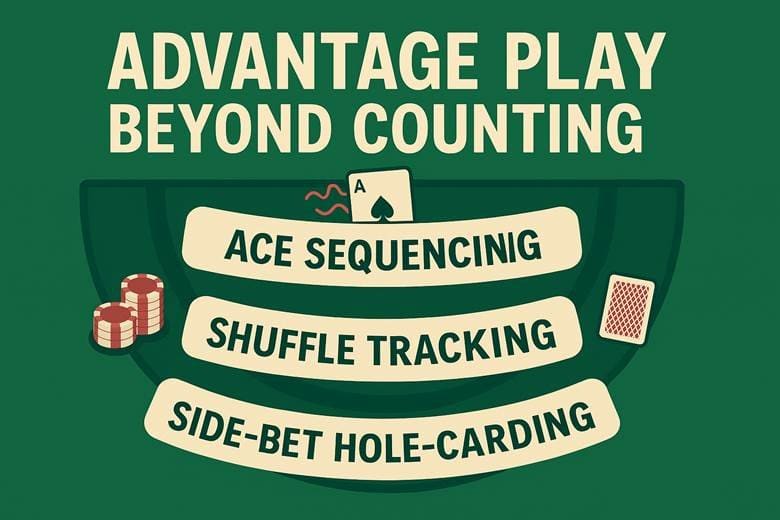
These tactics aren’t required to beat ordinary games, but they stack with counting for outsized ROI.
5.1 Ace Sequencing
Track where aces exit the discard tray; follow sloppy riffles to predict natural location. Edge +6% if mastered—rare due to modern shuffle machines.
5.2 Shuffle Tracking
Label discard zones (A, B, C) mentally; estimate high/low card clumps; cut shoe so high zone lands in first two decks post-shuffle. Adds 0.5–1% edge when penetration is > 75%.
5.3 Side-Bet Hole-Carding
Dealers pitching a single deck sometimes flash the facedown card by accident. Knowing the hole card on a side bet (e.g., Buster Blackjack) can yield a +10% edge. Casinos eject on suspicion, so use sparingly.
Pillar 6 – Psychology & Time-Management Strategy
6.1 Tilt Control Checklist
- 30-Second Rule: After a bad beat, stand, breathe, and sip water.
- Autopilot Off: Return to conscious basic strategy; no revenge doubles.
- Session Log: Record shoe number, count quality, and emotion level. Awareness kills tilt.
6.2 Dealer & Pit Rapport
Polite players get:
- Slower shuffles (more penetration)
- Dealer errors resolved in your favour
- Comp dollars coded accurately
6.3 Harvesting Comps—Edge on the Back End
A break-even counter earns ~1% in cash value comps (rooms, meals). Always:
- Use the player’s card.
- Ask pit to rate when buying in.
- Spread bets smoothly to avoid being labeled AP (advantage player).
Online vs. Live Blackjack: Strategy Adjustments
| Factor | Live Casino Shoe | Live-Dealer Stream | RNG / Video |
| Shuffle | Manual or CSM | CSM or shoe | Auto after each hand |
| Counting | Viable (manual shoe) | Limited | Impossible |
| Table Min/Max | $10–$100 / $2 000+ | $5 / $1 000 | $1 / $500 |
| Hands per Hour | 60–200 | 200–300 | 600+ |
| Edge Source | Counting + comps | Strict basic + promo hunting | Basic only |
Key takeaway: Online RNG games require unflinching basic strategy and bankroll discipline. Counting is dead; promo abuse and rakeback become the main edges.
Building Your Personal Blackjack Playbook (8-Week Curriculum)
| Week | Milestone | Tools |
| 1-2 | Basic chart 100 % memorised | BJ Tutor app, laminated card |
| 3 | Bankroll spreadsheet + session log | Google Sheets template |
| 4 | Casino scouting report (rules, pen) | Smartphone notes |
| 5-6 | Hi-Lo drill to ±1 RC error per deck | Metronome counting drill |
| 7 | Live low-stakes test (1–4 spread) | “>$5” table |
| 8 | Review heat; add 4 index plays | Flashcards; pit notes |
Rotate through study → drill → live test until each pillar is subconscious.
Common Blackjack Strategy Myths—Debunked
| Myth | Reality |
| “Third base controls the table.” | Only your EV matters; the dealer draws from the shoe, not seat magic. |
| “Betting progressions beat variance.” | Martingale doubles risk; the house edge stays unchanged. |
| “Dealer’s hot streak means cold shoe.” | Cards are independent; true count, not streaks, determines edge. |
| “Mimicking the dealer strategy (standing on 16) is safest.” | The house retains a > 5% edge; you’ll bleed slowly. |
| “Insurance is ‘always’ bad.” | True under TC < +3; profitable at high counts. |
Conclusion—Your Roadmap from Casual Player to Edge Hunter
You now hold the best blackjack strategies that actually work:
- Basic strategy shreds the house edge to half a percent.
- Bankroll rules stop variance from killing your career in one shot.
- Rule hunting keeps you out of 6:5 death traps.
- Card counting and index deviations flip the long-run edge positive.
- Advanced AP, mental game, and comps squeeze extra ROI when math alone isn’t enough.