

Introduction: Mastering Craps’ Diverse Betting Options
Understanding craps bet types separates casual players from strategic ones. While the craps table appears intimidating with numerous betting areas, most optimal play focuses on just a handful of core craps bet types. Yet many beginners scatter bets across unfavorable propositions, dramatically increasing expected losses.
Craps bet types range from fundamental Pass Line and Don’t Pass wagers to specialized Come, Don’t Come, Place, and Field bets. Each carries distinct house edges, payouts, and strategic purposes. The difference between optimal betting and suboptimal approaches creates vastly different long-term outcomes.
At a craps table, the biggest improvement usually comes from knowing which bets carry a lower house edge and which bets are mainly for excitement. That practical distinction is more useful than unsourced claims about how many beginners make each mistake.
This guide breaks down all major craps bet types: explaining mechanics, calculating exact payouts, analyzing house edges, comparing strategic value, and identifying which bets optimize long-term sustainability. You’ll master every category of craps bet types, enabling intelligent strategic decisions aligned with the underlying math.
Quick Takeaway: Focus craps betting on Pass/Don’t Pass (1.36-1.40% edge), Come/Don’t Come (identical edges), and Odds bets (0% edge). Avoid Field and Proposition bets entirely—their excessive house edges drain bankrolls unnecessarily.
Pass Line Bets: The Foundation of Craps Strategy
Basic Pass Line Mechanics
The Pass Line bet represents craps’ most fundamental and popular bet type. You place Pass Line bets before the come-out roll, wagering that the shooter will win.
Come-out roll outcomes:
- 7 or 11 (natural): Pass Line wins immediately, paying 1:1 (even money)
- 2, 3, or 12 (craps): Pass Line loses immediately
- Any other number (4, 5, 6, 8, 9, 10): Establishes the point—no immediate result
Once a point is established, Pass Line bets become active until one of two outcomes occurs: the point repeats (Pass Line wins) or 7 appears (Pass Line loses, called “seven out”).
House Edge Analysis
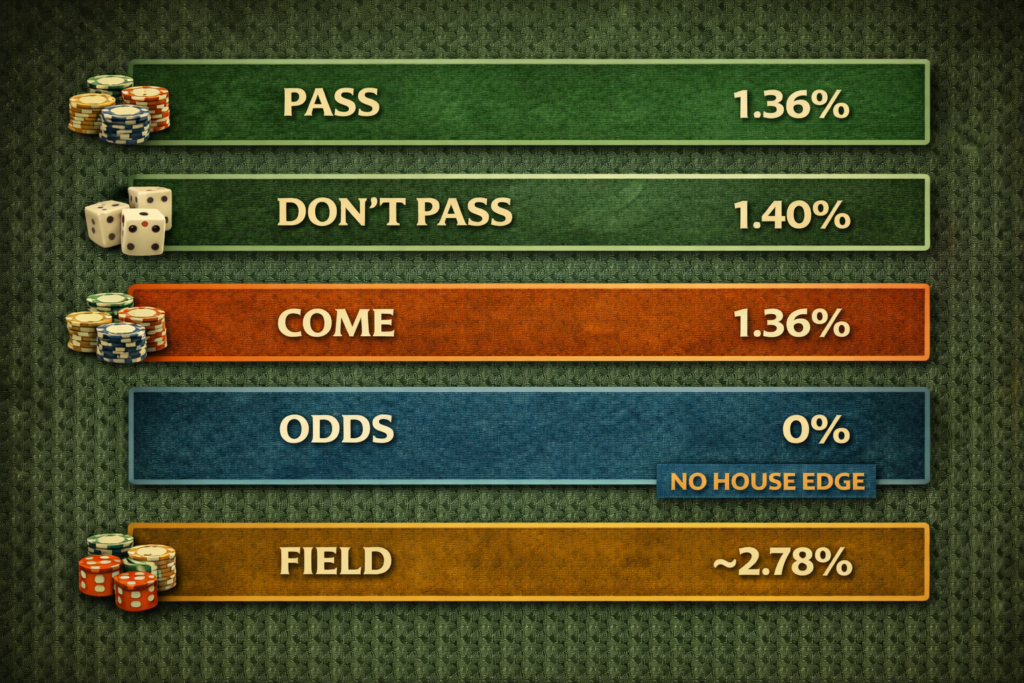
Mathematical breakdown:
- Pass Line wins: 49.29% of all outcomes
- Pass Line loses: 50.71% of all outcomes
- House edge: 1.36%
This means every $100 wagered on Pass Line bets averages $1.36 loss over extended play. While this remains unfavorable, it ranks among casino gaming’s lowest house edges, making Pass Line bets strategically superior to most alternatives.
Unique Characteristics
Contract bet status: Pass Line bets become “contract bets” once the point is established—they cannot be removed, reduced, or turned off until resolved. This permanence prevents mid-game abandonment.
Strategic implication: You’re committed to the point’s outcome, which protects fair play while requiring discipline during long point sequences.
Don’t Pass Bets: The Contrarian Alternative
Don’t Pass Mechanics
Don’t Pass bets are opposite Pass Line wagers—you’re betting against the shooter. Before the come-out roll, Don’t Pass bettors hope for outcomes losing Pass Line bets.
Come-out roll outcomes:
- 2 or 3: Don’t Pass wins immediately (1:1 payout)
- 7 or 11: Don’t Pass loses immediately
- 12: Push (tie—bet returns without win/loss)
- Any other number: Establishes point, with Don’t Pass winning if 7 appears first
House Edge Comparison
Mathematical reality:
- Don’t Pass wins: 50.71% of outcomes
- Don’t Pass loses: 49.29% of outcomes
- House edge: 1.40% (with 12 push)
Surprisingly, Don’t Pass carries a marginally higher house edge (1.40% vs 1.36%) than Pass Line. This seemingly counterintuitive disadvantage stems from the 12 push—casinos’ compensating mechanism.
Cultural and Strategic Considerations
Social stigma: Betting Don’t Pass is sometimes called “betting the dark side” or “playing wrong.” Some tables view this as bad luck (mathematically irrelevant), creating social friction.
Practical reality: Don’t Pass is mathematically defensible, though fractionally worse than Pass Line. The social cost (other players’ negative attitudes) may outweigh marginal mathematical differences.
Flexibility advantage: Unlike Pass Line contracts, Don’t Pass bets can be reduced or removed after the point is established. This provides flexibility Pass Line bettors lack.
Come and Don’t Come Bets: Secondary Positioning
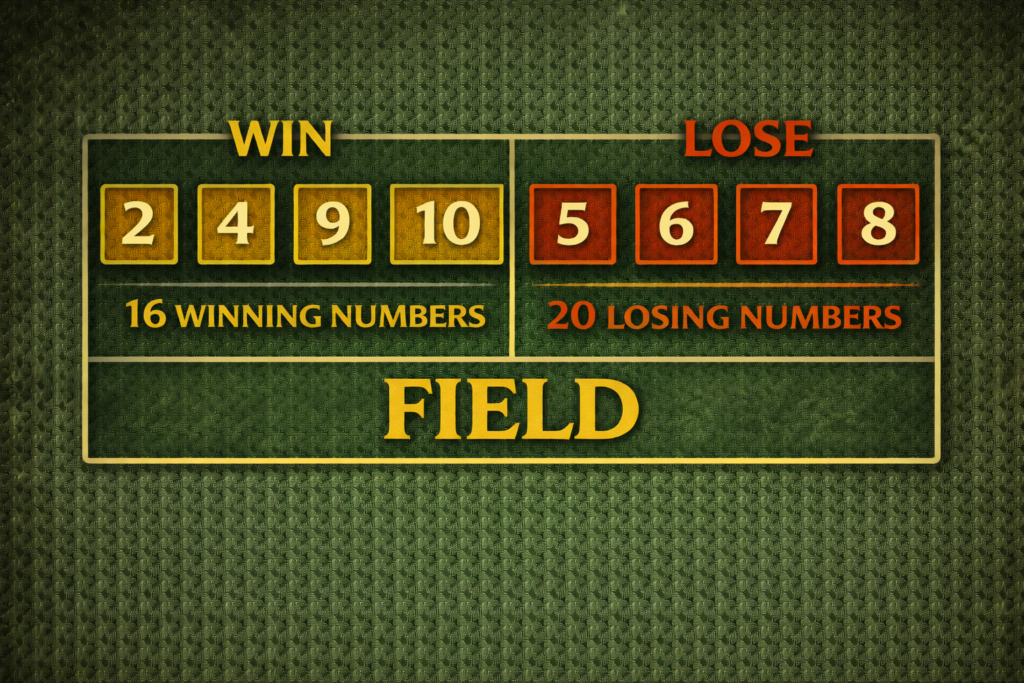
Come Bet Fundamentals
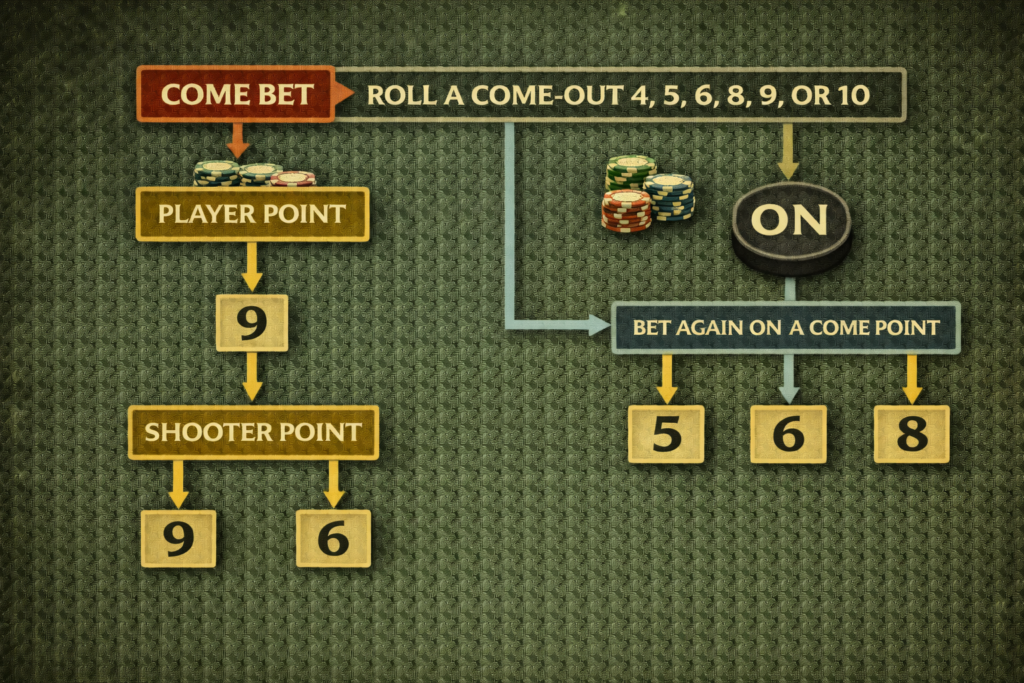
Come bets function identically to Pass Line wagers but are placed after the point is established. They become active immediately on the next roll.
Mechanics:
- 7 or 11 on next roll: Come bet wins immediately
- 2, 3, or 12 on next roll: Come bet loses immediately
- Any other number: Becomes that Come bet’s personal point
Strategic purpose: Come bets enable establishing multiple simultaneous points, creating layered winning scenarios.
Real-world example:
- Point established: 8
- You place Come bet
- Next roll: 5
- Result: You now have both an 8 pass point and a 5 Come point active simultaneously
Come Bet House Edge
House edge: 1.36% (identical to Pass Line)
Come bets carry the same mathematical characteristics as Pass Line, making them equally valuable strategically.
Don’t Come Bets: Opposite Mechanics
Don’t Come bets mirror Don’t Pass logic but work after the point is established.
- 2 or 3 on next roll: Don’t Come wins immediately
- 7 or 11 on next roll: Don’t Come loses immediately
- 12 on next roll: Push (tie)
- Any other number: Becomes that Don’t Come’s personal point, with Don’t Come winning if 7 appears first
House edge: 1.40% (identical to Don’t Pass)
The Field Bet: Understanding the Trap
Field Bet Mechanics
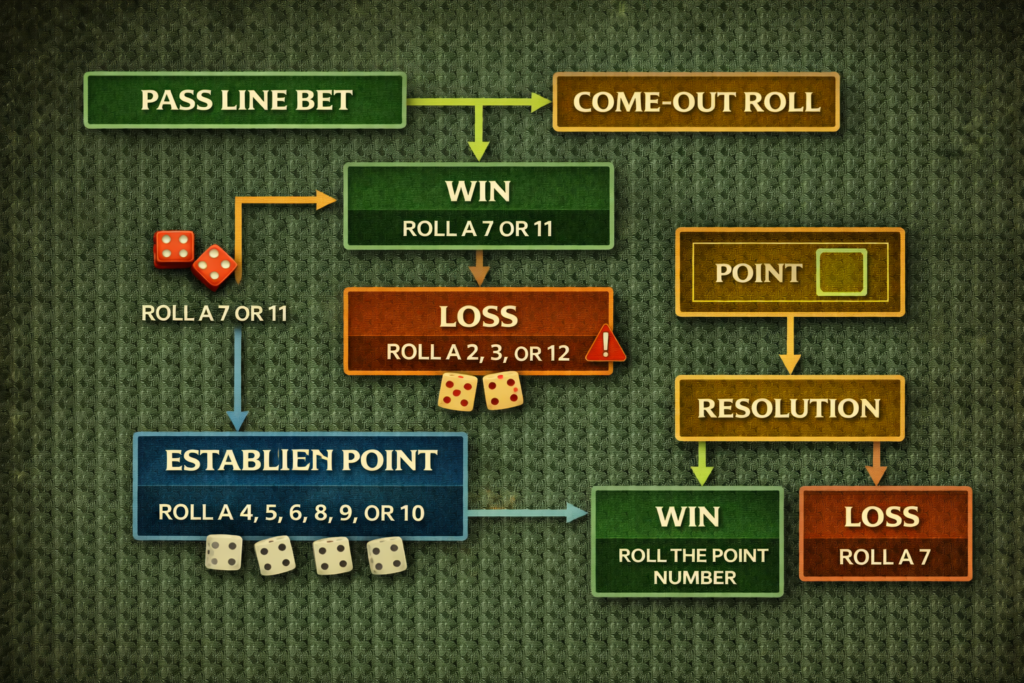
The Field bet is a one-roll wager predicting specific numbers will appear on the next roll: 2, 3, 4, 9, 10, 11, or 12.
Winning combinations:
- Numbers 2-4, 9-12 count as wins
- Numbers 5, 6, 7, 8 result in losses
- 16 winning outcomes of 36 possible dice combinations
Payout Structure
Typical field payouts:
- Numbers 3, 4, 9, 10, 11: Pay 1:1 (even money)
- Numbers 2 and 12: Pay 2:1 (with some casinos offering 3:1 on one number)
House Edge Reality
With 2:1 payout on both 2 and 12:
- House edge: 5.56%
- Expected loss: $5.56 per $100 wagered
With 3:1 payout on one number (2 or 12):
- House edge: 2.78%
- Expected loss: $2.78 per $100 wagered
Why Field Bets Deceive
The Field appears attractive—7 numbers covered versus 4 losing numbers. Yet 16 winning combinations versus 20 losing combinations creates deceptive arithmetic.
Comparison against alternatives:
- Pass Line: 1.36% house edge
- Field (best case): 2.78% house edge
Even the most favorable Field variant nearly doubles the house edge compared to Pass Line. Over $1,000 wagered, this represents $14 additional expected losses.
Pro Tip: Avoid Field bets entirely. The psychological appeal of “7 numbers covered” masks poor mathematical value. Every Field dollar spent costs nearly twice as much compared to Pass Line bets.
Odds Bets: The House-Neutral Opportunity
Understanding Odds Bets
Odds bets are supplemental wagers made after Pass Line, Don’t Pass, Come, or Don’t Come bets are established. They’re unique—carrying zero house edge.
How it works: After a point is established on Pass Line, you can place an “Odds” bet at true mathematical odds. The casino pays exactly the mathematical odds of winning.
Odds Payout Structure
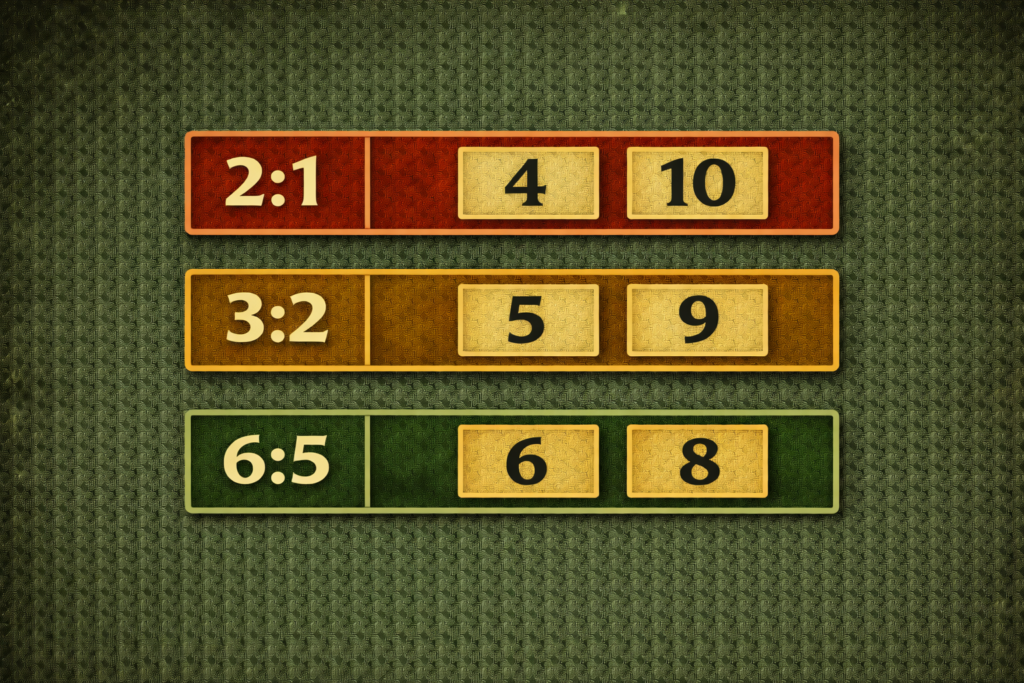
Varies by point number:
- 4 or 10: Odds pay 2:1
- 5 or 9: Odds pay 3:2
- 6 or 8: Odds pay 6:5
Real-World Odds Example
Scenario: Point established at 6, $10 Pass Line + $10 Odds
If 6 repeats:
- Pass Line wins: $10 profit
- Odds win: $12 profit ($10 × 6:5)
- Total gain: $22
If 7 appears:
- Pass Line loses: -$10
- Odds lose: -$10
- Total loss: -$20
Impact on Overall House Edge
With optimal odds:
- Pass Line only: 1.36% house edge
- Pass Line + single odds: 0.85% house edge
- Pass Line + double odds: 0.65% house edge
- Pass Line + unlimited odds: Approaches 0.70% edge
Professional insight: Maximizing available odds dramatically improves game value. A table offering 5x odds reduces house edge substantially compared to limited odds tables.
Comparison Table: All Major Craps Bet Types
| Bet Type | House Edge | Payout | Recommendation | Win % |
| Pass Line | 1.36% | 1:1 | Excellent | 49.29% |
| Don’t Pass | 1.40% | 1:1 | Good (social issues) | 50.71% |
| Come | 1.36% | 1:1 | Excellent | 49.29% |
| Don’t Come | 1.40% | 1:1 | Good (social issues) | 50.71% |
| Odds (all) | 0% | True | Essential to maximize | Varies |
| Field | 5.56% (avg) | 1-2:1 | Avoid | 44.44% |
| Place 6/8 | 1.52% | 7:6 | Alternative | Varies |
| Proposition | 11-16% | High | Avoid entirely | 25-35% |
Strategic Decision Framework: Choosing Your Bets
Optimal Approach: Pass/Come + Maximum Odds
Strategic sequence:
- Place Pass Line before come-out roll
- After point establishment, place maximum available Odds
- Make Come bets with additional Odds after first point established
- Continue until naturally ending session or hitting profit target
Why it works: Combines favorable 1.36% house edge with 0% Odds bets, achieving optimal overall house edge. Multiple Come points create layered winning scenarios.
Alternative Approach: Don’t Pass/Come + Odds
Sequence:
- Place Don’t Pass before come-out roll
- After point establishment, place Odds
- Make Don’t Come bets with Odds
- Accept social friction as cost of marginal mathematical advantage
Trade-off: Marginally better odds (50.71% vs 49.29%) offset by social awkwardness and psychological discomfort.
Never Acceptable: Heavy Field/Proposition Betting
Why it fails:
- Field bets cost 5.56% versus Pass Line’s 1.36% (4x more expensive)
- Proposition bets cost 11-16% (8-12x more expensive)
- $1,000 in Field bets costs approximately $55 versus $14 with Pass Line
Example: A player alternating Field and Proposition bets wastes approximately $65-140 of every $1,000 wagered compared to Pass/Come/Odds strategy.
Common Craps Betting Mistakes
Mistake #1: Overweighting Field Bets
Error: Assuming “7 covered numbers” means good value
Reality: Only 16 of 36 combinations win; house edge is 5.56%
Prevention: Allocate Field bets zero capital; direct funds to Pass/Come/Odds instead
Mistake #2: Ignoring Odds Bet Availability
Error: Making Pass Line bets without taking available Odds
Reality: Missing house-edge reduction opportunity
Prevention: Always place maximum available Odds after point establishment
Mistake #3: Social Pressure Against Don’t Pass
Error: Avoiding Don’t Pass due to “bad luck” superstitions
Reality: Mathematically defensible with 50.71% win rate
Prevention: Make personal mathematical decision regardless of table culture
Mistake #4: Attempting Complex Betting Systems
Error: Spreading bets across multiple bet types without understanding house edges
Reality: Each additional low-edge bet improves overall position; high-edge bets destroy it
Prevention: Stick to Pass/Come/Odds exclusively until mastering fundamentals
Conclusion: Mastering Craps Bet Types
Craps bet types span from exceptional value (Pass/Come/Odds at ~0.7% edge) to catastrophic value (Proposition bets at 14%+ edge). The 20x difference between optimal and worst betting turns $1,000 sessions from $7 expected loss to $140+ expected loss.
Master these fundamental craps bet types:
- Pass Line: 1.36% edge—core wager for right-side bettors
- Don’t Pass: 1.40% edge—slightly worse but mathematically defensible
- Come: 1.36% edge—secondary positioning with multiple simultaneous points
- Don’t Come: 1.40% edge—opposite Come mechanics
- Odds: 0% edge—always maximize when available
- Field: 5.56% edge—avoid entirely for strategic play
- Proposition: 11-16% edge—entertainment only, never strategy
Focus capital on Pass/Come variants with maximum Odds. This discipline alone reduces expected losses by 75-80% compared to typical casual player distribution.
With strategic craps bet type selection, you’ll approach tables equipped to optimize mathematical outcomes within the inherent house advantage reality.
Responsible Play Note
Casino strategy can reduce avoidable mistakes, but it cannot remove variance or guarantee profit. Set a budget before you play, keep gambling separate from income or bills, and stop when the session limit is reached. If gambling stops feeling recreational, take a break and use local support resources.