

Introduction: The Technology Behind Fairness
How slot machine RNG works represents one of casino gaming’s most misunderstood yet critically important technologies. Modern slot machines use sophisticated Random Number Generator algorithms ensuring completely unpredictable outcomes that cannot be influenced, predicted, or manipulated. Understanding how RNG works turns players from suspicious skeptics to informed participants who appreciate the engineering ensuring fair play.
For slot players, the useful distinction is between what the game controls and what you control. The machine controls the random outcome, RTP model, and volatility; you control game selection, stake size, session length, and whether you chase losses.
The truth is simultaneously reassuring and important: RNG in slot machines operates completely independently of player behavior, previous results, time of day, or any factor players might hypothesize influences outcomes. Every spin is mathematically determined milliseconds before visual display, with outcomes generated thousands of times per second by algorithms tested by independent laboratories certifying genuine randomness.
This guide breaks down how RNG works : explaining mathematical foundations, distinguishing pseudo-random from true random generation, detailing certification processes, addressing misconceptions, and providing actionable frameworks understanding fairness verification. You’ll transition from skeptical confusion to informed trust in certified slot systems.
Quick Takeaway: Modern slots use Pseudo-Random Number Generators (PRNGs) continuously generating thousands of unpredictable numbers per second. When you press spin, the RNG’s current number determines your outcome instantly. Each spin is mathematically independent—previous results have zero influence on future outcomes. Independent laboratories certify RNG systems through rigorous statistical testing.
What Is a Random Number Generator? Foundational Concepts
Defining RNG Purpose and Function
A Random Number Generator is a software algorithm or hardware device continuously producing unpredictable numerical sequences. In slot machines, RNG generates outcomes determining reel symbol combinations displayed to players.
Core function: Generate sequences of numbers appearing completely random despite technical implementation through algorithms. The distinction between “appearing random” and “being random” is crucial for understanding modern slot machine RNG operation.
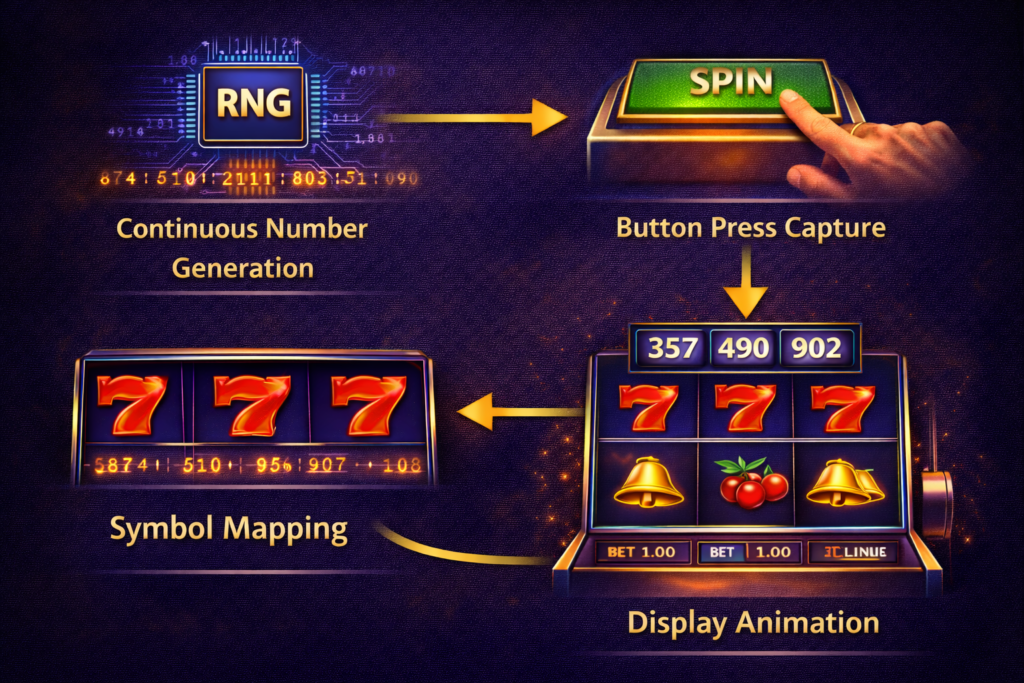
Generating speed: Modern RNGs generate thousands of numbers per second—often 1,000+ unique numbers daily continuously. This constant generation means outcomes are determined the instant you press spin, not when reels finish physically displaying results.
Why RNG Matters for Fairness
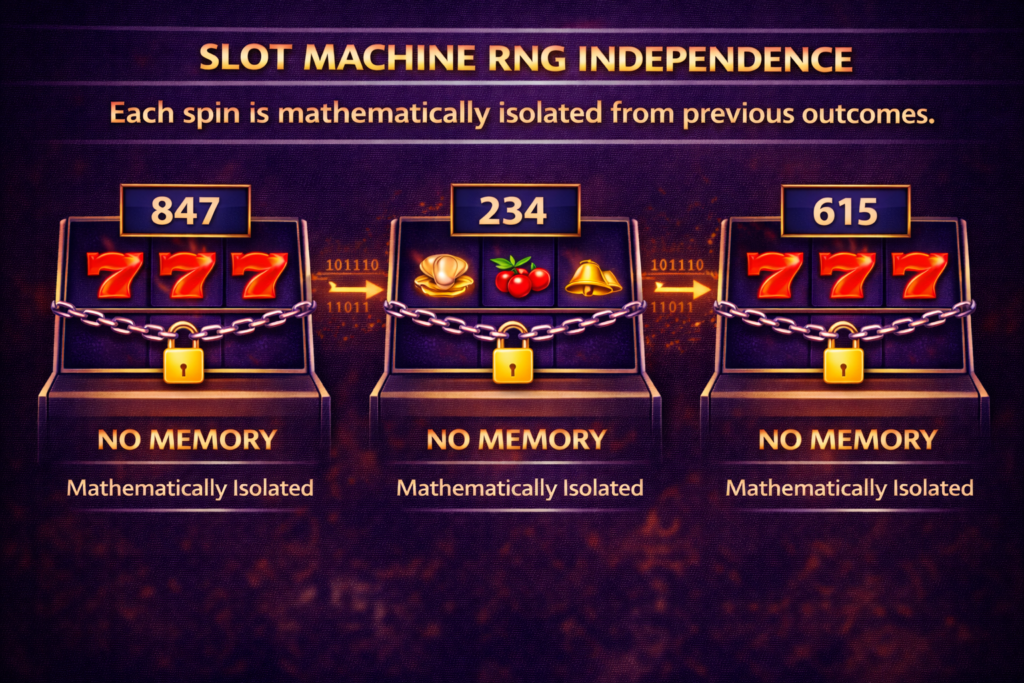
RNG systems determine fairness through mathematical independence. Each number generated has zero relationship to previous or future numbers. This independence eliminates possibility of patterns, “due” outcomes, or predictable sequences—the cornerstones of legitimate gambling fairness.
Pseudo-Random Number Generators: The Practical Standard
Understanding PRNGs
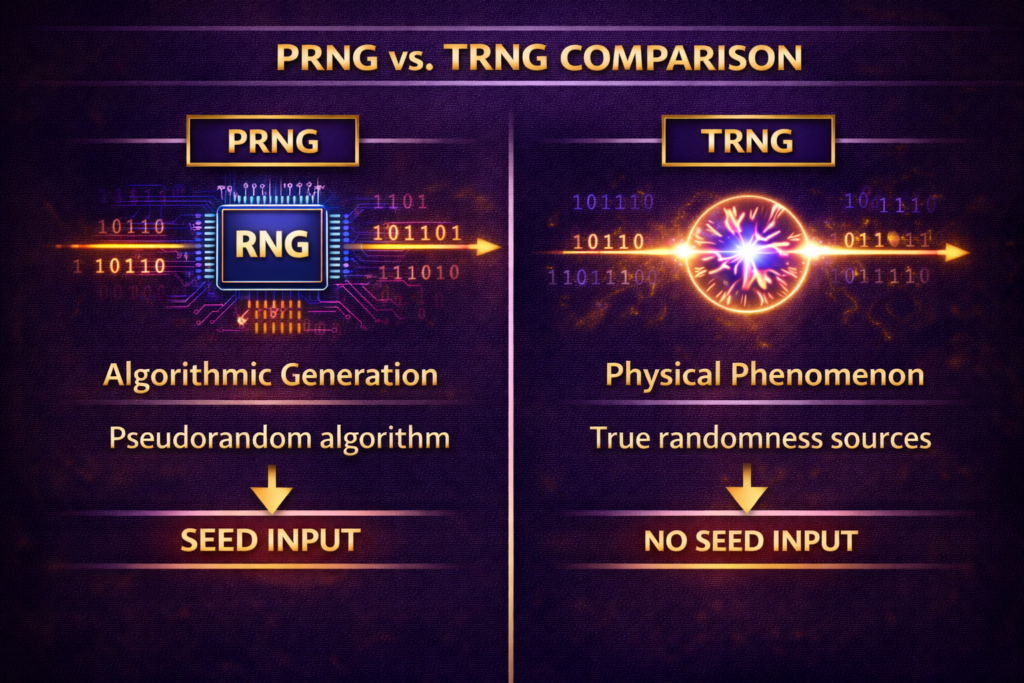
Pseudo-Random Number Generators (PRNGs) use mathematical formulas generating sequences appearing completely random despite technically following algorithms. Most modern slot machines use PRNGs because they’re efficient, testable, and cryptographically secure when properly designed.
How PRNGs work:
- Seed value (initial number) enters algorithm
- Mathematical formula turns seed through complex calculations
- Output becomes next number in sequence
- Next iteration uses previous output as new seed
This iterative process continues indefinitely, generating new numbers continuously whether machines are active or idle.
Why PRNGs Are Preferred
Advantage #1: Speed
PRNGs generate thousands per second without hardware limitations. This speed enables rapid game play and millisecond-precision outcome determination.
Advantage #2: Efficiency
PRNGs run on standard computer hardware without specialized equipment. They’re economical to implement across thousands of machines.
Advantage #3: Testability
PRNGs are mathematically analyzable through statistical testing. Independent labs verify randomness through sophisticated algorithms (Diehard tests, chi-square tests) proving sequences meet randomness standards.
Critical PRNG Limitation
Important reality: PRNGs are technically deterministic—if someone knew the seed value and algorithm, they could theoretically predict future numbers. However, practical prediction is impossible because:
- Seed values are cryptographically secure
- Algorithms are publicly unknown (proprietary)
- Finding seed through analysis would require computational resources exceeding modern capabilities
True Random Number Generators: The Theoretical Alternative
Understanding TRNGs
True Random Number Generators use physical phenomena (radioactive decay, atmospheric noise, thermal fluctuations) generating genuinely unpredictable outcomes impossible to predict even theoretically.
Characteristics:
- Physical hardware required
- Measurement-based randomness
- Genuinely unpredictable
- Impossible to replicate sequences
Why TRNGs Aren’t Standard in Slots
Disadvantage #1: Speed
Physical measurements generate random bits slowly. Slot machine speeds require thousands of numbers per second—impossible with most TRNG implementations.
Disadvantage #2: Cost
Specialized hardware is expensive compared to standard computer processors running PRNG algorithms.
Disadvantage #3: Complexity
TRNG systems are mechanically complex, requiring specialized expertise for implementation and troubleshooting.
Professional insight: Modern casinos occasionally use hybrid systems combining TRNG (for seeding) with PRNG (for speed), achieving both genuine randomness and practical performance.
How Slot Machine RNG Determines Outcomes
The Complete Process
Step 1: Continuous Generation
RNG generates numbers constantly, thousands per second, whether machines are active, idle, or between sessions. This continuous operation means outcomes aren’t determined “by” button presses but rather “captured” at button press moments.
Step 2: Number-to-Symbol Mapping
Each generated number corresponds to specific reel position combinations through internal mapping. The mapping determines which symbols appear without player knowledge.
Real-world example:
- RNG generates number: 4,782,915
- Software maps number to positions: Reel 1 = Cherry, Reel 2 = Bell, Reel 3 = Seven
- Player sees three symbols with associated payout
Step 3: Instant Determination
When you press spin, the current RNG number determines outcome immediately. The 2-3 second animation showing reels spinning is purely theatrical—your outcome was determined the moment you pressed the button.
Step 4: Display Animation
Reels animate showing the predetermined outcome. Animation duration is arbitrary; the result is already calculated. Fast animations and slow animations show identical mathematical outcomes—only display speed differs.
Independence: The Fairness Guarantee
Critical principle: Each spin’s RNG outcome is mathematically independent of all previous and future outcomes. Previous spins have zero influence on next spin probabilities.
Consequence: You cannot be “due” for a win. Losing streaks don’t predict future wins. Long gaps without jackpots don’t increase next jackpot probability. Each spin is isolated mathematically.
RNG Certification: Ensuring Fairness Verification
The Certification Process
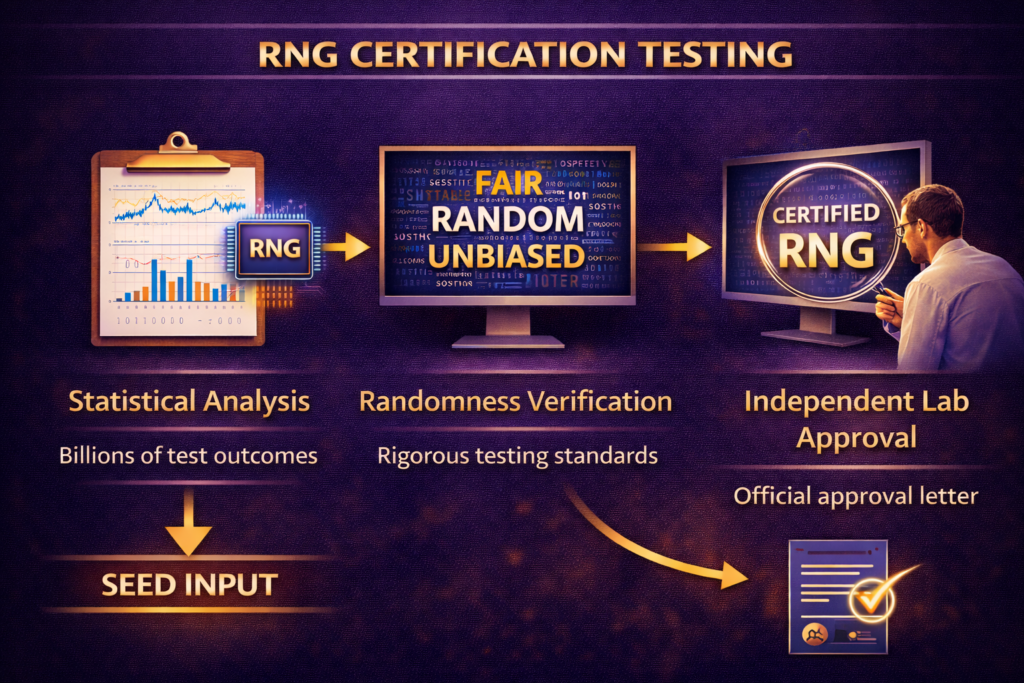
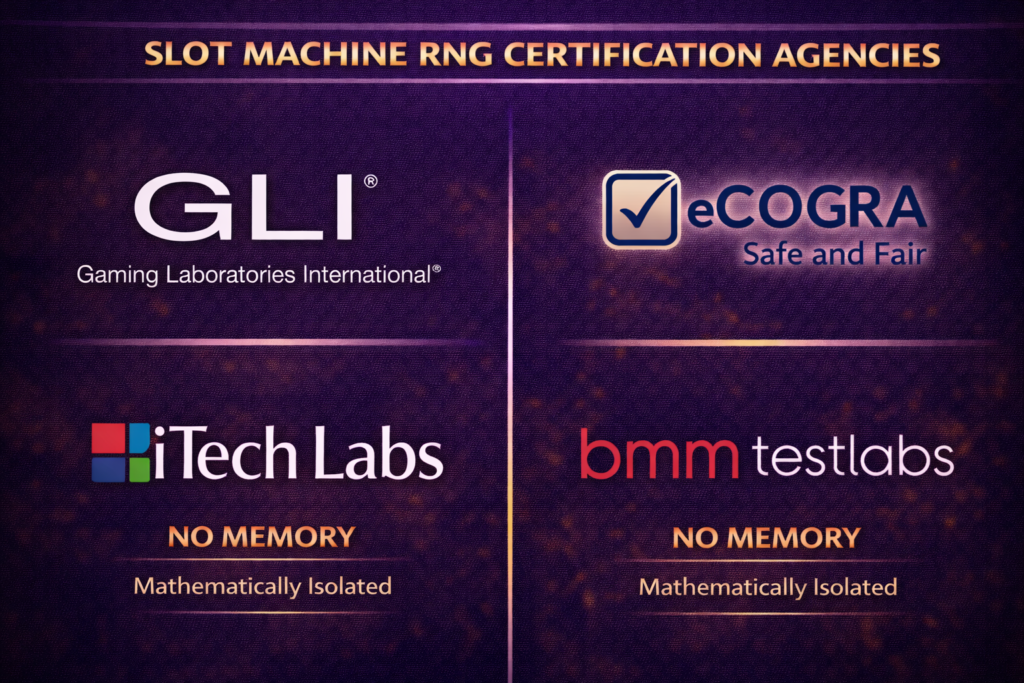
Legitimate casinos submit their RNG systems to independent testing laboratories conducting rigorous verification. Major certification agencies include:
- GLI (Gaming Laboratories International)
- eCOGRA (eCommerce and Online Gaming Regulation and Assurance)
- iTech Labs
- BMM Testlabs
Testing Methodology
Statistical testing analyzes RNG output through sophisticated mathematical algorithms:
- Diehard Tests examine randomness characteristics through 15+ specific tests
- Chi-Square Tests verify uniform distribution
- Entropy Analysis confirms unpredictability
- Sequence Testing ensures independence
Certification Requirements
Legitimate casinos must:
- Document complete RNG algorithm specifications
- Undergo independent testing
- Pass rigorous statistical validation
- Receive official certification
- Maintain compliance through periodic re-testing
Pro Tip: Check for certification badges on casino websites. Legitimate online casinos display eCOGRA, GLI, or other independent certifications proving third-party RNG verification. Absence of visible certification suggests avoiding that casino.
Common RNG Misconceptions and Reality
Misconception #1: “Machines Can Be Hot or Cold”
False claim: Recent losses mean wins are imminent
Reality: RNG independence eliminates any “temperature.” Previous outcomes never affect future probabilities. Statistical variance naturally creates winning/losing streaks, but these are random variance, not predictive patterns.
Misconception #2: “Casinos Can Control Individual Outcomes”
False claim: Casinos can adjust specific machines to reduce payouts
Reality: Certified RNG systems are hardware-locked at programming level. Adjusting individual outcomes requires complete machine replacement—impractical and detectable. Casino licenses and massive financial penalties eliminate any tampering incentive.
Misconception #3: “Playing at Specific Times Improves Odds”
False claim: Playing midnight slots differs from noon slots
Reality: RNG operates identically regardless of time, day, or player count. Time has zero mathematical influence on outcomes. Midnight and noon spins have identical mathematical properties.
Misconception #4: “Near-Misses Predict Wins”
False claim: Seeing close-call jackpots means next spin is likely
Reality: Near-misses are programmed display features designed for psychological engagement, not predictive. They have zero mathematical predictive value. RNG independently determines each outcome.
Conclusion: Understanding RNG Builds Appropriate Confidence
Understanding how RNG works builds justified confidence in slot fairness. Modern slot machine RNG systems are among technology’s most thoroughly tested and audited systems—more rigorous than many financial systems handling billions daily.
Key takeaways:
- RNG is continuous (generates numbers constantly, thousands per second)
- Outcomes are predetermined (determined at button press, before display animation)
- Each spin is independent (no spin influences any other spin)
- Certification is rigorous (independent labs verify randomness through sophisticated testing)
- Tampering is impractical (hardware-locked systems impossible to adjust without detection)
- Misconceptions abound (but they contradict the underlying math)
With these fundamentals understood, you can approach slots with realistic expectations: outcomes are completely random and unpredictable, certification ensures fairness, and no strategy overcomes the programmed house edge. RNG technology, rather than diminishing trust, should build confidence that legitimate casinos cannot and will not manipulate individual outcomes.
Responsible Play Note
Casino strategy can reduce avoidable mistakes, but it cannot remove variance or guarantee profit. Set a budget before you play, keep gambling separate from income or bills, and stop when the session limit is reached. If gambling stops feeling recreational, take a break and use local support resources.
Practical Checklist Before You Play
- Read the paytable before increasing your stake.
- Match volatility to your budget: high volatility needs smaller bets and more patience.
- Set a fixed session limit before the first spin.
- Do not change machines because a payout feels due; each spin is independent.