

Introduction: Demystifying the Most Popular Casino Game
Slot machines represent casino gaming’s most misunderstood category. While appearing simple—spin and hope for matching symbols—how slot machines work involves sophisticated mathematical frameworks, cryptographic random number generation, and carefully calibrated probability systems that most players never understand.
Understanding how slot machines work changes your approach from hopeful guessing to informed entertainment. Modern slot machines generate approximately 70% of casino gaming revenue annually, yet most players lack basic understanding of mechanics, odds, and realistic expectations.
The critical truth: slot machines are not skill-based like blackjack or poker. They’re purely chance-driven games engineered with built-in house advantage, progressing through predictable mathematical patterns invisible to casual observers. However, understanding these mechanics enables smarter play, appropriate bankroll management, and realistic outcome expectations.
This pillar guide breaks down how slot machines work : explaining mechanical foundations, random number generation technology, Return to Player (RTP) mathematics, house edge calculations, volatility concepts, bankroll optimization, and distinction between online and land-based machines. You’ll transition from mystified player to informed participant, understanding exactly what odds you face and how to optimize entertainment value within realistic mathematical constraints.
Quick Takeaway: Modern slot machines use Random Number Generators (RNGs) ensuring completely unpredictable outcomes. RTP (Return to Player) ranges 85-98%, representing the percentage machines return to players long-term. House edge—the casino’s advantage—ranges 2-15%, meaning $100 wagered costs $2-15 in expected losses. Understanding this framework enables informed play.
How Slot Machines Work: The Mechanical Foundation
Historical Evolution: From Mechanical to Digital
Early slot machines (1890s-1980s) used mechanical reels, springs, and gears determining outcomes. A player pulled a lever, reels spun through friction, and physical alignment determined results. This mechanical simplicity meant outcomes were theoretically predictable through physics calculation.
Modern slot machines abandoned mechanical determination entirely. Digital systems now control everything, enabling sophisticated probability programming impossible mechanically. This transition enabled higher payout percentages, more game variety, and globally standardized fairness standards.
Modern Slot Machine Components
Contemporary slot machines contain four essential components:
Component #1: The Random Number Generator (RNG)
The RNG is a microprocessor continuously generating random numbers at incredible speeds—typically thousands per second, even when the machine sits idle. Each number generated corresponds to specific reel symbol combinations within the machine’s programming.
Component #2: The Payout Schedule
Every slot machine contains programmed payout combinations and their associated rewards. This schedule determines which symbol combinations produce wins, lose amounts, and bonus features.
Component #3: The Display System
Modern machines use digital screens or LED displays showing reels and results. These displays are purely presentation—the outcome is already determined by the RNG before symbols appear visually.
Component #4: The Financial System
This component manages money input, validates bets, calculates payouts, and distributes winnings. Financial systems are typically certified by gaming authorities for accuracy.
Random Number Generation: The Technology Behind Fairness
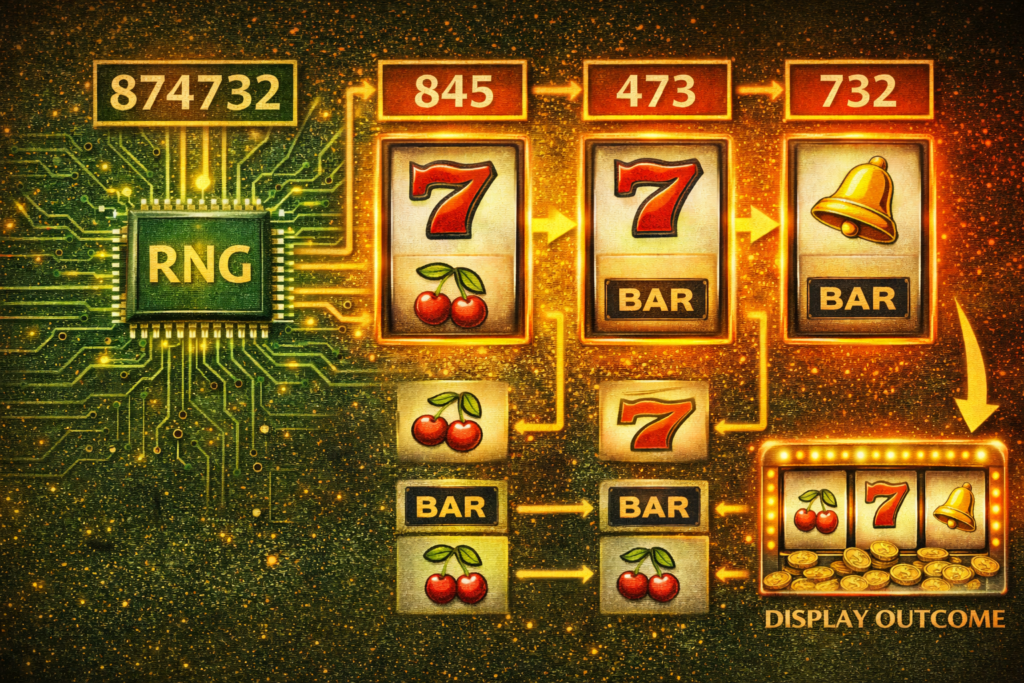
Understanding RNG Technology
Random Number Generators (RNGs) are sophisticated algorithms generating unpredictable numerical sequences. RNGs in modern casinos use “Pseudo-Random Number Generators” (PRNGs)—mathematical formulas producing results that appear completely random despite technically following algorithmic patterns.
Critical characteristic: RNGs operate continuously, generating numbers constantly whether the machine is active or idle. This means outcomes are determined the instant you press spin, not when reels stop physically displayed.
Real-world example: When you press spin, the RNG has been generating thousands of numbers per second throughout your session. Your spin button press captures the “current” number, mapping it to reel symbols immediately. The 2-3 second reel spinning animation is purely theatrical—your outcome is already determined.
How RNG Maps to Outcomes
RNG-to-outcome mapping follows this sequence:
- RNG generates random number (example: 4,782,915)
- Software maps number to reel positions (number determines specific symbol combinations)
- Display system animates reel spin showing predetermined outcome
- Machine calculates payout based on result
- Result displays to player
Each spin is mathematically independent. Previous spin results have zero influence on next spin outcomes because RNG generates completely new numbers each time.
RNG Certification and Testing
For slot players, the useful distinction is between what the game controls and what you control. The machine controls the random outcome, RTP model, and volatility; you control game selection, stake size, session length, and whether you chase losses.
Pro Tip: Licensed casinos cannot adjust individual spin outcomes. RNG formulas are programmed at the hardware level, requiring complete machine replacement to modify—an impractical and detectable solution. Your security comes from enforcement mechanisms, not goodwill.
Return to Player (RTP): The Mathematics of Long-Term Payouts
Defining RTP
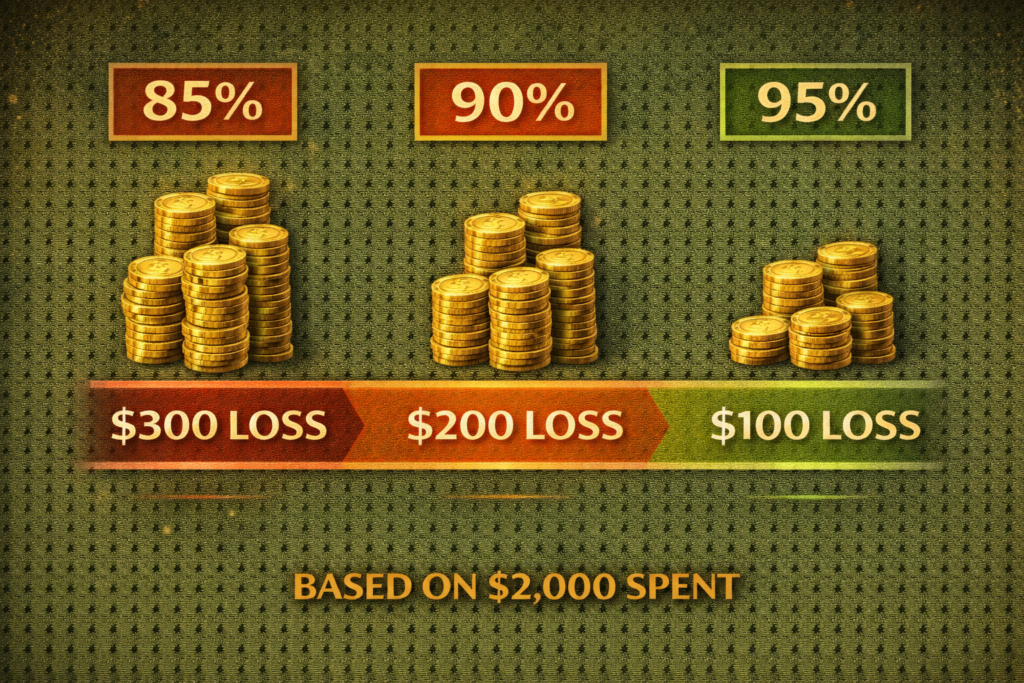
Return to Player (RTP) is the percentage of all wagered money machines are programmed to return to players over extended play. A 96% RTP means machines return $96 of every $100 wagered, with the casino keeping $4.
Mathematical example: Slot machine with 96% RTP played for $1,000,000:
- Total wagered: $1,000,000
- Expected return to players: $960,000
- Casino retention: $40,000
- RTP calculation: $960,000 ÷ $1,000,000 = 96%
RTP vs. House Edge
House edge is simply the inverse of RTP:
- RTP 96% = 4% house edge
- RTP 90% = 10% house edge
- RTP 98% = 2% house edge
Lower RTP means higher house edge, meaning casino keeps larger percentages. Conversely, higher RTP means lower house edge, meaning casinos keep smaller percentages while players retain larger amounts long-term.
Why RTP Matters in Practical Terms
Real-world impact comparison ($1,000 wagered):
- 85% RTP machine: Expected loss $150
- 95% RTP machine: Expected loss $50
- 98% RTP machine: Expected loss $20
- Difference (85% vs 98%): $130 additional loss per $1,000 wagered
Over 50 annual $1,000 sessions, this RTP difference produces $6,500 differential in expected losses—a dramatic long-term impact despite similar per-session visibility.
RTP Variation by Machine Type
Typical RTP ranges vary significantly:
- Penny slots: 85-92%
- Standard slots: 92-96%
- Premium/VIP slots: 96-98%
- Table game slots (video poker style): 95-99%+
Professional insight: Video poker machines and blackjack-themed slots typically offer higher RTPs than traditional slot machines because they emulate table game odds, which regulatory pressure requires maintaining competitively.
Volatility: Understanding Win Frequency vs. Win Size
Defining Volatility
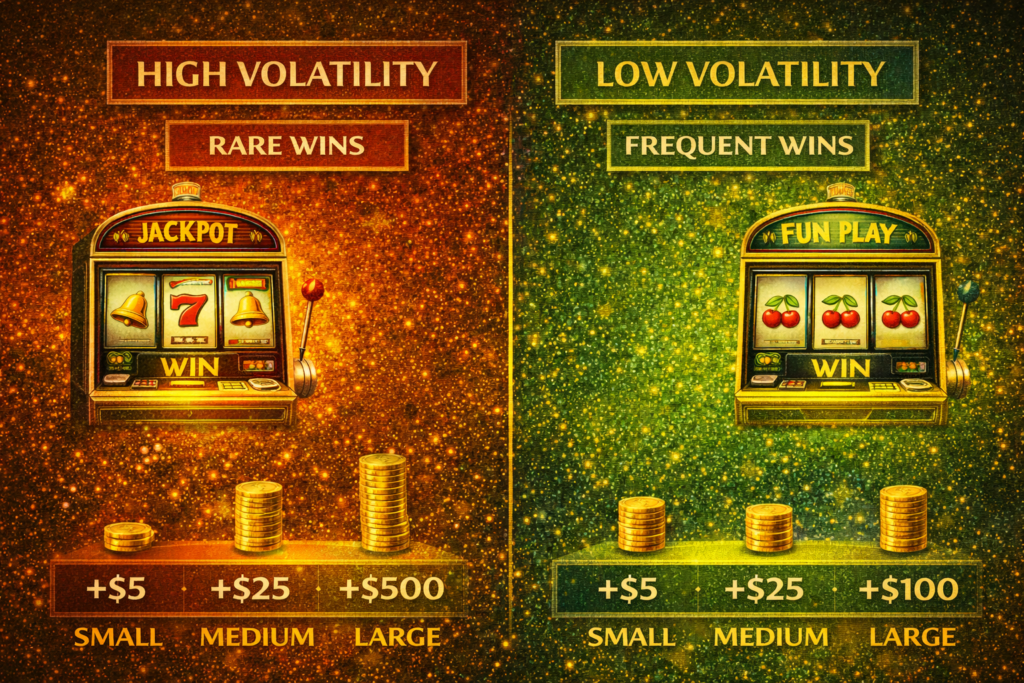
Volatility describes how wins distribute across play sessions. High volatility means infrequent large wins (long losing streaks interrupted by jackpots). Low volatility means frequent small wins (steady small payouts with rare large wins).
Volatility is independent of RTP: A 95% RTP slot can have high or low volatility. RTP determines total return percentage; volatility determines distribution pattern.
Volatility Categories
Low Volatility Slots:
- Win frequency: Frequent (multiple wins per session typical)
- Typical win sizes: Small to moderate
- Best for: Conservative players with limited bankrolls
- Risk level: Lower variance
- Example session: Win $5, lose $3, win $8, lose $2
High Volatility Slots:
- Win frequency: Infrequent (long losing streaks common)
- Typical win sizes: Large (rare jackpots or substantial payouts)
- Best for: Aggressive players seeking jackpot excitement
- Risk level: Higher variance
- Example session: Lose $40, lose $15, lose $25, win $200
Why Volatility Matters
Bankroll impact varies dramatically:
Scenario: $200 session bankroll, 96% RTP
Low volatility slot:
- Expected losses: $8
- Volatility: $50-100 typical session range
- Likely outcomes: Small wins/losses throughout session
- Session duration: 45+ minutes average
High volatility slot:
- Expected losses: $8 (identical RTP)
- Volatility: $150-300+ typical session range
- Likely outcomes: Either significant loss or jackpot hit
- Session duration: 15-20 minutes average
Same RTP, dramatically different short-term experiences based on volatility differences.
House Edge: Understanding the Casino’s Mathematical Advantage
How House Edge Works
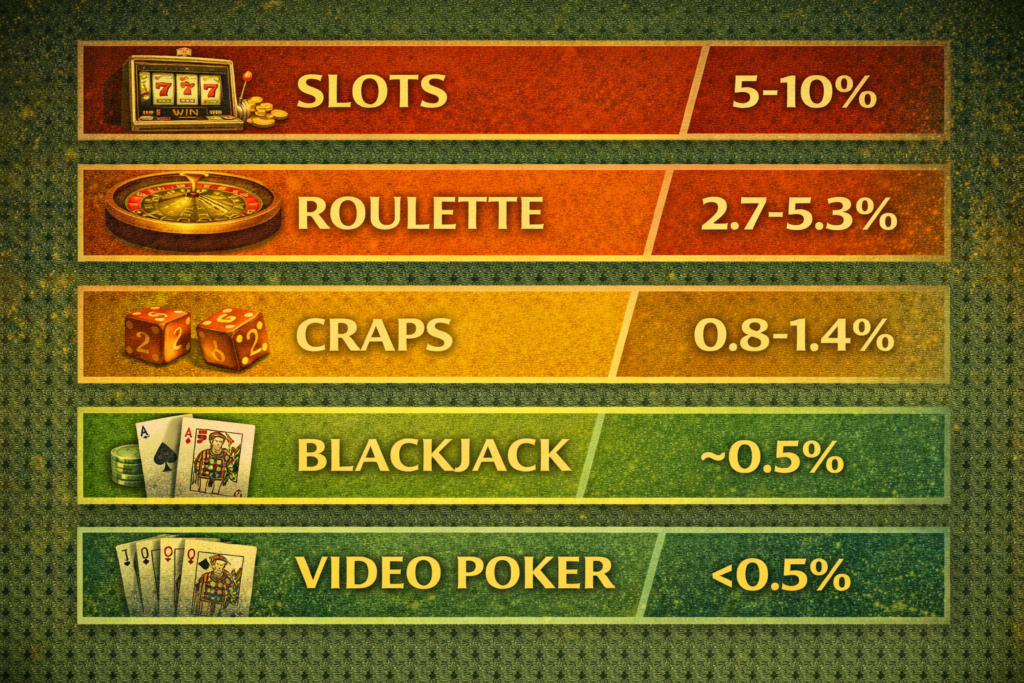
House edge is the casino’s mathematical expectation per bet. Unlike individual spins (which are random), house edge becomes increasingly predictable over millions of bets.
Fundamental principle: The larger your total wagered amount, the more closely your actual results approach mathematical expectations. A $20,000 bettor approaches RTP exactly; a $100 bettor experiences enormous variance.
House Edge Comparison Across Casino Games
| Game | House Edge | Context |
| Video Poker (optimal play) | 0.5%-2% | Skill influences outcome |
| Blackjack (basic strategy) | 0.5%-1% | Skill-based decisions matter |
| Baccarat (Banker bet) | 1.06% | Pure chance game |
| Craps (Pass Line + Odds) | 1.36% | Pure chance game |
| Roulette (European) | 2.7% | Pure chance game |
| Roulette (American) | 5.26% | Pure chance game |
| Slots (average) | 4-5% | Pure chance game |
| Keno | 25-35% | Pure chance game |
Critical observation: Slots occupy middle-range position—better odds than keno, worse than blackjack or craps. Slot odds are neither exceptional nor terrible by casino standards.
What House Edge Means for Your Bankroll
Mathematical certainty: Over sufficient play, results gravitate toward house edge expectations. However, “sufficient play” requires enormous volume.
Example:
- 100 spins: Results could be anything (win $500 or lose $500)
- 10,000 spins: Results cluster around mathematical expectation
- 1,000,000 spins: Results almost certainly within 0.5% of mathematical expectation
This is why casinos profit long-term while individual players experience wild variance.
Slot Machine Types and Their Mechanics
Mechanical Reel Slots
Traditional mechanical reels spin on actual mechanical gears and springs. Despite appearing fully mechanical, modern mechanical slots use RNG technology invisible to players.
Why persist? Players perceive mechanical reels as “more honest” than digital displays, despite mechanical and digital slots using identical RNG technology. Perception drives preference regardless of actual mechanical processes.
Video Slots
Digital video display systems replaced mechanical reels at most casinos. Video slots enable complex multi-line games, bonus features, and graphics impossible mechanically.
Advantage: Video slots can feature 100+ paylines compared to 3-5 mechanical reel lines, though line quantity doesn’t improve odds—only increases complexity.
Progressives and Mega Progressives
Progressive jackpots accumulate from multiple machines, creating pools reaching millions. Mega progressives span multiple casinos or online platforms, reaching $5 million+ frequently.
Mathematical reality: Progressive machines have lower base RTPs (typically 85-92%) because jackpot contributions reduce immediate returns. Players trade certain small wins for jackpot possibility.
Multi-Game and Multiplayer Machines
Multi-game machines enable choosing between 50+ games on a single machine. Each game has independent RTP and volatility, requiring individual game research.
Multiplayer machines allow simultaneous play of identical games by multiple people, creating social atmosphere. Game odds remain identical to single-player versions; social aspect drives usage preference.
Online vs. Land-Based Slot Machines: Key Differences
RNG Differences
Land-based slots: RNG hardware is physical and location-specific, certified by local gaming authorities. Testing and certification is ongoing and location-regulated.
Online slots: RNG software is identical algorithmically but operates on remote servers. Certification is typically international through licensing jurisdictions. Online RTPs are often publicly disclosed; land-based RTPs frequently remain proprietary.
Practical difference: Online slots typically feature higher RTPs (95-98%) compared to land-based average (92-95%) because online casinos face greater software transparency pressure and international competition.
Payout Speed
Land-based slots: Winnings must be manually distributed by casino staff for jackpots exceeding hand-pay thresholds (typically $1,200+).
Online slots: Winnings deposit to player accounts instantly, enabling immediate withdrawal or re-wagering.
Game Variety
Land-based casinos: Limited to ~50-100 different slot games due to physical space constraints.
Online casinos: Offer 1,000+ different slot games from multiple software providers.
Betting Minimums and Maximums
Land-based slots: Minimum bets typically $0.01-$1; maximum bets $10-$100.
Online slots: Minimum bets often $0.001-$0.01; maximum bets typically $100-$500, with VIP games featuring $1,000+ maximums.
Bonus Features
Land-based slots: Limited to basic features due to hardware constraints.
Online slots: Extensive bonus features (free spins, multipliers, progressive bonuses) enabled by software flexibility.
Smart Slot Play: Strategies Within Realistic Constraints
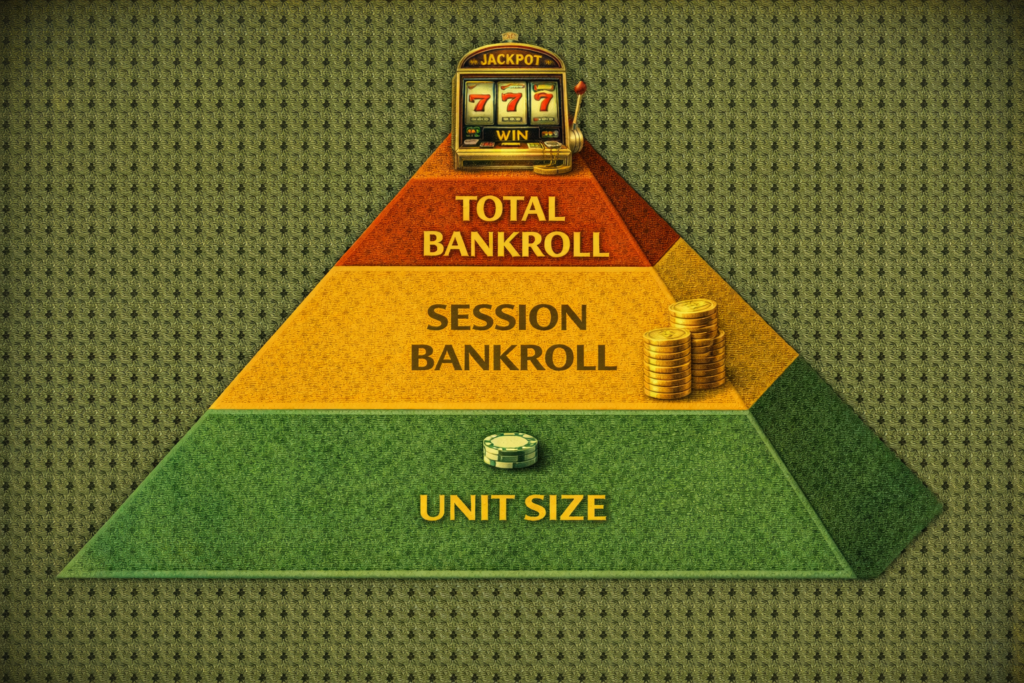
Bankroll Management: The Essential Framework
No strategy eliminates house edge. However, proper bankroll management extends play duration and minimizes catastrophic losses.
Three-tier bankroll structure:
- Total bankroll: $500-1,000 money you can afford to lose entirely
- Session bankroll: 5-10% of total ($25-100)
- Bet size: 1-2% of session bankroll ($0.25-2 per spin typically)
Implementation: With $100 session bankroll and $1 bets, you sustain approximately 50 spins before total depletion at 96% RTP (expected loss $4).
Choosing Machines Strategically
Selection criteria:
- Highest available RTP (target 95%+ whenever possible)
- Volatility matching your bankroll (limited budget = low volatility preferred)
- Game enjoyment (entertainment value matters for session duration)
Research approach: Modern casinos display RTP information at machines or online. Higher RTPs directly reduce expected losses—96% RTP costs $4 per $100 versus $8 at 92% RTP.
Loss Limits and Win Targets
Stop-loss discipline: Exit immediately upon losing 50% of session bankroll. This single rule prevents catastrophic losses exceeding planned entertainment budget.
Win target: Exit when winning 100-200% of session bankroll. This locks gains rather than risking winnings chasing larger jackpots.
Implementation: $100 session: exit at $50 loss or $100-200 win.
Time-Based Discipline
Session duration limits: Restrict sessions to 60-90 minutes maximum. Extended play increases variance exposure without improving odds.
Fatigue management: Stop playing when tired, frustrated, or emotional. Decision quality deteriorates, leading to poor bankroll discipline.
Bonus Optimization (Online Only)
Free spin promotions: Maximize “free spin” promotions to extend play with casino capital rather than personal funds.
Wagering requirements: Understand complete bonus terms before claiming. Some bonuses have unrealistic wagering requirements making withdrawal impossible.
Common Slot Machine Misconceptions
Misconception #1: “Machines Get ‘Hot’ or ‘Cold'”
Reality: RNG independence means no history dependence. Previous 10 losses don’t predict future wins. Machines generating numbers continuously have no “temperature” concept.
Misconception #2: “Timing Affects Outcomes”
Reality: Playing at midnight vs. noon has zero impact. RNG generates outcomes regardless of time, day, or player count. Each spin is completely independent.
Misconception #3: “Certain Strategies Predict Wins”
Reality: No strategy predicts RNG-determined outcomes. Bet size, game selection, or play speed cannot influence results. Only bankroll management strategy exists.
Misconception #4: “Near Misses Indicate Imminent Wins”
Reality: “So close” jackpot displays are programming features, not predictive indicators. Near misses are deliberate design to maintain engagement; they hold zero predictive value.
Misconception #5: “Slower Machines Pay Better”
Reality: Physical reel speed is cosmetic. Slow spinning machines have identical odds to fast-spinning ones. Speed affects only display presentation, not probability.
Conclusion: Playing Slot Machines Intelligently
Understanding how slot machines work fundamentally changes your expectations. Modern slots use Random Number Generators ensuring unpredictable outcomes controlled by careful probability programming calibrated to specific house edges and volatility patterns.
Key takeaways:
- RNGs generate completely unpredictable outcomes independent of previous spins or external timing
- RTP determines long-term return percentages (96% RTP = $96 returned per $100 wagered long-term)
- House edge (4% for 96% RTP) guarantees casino profit over sufficient play volume
- Volatility determines win frequency and distribution pattern independent of RTP
- No strategy improves odds, only bankroll discipline extends entertainment value
- Online slots average 95-98% RTP compared to land-based 92-95%
- Bonus features and complexity don’t affect odds, only entertainment value
- Time, speed, and “hot/cold” patterns have zero impact on RNG-determined outcomes
With realistic expectations, proper bankroll management, and machine selection focus, slot play becomes responsible entertainment rather than speculative income pursuit. Accept house edge as entertainment cost, manage bankroll strictly, and enjoy slots for what they are—pure chance games with mathematically transparent advantages favoring the house long-term.
Responsible Play Note
Casino strategy can reduce avoidable mistakes, but it cannot remove variance or guarantee profit. Set a budget before you play, keep gambling separate from income or bills, and stop when the session limit is reached. If gambling stops feeling recreational, take a break and use local support resources.