
Introduction: Mastering One of Casino Gaming’s Most Exciting Games
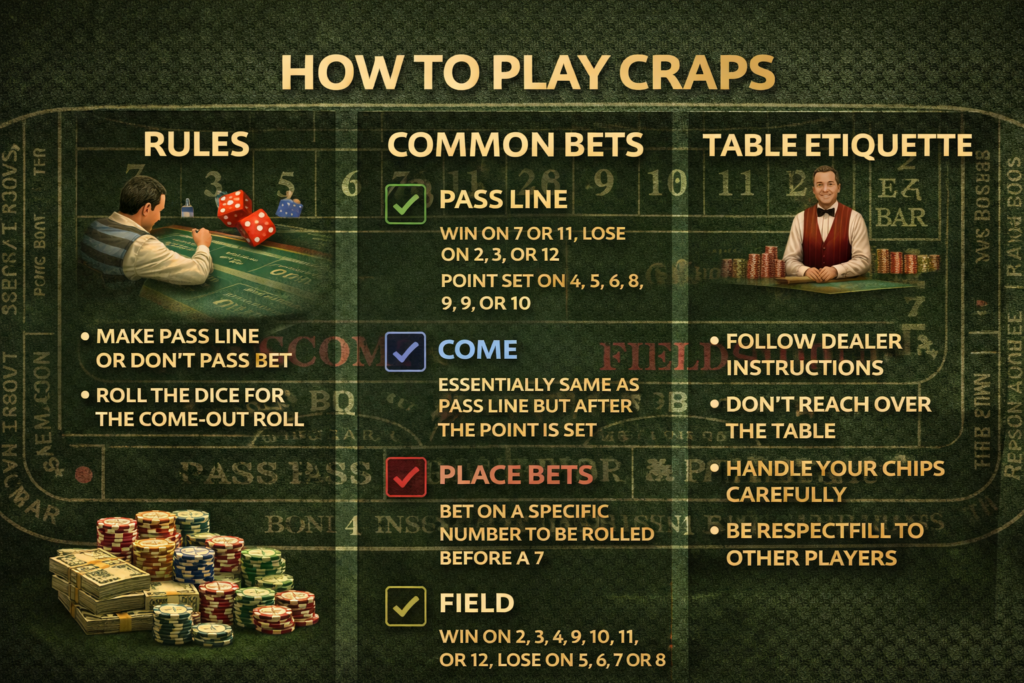
How to play craps represents one of casino gaming’s most intimidating yet ultimately rewarding skill sets. Many beginners approach the craps table overwhelmed by complexity, confused terminology, and the fast-paced energy surrounding it. Yet craps remains one of gaming’s most social, thrilling, and mathematically fair games when you understand the fundamentals.
The craps game offers among casino gaming’s lowest house edges—particularly on key bets like Pass Line, Don’t Pass, Come, and Odds bets, which carry only 1.36-1.4% house edge. This mathematical fairness, combined with the communal nature of the game and genuine opportunities for strategic betting, makes craps attractive to serious players worldwide.
This comprehensive guide deconstructs how to play craps completely: from the basic come-out roll through advanced betting strategies, table layout navigation, proper etiquette, bankroll management, and common beginner mistakes. By the end, you’ll approach the craps table with confidence, understanding both mechanical rules and strategic frameworks optimizing your play.
Quick Takeaway: Craps combines community excitement with some of casino gaming’s best odds. Master the fundamentals, and you’ll enjoy one of gaming’s most engaging experiences.
The Craps Table: Understanding Layout and Navigation
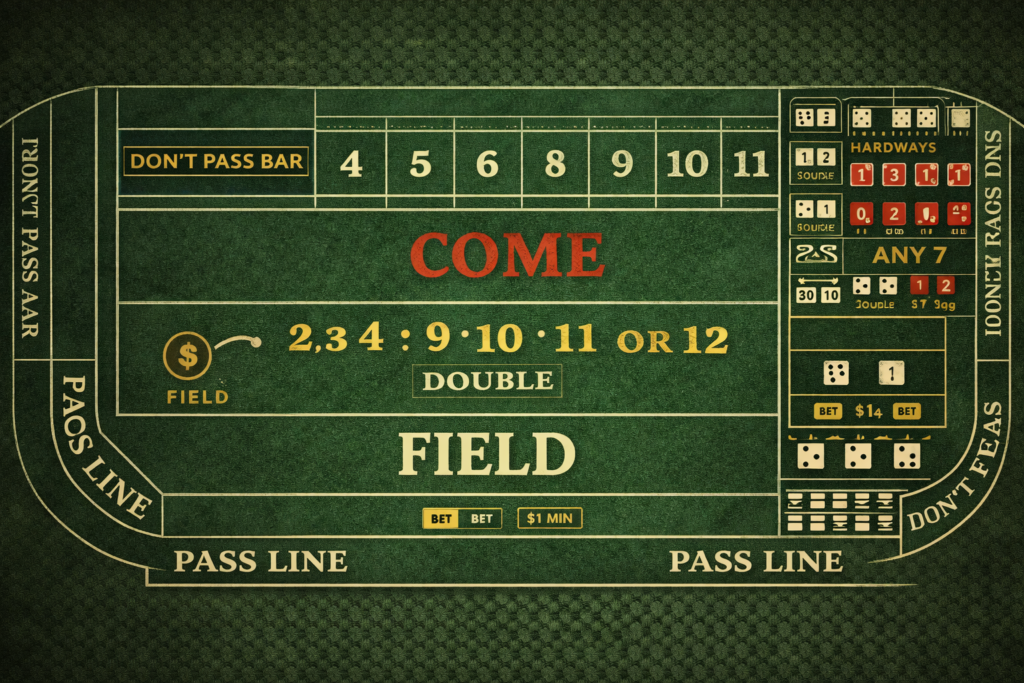
Table Dimensions and Basic Layout
A standard craps table measures approximately 12 feet long by 4 feet wide, designed to accommodate up to 20 players simultaneously. The table features three distinct sections: two identical wings and a central proposition area.
The two wings contain all primary betting areas (Pass Line, Don’t Pass, Come, Don’t Come, Point boxes, Field, Big 6/8, Place numbers). These wings are mirror images, enabling players at any position to access identical betting options. This symmetry ensures no positional advantage exists around the table—any spot is equally playable.
The central proposition area contains high-payout, high-house-edge proposition bets used less frequently by strategic players. This central section houses One-Roll bets (Snake Eyes, Boxcars, etc.), Horn bets, and other specialized wagers.
Three casino employees manage the table:
- Boxman: Supervises game integrity and collects/pays bets from the casino bankroll
- Stickman: Controls center bets, announces outcomes, and manages proposition area
- Dealers: Two dealers (one per wing) manage player bets on their respective sides
Understanding Your Position and Betting Area
Self-service vs dealer-assisted bets determine where you place chips. Your physical position around the table matters—bets placed directly in front of you are your own, while bets requiring dealer assistance correspond to your table position.
Key principle: Dealers maintain chip positions corresponding to each player’s location. If you stand at the table’s upper-left corner, your bets in the center proposition area appear in the upper-left portion of those boxes.
Pro Tip: Maintain consistency with your betting position. Help your dealer by placing chips clearly and confirming every bet after placement. This prevents confusion during fast-paced action.
The Come-Out Roll: Starting Your Game
The Fundamental Phase
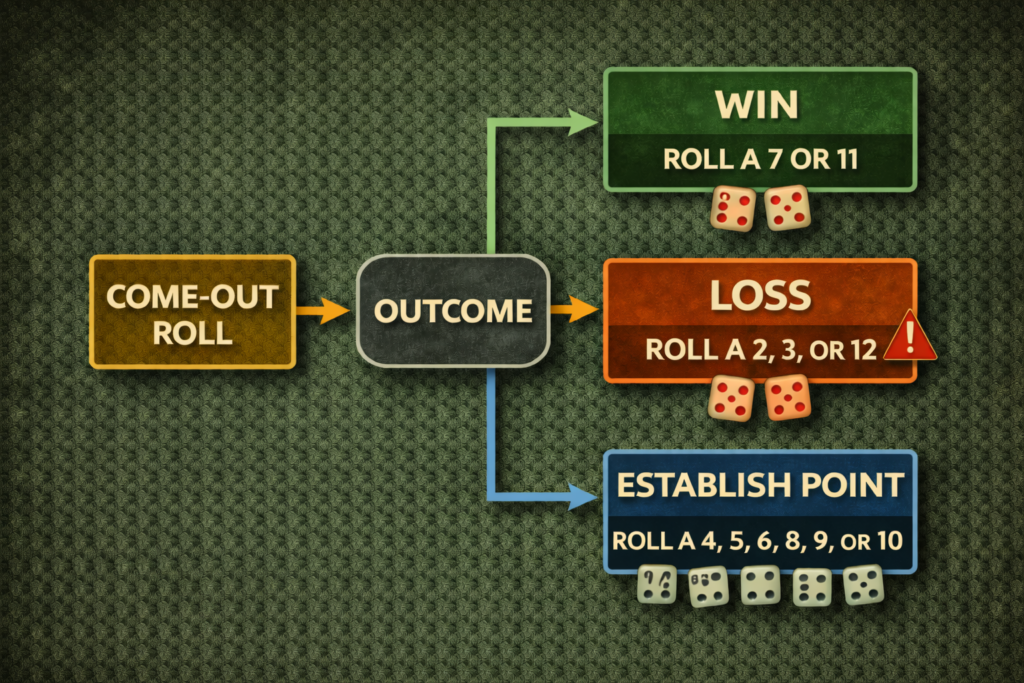
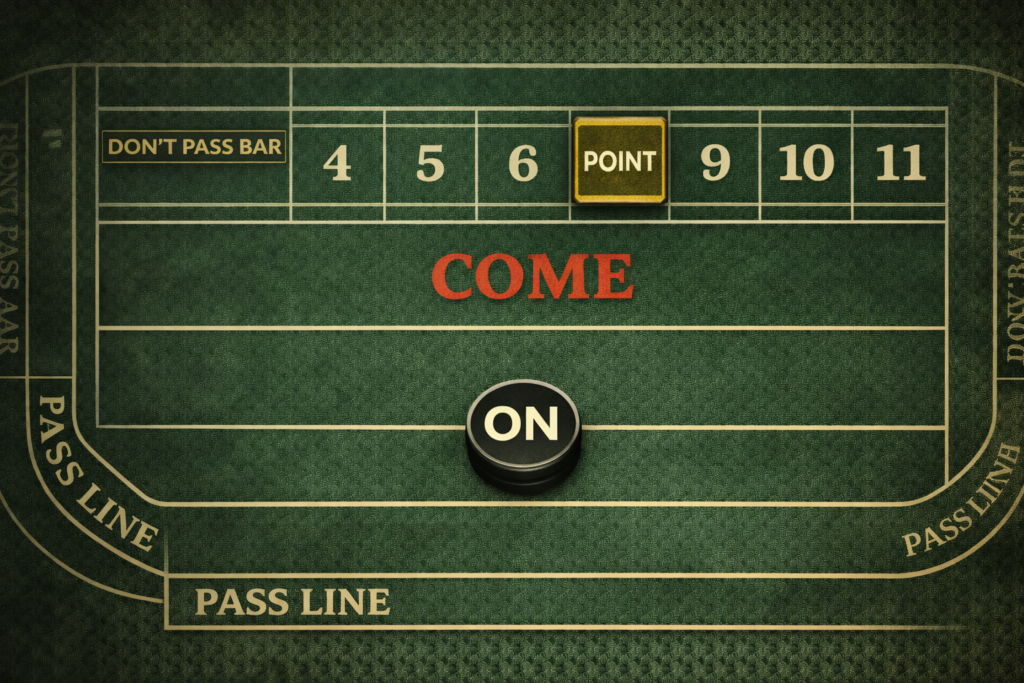
The come-out roll initiates each new game cycle. This is the first roll when the point marker (puck) sits in the “OFF” position. Understanding come-out roll outcomes determines whether you win, lose, or establish the point that directs subsequent action.
Pass Line betting (most common): Before the come-out roll, players place Pass Line bets wagering “with the dice.” Pass Line bettors win immediately with rolls of 7 or 11 (natural), lose immediately with rolls of 2, 3, or 12 (craps), and neither win nor lose with any other number.
Don’t Pass betting (opposite outcome): Don’t Pass bets win on 2 or 3, tie (push) on 12, and lose on 7 or 11. This “betting against the dice” approach appeals to contrarian players but is statistically less popular.
Payouts on Come-Out Roll
Pass Line immediate outcomes:
- 7 or 11: Win even money (1:1 payout)
- 2, 3, or 12: Lose the entire bet
- Any other number (4, 5, 6, 8, 9, 10): No immediate outcome; this number becomes your “point”
Don’t Pass immediate outcomes:
- 2 or 3: Win even money (1:1 payout)
- 7 or 11: Lose the entire bet
- 12: Push (tie—bet returns without win/loss)
- Any other number: This becomes the point (but now Don’t Pass needs a 7 before the point to win)
Real-World Example: Come-Out Roll Scenarios
Scenario 1: Come-out roll produces 6
- Pass Line bettors: Establish 6 as their point—must continue rolling until either repeating 6 (win) or rolling 7 (loss)
- Don’t Pass bettors: Need a 7 before 6 appears to win
- Puck: Moves to “ON” position over the 6
Scenario 2: Come-out roll produces 7
- Pass Line bettors: Win immediately (7 is a natural)
- Don’t Pass bettors: Lose immediately
- Puck: Remains “OFF”; next shooter rolls a new come-out roll
Establishing and Playing the Point
After Come-Out Roll: Point Establishment
Once the come-out roll produces any number except 2, 3, 7, 11, or 12, that number becomes your point. The puck moves to the “ON” position, covering that number on the craps table layout.
Shooter’s objective: Roll the point number again before rolling 7. Pass Line bettors win when the point repeats; they lose when 7 appears first (called “seven out”).
Don’t Pass objective: Opposite—win when 7 appears before the point repeats.
Rolling After Point Establishment
The shooter continues rolling continuously until:
- Point repeats (Pass Line wins, Don’t Pass loses)
- 7 appears (Pass Line loses, Don’t Pass wins)
During this phase, all other numbers rolled are irrelevant to Pass Line/Don’t Pass outcomes—only the point and 7 matter.
Key rule: Pass Line bets, once a point is established, become “contract bets”—they cannot be removed, reduced, or changed until resolved. This prevents mid-game modification that would undermine fair play.
Don’t Pass bets, conversely, can be reduced or removed after the point is established (though increasing is prohibited).
Real-World Point-Playing Scenario
Sequence: Come-out roll = 4 (point established)
- Roll 2: Irrelevant to Pass Line outcome
- Roll 8: Irrelevant
- Roll 3: Irrelevant
- Roll 7: Pass Line loses, Don’t Pass wins → Game ends, next shooter
Alternative sequence: Come-out = 4
- Roll 9: Irrelevant
- Roll 5: Irrelevant
- Roll 4: Point repeats → Pass Line wins, Don’t Pass loses → Game ends
Core Betting Options: Finding Your Strategy
Pass Line and Don’t Pass: The Foundation
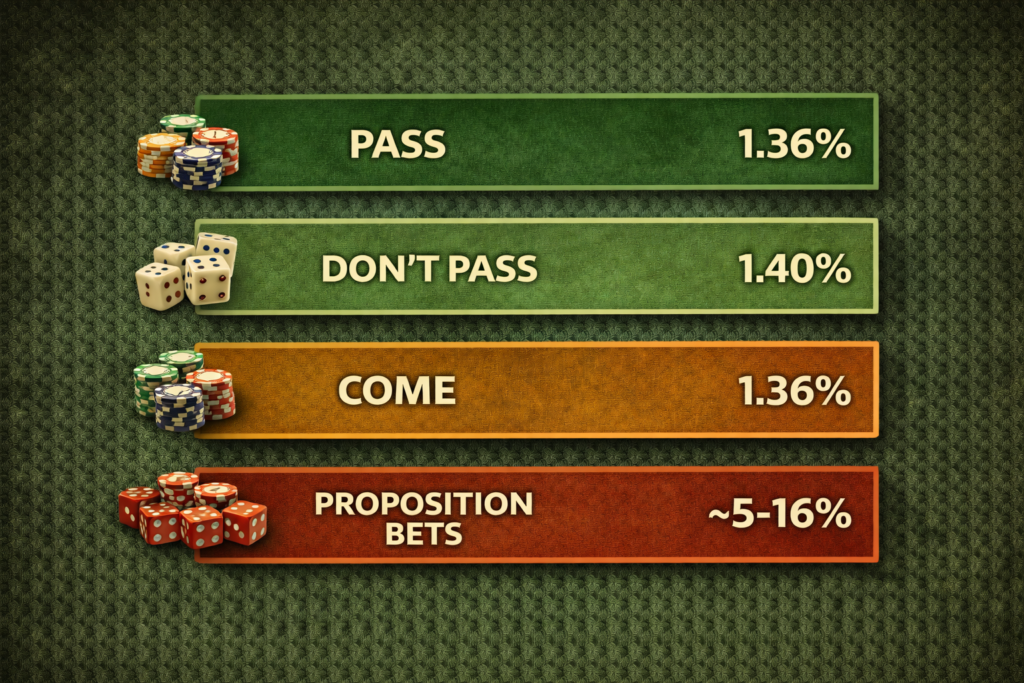
Pass Line represents craps’s most popular bet. It’s the default wager most players make because it’s intuitive (“betting with the shooter”) and carries a respectable 1.36% house edge.
Mathematical reality:
- Pass Line wins: 40.87% of the time
- House edge: 1.36%
- Expected loss: $1.36 per $100 wagered over extended play
Don’t Pass offers nearly identical odds (1.40% house edge), appealing to contrarian players. However, Don’t Pass carries social stigma—many tables view “wrong-way” betting as bad luck (despite mathematical irrelevance).
Odds Bets: The House-Neutral Opportunity
Odds bets represent craps’s unique feature: wagers with zero house edge. After the point is established, Pass Line and Don’t Pass bettors can place additional “odds” bets at true mathematical odds.
How it works:
- Point = 4 or 10: Odds pay 2:1
- Point = 5 or 9: Odds pay 3:2
- Point = 6 or 8: Odds pay 6:5
Example: $10 Pass Line bet, point = 6, $10 Odds
- If 6 repeats: Win $10 (Pass) + $12 (Odds) = $22 total gain
- If 7 appears: Lose $10 (Pass) + $10 (Odds) = $20 total loss
Critical insight: Odds bets carry 0% house edge—the casino pays exactly true mathematical odds. This makes odds bets the most valuable wagers available. Professional craps players maximize odds betting while minimizing lower-odds line bets.
Pro Tip: Table limits on odds vary. Some allow 3x-4x odds (3-4 times your line bet), while premium tables allow 5x, 10x, or unlimited odds. Higher odds limits directly improve game value through reduced overall house edge.
Advanced Betting Options: Expanding Your Arsenal
Come and Don’t Come Bets
Come bets function identically to Pass Line bets but are placed after the point is established. Come bets become active immediately on the next roll.
How it works:
- Place Come bet after point is established
- Next roll of 7 or 11: Come bet wins
- Next roll of 2, 3, or 12: Come bet loses
- Any other number: That number becomes the Come point, moving the bet to the corresponding point box
Strategic advantage: Come bets enable establishing multiple simultaneous points, creating layered win scenarios. If the point is 8 and you make a Come bet, and the next roll is 5, you now have both an 8 point and a 5 Come point active.
Don’t Come bets work oppositely, winning on 2/3, tying on 12, and losing on 7/11.
Place Bets: Direct Number Wagering
Place bets wager that a specific number (4, 5, 6, 8, 9, or 10) will roll before 7. Unlike Come bets, Place bets don’t require establishment—they can be placed anytime.
Payouts vary by number:
- 4 or 10: Pay 9:5 (1.67% house edge)
- 5 or 9: Pay 7:5 (4% house edge)
- 6 or 8: Pay 7:6 (1.51% house edge)
Strategic insight: Place bets on 6 and 8 offer exceptional value (lower house edge than Come bets on these numbers). Many experienced players focus here rather than center proposition bets.
Field Bets: Single-Roll Simplicity
Field bets wager that specific numbers (2, 3, 4, 9, 10, 11, or 12) roll on the next spin. Notably, 5, 6, 7, and 8 are missing—covering only 22 of 36 possible outcomes.
Reality: Field bets appear attractive (7 numbers covered) but carry 5.56% house edge due to omitted numbers and payout structure. Most experienced players avoid field bets entirely.
House Edge Analysis: Which Bets Matter Most
| Bet Type | House Edge | Recommendation |
| Pass Line/Don’t Pass | 1.36%-1.40% | Core fundamental bets |
| Odds (all types) | 0% | Take maximum available |
| Come/Don’t Come | 1.36%-1.40% | Excellent secondary bets |
| Place 6 or 8 | 1.51% | Good alternative to field |
| Field | 5.56% | Avoid—terrible value |
| Big 6/Big 8 | 9.09% | Avoid—extremely poor value |
| Proposition (center) | 11-16% | Avoid—recreational only |
Strategic insight: The difference between optimal (Pass + max Odds) and suboptimal (Field + Proposition bets) betting reduces your total house edge from ~0.8% to over 10%—a 1,150% increase in expected losses.
Table Etiquette: Social Dynamics and Respect
The Unwritten Code
Craps culture emphasizes community and respect. Breaking etiquette norms creates friction even if you’re mathematically correct.
Core etiquette principles:
- Don’t curse the dice. Superstition pervades craps. Suggesting a shooter is “due” to seven out or criticizing their rolls violates communal spirit.
- Never mention “seven” during point play. This superstition is so strong that many players say “the number” or “that number” to avoid verbally invoking 7.
- Respect the shooter. The shooter is attempting to accomplish something—making their point. Cheering on your fellow shooter creates community atmosphere.
- Don’t touch the dice. Only the shooter handles dice. Hands off.
- Place bets clearly and promptly. Slow betting disrupts game rhythm. Dealers appreciate players who know what they want and communicate clearly.
- Tip your dealers. Standard tipping is $1-5 per hand on their behalf. This creates positive atmosphere and shows appreciation for their work.
Bankroll Management: Sustaining Your Play
The Three-Tier Framework
Total bankroll: Money you can afford to lose entirely (e.g., $500)
Session bankroll: 10-20% of total bankroll per session (e.g., $50-100 per session)
Unit size: 5-10% of session bankroll per wager (e.g., $5-10 per Pass Line bet)
This framework enables approximately 5-10 independent sessions before total bankroll depletion despite negative house edge.
Stop-Loss and Profit Target Implementation
Stop-loss threshold: Exit when losing 50% of session bankroll.
Profit target: Exit when winning 50-100% of session bankroll.
Rationale: Strict discipline prevents emotional escalation. Humans consistently violate self-imposed limits after losses, leading to accelerated bankroll depletion.
Common Beginner Mistakes and Prevention
Mistake #1: Focusing on Proposition Bets
Error: Betting center proposition bets (Snake Eyes, Boxcars) due to high payouts.
Reality: These carry 11-16% house edge—catastrophic value compared to Pass Line’s 1.36%.
Prevention: Exclusively focus on Pass Line, Don’t Pass, Come, Don’t Come, and Odds for first 50 sessions. Only experiment with proposition bets once you understand core games.
Mistake #2: Inadequate Odds Betting
Error: Making Pass Line bets without taking available odds.
Reality: Pass Line alone carries 1.36% edge. Adding max odds reduces edge dramatically (varies by odds limit).
Prevention: Always take maximum available odds on established points.
Mistake #3: Violating Your Bankroll Plan
Error: Increasing bet sizes after losses, abandoning stop-loss discipline.
Reality: Escalated betting accelerates total bankroll depletion exponentially.
Prevention: Treat bankroll plan like law—violate zero times per session.
Mistake #4: Forgetting Odds Payouts
Error: Confusing 2:1 (4/10) versus 3:2 (5/9) versus 6:5 (6/8) odds.
Reality: Miscalculating odds creates confusion and errors.
Prevention: Memorize: “4 and 10 pay 2 to 1, 5 and 9 pay 3 to 2, 6 and 8 pay 6 to 5.”
Mistake #5: Not Understanding True Odds vs Payouts
Error: Confusing what “true odds” mean versus actual payouts.
Reality: Odds bets pay true mathematical odds (0% house edge), while line bets incorporate house edge.
Prevention: Study odds structure thoroughly before playing.
Bankroll Strategies: Simple Progression Systems
The Conservative Approach: Flat Betting
Mechanics: Bet identical amounts per hand regardless of outcomes.
Advantages:
- Zero stress from bet management
- Predictable variance patterns
- Excellent for learning table flow
Disadvantages:
- Misses winning streaks
- Doesn’t optimize psychological engagement
The 1-3-2-6 Positive Progression
This betting progression captures winning streaks while minimizing losses:
Sequence (using $10 units):
- First hand: Bet $10. If you lose, restart at $10.
- If you win: Bet $30. If you lose, restart at $10.
- If you win again: Bet $20. If you lose, restart at $10.
- If you win a third time: Bet $60. This completes the sequence.
- After completing sequence: You’ve profited $120 from $10 units. Restart sequence.
Why it works: Any single loss returns you to baseline, preventing escalation. Winning streaks are captured with increasing bets. Even partial sequence completion produces profit.
Advanced Strategies: Playing Multiple Numbers
The “Inside” Strategy
Inside numbers: 5, 6, 8, 9 (Point boxes excluding 4 and 10)
Typical setup (after point established):
- Place $25 on 5 and 9
- Place $30 on 6 and 8
- Total investment: $110
Why it works: These four numbers produce payouts more frequently than 4 and 10, creating steady income stream.
The “Across” Strategy
Across betting: Placing all six point numbers (4, 5, 6, 8, 9, 10) simultaneously.
Typical setup:
- Place $10 on 4 and 10
- Place $12 on 5 and 9
- Place $12 on 6 and 8
- Total investment: $56
Advantage: Covers multiple numbers, capitalizing on shooter momentum.
Disadvantage: Large capital outlay with vulnerability to 7-outs.
Advanced Considerations: Reading the Table and Adapting
Shooter Skill Recognition
While craps is primarily chance-based, some shooters develop consistent trajectories affecting dice outcomes slightly. Experienced players recognize “controlled shooters” and adjust bets accordingly.
Indicators of shooter skill:
- Consistent dice handling style
- Predictable throw patterns
- Specific impact points on back wall
Hot Table Identification
When shooters establish multiple successful points, the table becomes “hot.” Strategic players increase bets during hot tables and decrease during “cold” tables (frequent 7-outs).
Reality: Variance, not skill, typically explains table temperature. However, psychological momentum is real—hot tables attract better energy and higher bets.
Conclusion: Mastering Your Craps Journey
How to play craps encompasses both mechanical rules and strategic decision-making. The fundamentals—understanding come-out rolls, point establishment, and basic betting—enable immediate competent play.
The advanced frameworks—bankroll management, odds maximization, and strategic number selection—separate casual players from those optimizing long-term sustainability.
Begin with these core commitments:
- Master Pass Line and Odds exclusively for your first 20 sessions
- Always take maximum available odds on established points
- Maintain strict bankroll discipline with predetermined stop-losses
- Respect table culture and fellow players
- Practice etiquette by tipping dealers and supporting other shooters
Within this framework, craps transitions from overwhelming chaos to engaging, community-driven gaming. You’ll appreciate the social aspects while optimizing mathematical outcomes.
The craps table awaits—approach it with prepared knowledge, disciplined bankroll, and respect for the culture. You’re now equipped to play competently, enjoying one of casino gaming’s most thrilling experiences.