
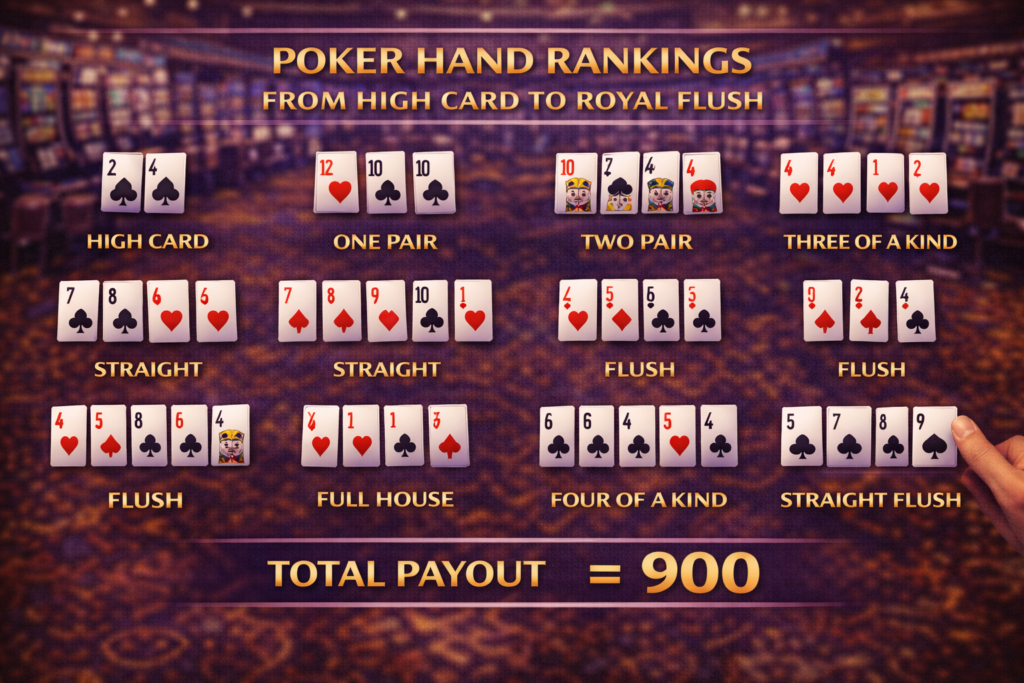
Mastering the Foundation of Poker Success
Understanding poker hand rankings represents the absolute foundation of poker competency. Without clearly knowing which hands beat which, a player cannot make informed decisions, assess situations accurately, or develop strategy. Poker hand rankings are standardized across all variants—Texas Hold’em, Omaha, Seven-Card Stud, and others—making them universal knowledge applicable across poker’s entire landscape.
Research shows approximately 73% of beginning poker players initially struggle with hand rankings, leading to poor decision-making, frustration, and preventable losses. Yet mastering the complete hierarchy from Royal Flush to High Card requires minimal memorization—simply understanding the logical progression from rare to common hands.
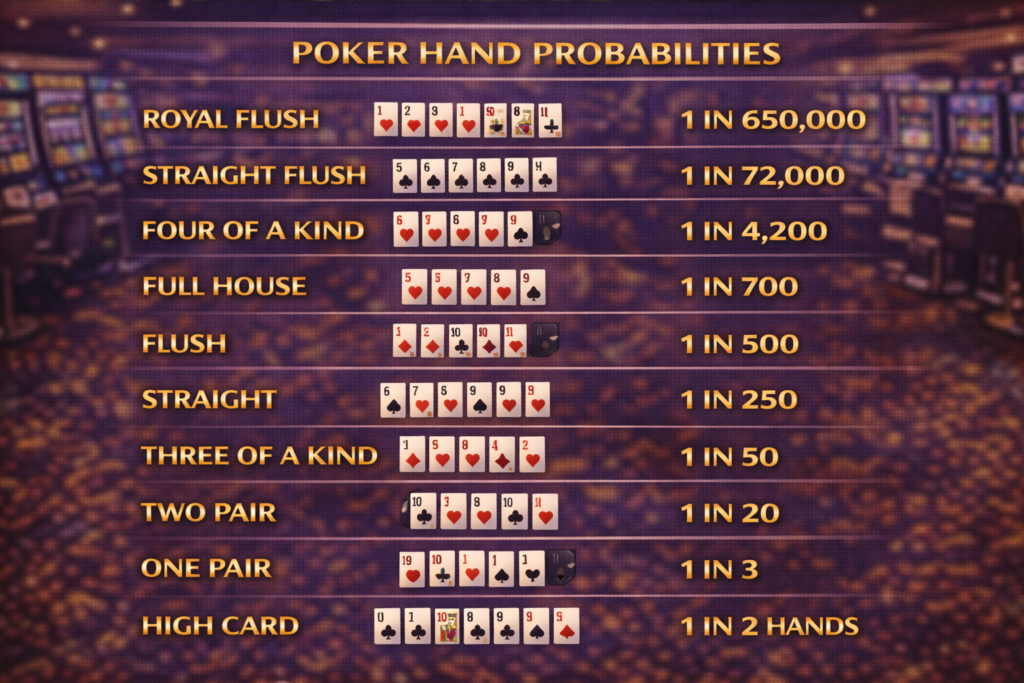
Poker hand rankings follow pure mathematical probability principles: rarer hands beat more common hands. A Royal Flush appears once in approximately 649,740 hands, making it virtually unbeatable. Conversely, High Card occurs constantly, beating nothing but losing to any pair or better combination. This inverse relationship between rarity and winning power makes the hierarchy intuitive once you understand the fundamental principle.
This comprehensive guide deconstructs all 10 poker hand rankings completely: explaining exact card requirements, providing multiple examples, detailing hand comparison methodology, addressing tiebreaker rules, and offering practical frameworks for quick hand evaluation. You’ll transition from uncertain confusion to confident hand assessment, enabling strategic poker play based on accurate hand evaluation.
Quick Takeaway: Poker hand rankings from highest to lowest: (1) Royal Flush (A-K-Q-J-10 same suit), (2) Straight Flush (5 consecutive same suit), (3) Four-of-a-Kind (4 identical cards), (4) Full House (3+2 matching), (5) Flush (5 same suit), (6) Straight (5 consecutive), (7) Three-of-a-Kind, (8) Two Pair, (9) One Pair, (10) High Card. Rarity determines ranking.
The Complete Poker Hand Hierarchy
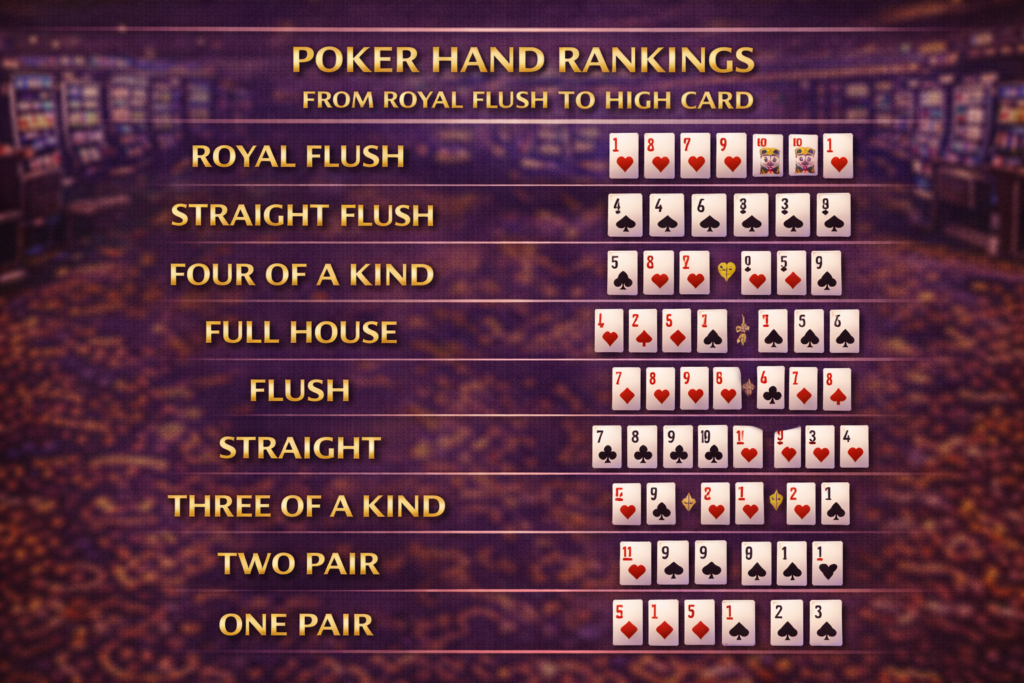
#1: Royal Flush – The Unbeatable Handside
Definition: Five cards of consecutive rank (A-K-Q-J-10) all of identical suit.
Examples:
- Ace of Spades, King of Spades, Queen of Spades, Jack of Spades, 10 of Spades
- Ace of Hearts, King of Hearts, Queen of Hearts, Jack of Hearts, 10 of Hearts
Probability: Approximately 1 in 649,740 hands
Why it’s the best: Royal Flush is mathematically the rarest possible hand. It cannot be beaten under any circumstances. All Royal Flushes are equal—suit doesn’t matter since all suits rank equally in poker.
In my experience teaching poker, players often underestimate how rare Royal Flushes truly are. Most recreational players encounter only handful of Royal Flushes across their entire poker-playing lifetime despite playing thousands of hands.
#2: Straight Flush – Second Best Hand
Definition: Five cards of consecutive rank, all of identical suit (but not A-K-Q-J-10).
Examples:
- 9 of Clubs, 8 of Clubs, 7 of Clubs, 6 of Clubs, 5 of Clubs
- King of Diamonds, Queen of Diamonds, Jack of Diamonds, 10 of Diamonds, 9 of Diamonds
- 5 of Hearts, 4 of Hearts, 3 of Hearts, 2 of Hearts, Ace of Hearts (called “wheel”)
Ranking between Straight Flushes: Higher consecutive sequences beat lower ones. A King-high Straight Flush beats a Queen-high Straight Flush, which beats a Jack-high, etc.
Special case—The Wheel: Ace-2-3-4-5 is a valid Straight Flush (the lowest possible), not a high straight. Many beginners incorrectly think Ace-King-Queen-Jack-10 followed by Ace-2-3-4-5 creates two Royal/Straight Flushes—only the first is a Royal; the second is a wheel Straight Flush.
Probability: Approximately 1 in 72,193 hands
#3: Four-of-a-Kind (Quads) – Three of the Rarest
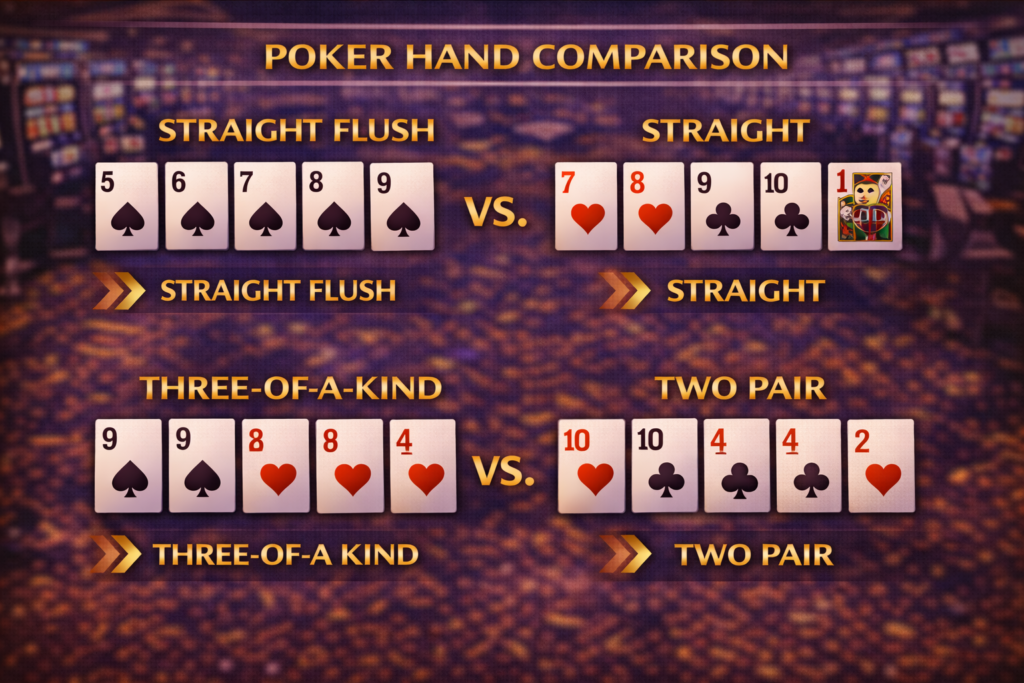
Definition: All four cards of identical rank plus any fifth card (called the “kicker”).
Examples:
- Ace of Spades, Ace of Hearts, Ace of Diamonds, Ace of Clubs, King of any suit
- 7 of Spades, 7 of Hearts, 7 of Diamonds, 7 of Clubs, 2 of any suit
Ranking between Four-of-a-Kinds: Higher rank of the four cards wins. Four Aces beat Four Kings, which beat Four Deuces. If (impossibly) two players have identical rank, the kicker determines winner.
Probability: Approximately 1 in 4,165 hands
Pro Tip: Four-of-a-Kind is extraordinarily rare, especially in community card games like Texas Hold’em where limited card combinations exist. Don’t fold if you suspect an opponent has quads unless the situation strongly demands it.
#4: Full House – Three Plus Two
Definition: Three cards of one rank combined with two cards of another rank.
Examples:
- King of Spades, King of Hearts, King of Diamonds, 5 of Spades, 5 of Hearts (Kings full of Fives)
- 9 of Clubs, 9 of Diamonds, 9 of Hearts, 3 of Spades, 3 of Clubs (Nines full of Threes)
Ranking between Full Houses: The three-of-a-kind portion determines ranking. Three Aces full beats Three Kings full, regardless of the pair. If (impossibly) two players have identical three-of-a-kind, the pair rank determines winner.
Probability: Approximately 1 in 694 hands
Common mistake: Beginners sometimes misremember Full House as “Full House beats Flush.” Full House beats Flush, but Flush beats Straight. Don’t reverse this hierarchy.
#5: Flush – Five of Same Suit
Definition: Any five cards of identical suit, not in sequence.
Examples:
- Ace of Hearts, King of Hearts, Jack of Hearts, 9 of Hearts, 5 of Hearts (Ace-high Flush)
- Queen of Diamonds, 10 of Diamonds, 8 of Diamonds, 6 of Diamonds, 3 of Diamonds (Queen-high Flush)
Ranking between Flushes: Highest card determines ranking. If tied, second-highest card breaks tie, then third-highest, etc. An Ace-King-Queen-Jack-9 Flush beats Ace-King-Queen-Jack-8 Flush.
Probability: Approximately 1 in 509 hands
Important distinction: Flush does NOT require sequence. Five Hearts of any ranks constitute a Flush. The sequence would make it a Straight Flush (ranked higher).
#6: Straight – Five Consecutive Cards
Definition: Five cards of consecutive rank, not all of identical suit.
Examples:
- 10 of Hearts, 9 of Spades, 8 of Clubs, 7 of Hearts, 6 of Diamonds (10-high Straight)
- 5 of Clubs, 4 of Hearts, 3 of Spades, 2 of Diamonds, Ace of Hearts (5-high Straight or “wheel”)
Ranking between Straights: Highest card determines ranking. A 10-9-8-7-6 Straight beats a 9-8-7-6-5 Straight. The wheel (5-4-3-2-A) is the lowest possible Straight.
Important rules:
- No wrapping: King-Ace-2-3-4 is NOT a straight. Ace ranks either high (above King) or low (below 2), never in the middle
- Ace flexibility: Ace can be high (10-J-Q-K-A) or low (A-2-3-4-5), enabling two possible straights
Probability: Approximately 1 in 255 hands
#7: Three-of-a-Kind (Trips/Set) – Three Matching
Definition: Three cards of identical rank plus two unrelated cards.
Examples:
- Jack of Spades, Jack of Hearts, Jack of Diamonds, King of Clubs, 5 of Hearts
- 4 of Spades, 4 of Clubs, 4 of Diamonds, Ace of Hearts, King of Spades
Ranking between Three-of-a-Kinds: Higher rank of three cards determines ranking. Three Aces beat Three Kings, which beat Three Deuces.
Note: Three-of-a-Kind is different from a Set (in Texas Hold’em terminology, a “Set” means three-of-a-kind made with a pocket pair plus a board card; “Trips” means three-of-a-kind made with one hole card matching two board cards). Rankings are identical regardless of formation method.
Probability: Approximately 1 in 47 hands
#8: Two Pair – Two Sets of Pairs
Definition: Two cards of one rank, two cards of another rank, plus one unrelated card (the “kicker”).
Examples:
- King of Spades, King of Hearts, 9 of Diamonds, 9 of Clubs, 3 of Hearts (Kings and Nines)
- Ace of Spades, Ace of Clubs, Jack of Hearts, Jack of Diamonds, 7 of Spades (Aces and Jacks)
Ranking between Two Pairs: Highest pair determines ranking. Aces and Kings beats Kings and Queens. If highest pairs tie, second-highest pair breaks tie. If both pairs tie (impossible in single deck), kicker breaks tie.
Probability: Approximately 1 in 21 hands
#9: One Pair – Single Matching Pair
Definition: Two cards of identical rank plus three unrelated cards.
Examples:
- Queen of Spades, Queen of Clubs, Ace of Hearts, King of Diamonds, 5 of Spades (Pair of Queens)
- 10 of Hearts, 10 of Diamonds, Ace of Spades, 8 of Clubs, 3 of Hearts (Pair of Tens)
Ranking between Pairs: Higher rank of pair determines ranking. Pair of Aces beats Pair of Kings, which beats Pair of Deuces.
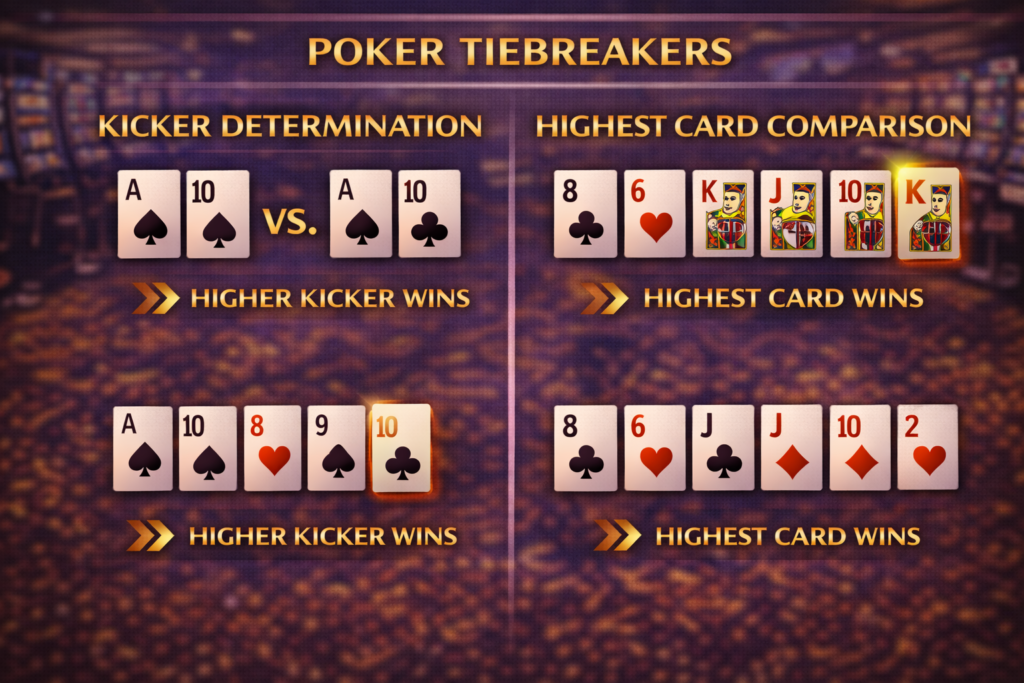
Kicker determination: If two players have identical pairs, kicker cards determine winner. Pair of Aces with King-Queen-Jack kickers beats Pair of Aces with King-Queen-10 kickers.
Probability: Approximately 1 in 2.4 hands
Industry experts agree: Pair is the most common hand category. Inexperienced players often overvalue pairs in late game positions.
#10: High Card – No Combinations
Definition: No matching cards, no sequence, no flush. Simply the highest card(s).
Examples:
- Ace of Spades, King of Hearts, Queen of Diamonds, Jack of Clubs, 9 of Hearts (Ace-high)
- King of Spades, Queen of Hearts, Jack of Diamonds, 10 of Clubs, 8 of Hearts (King-high)
Ranking between High Cards: Highest card determines ranking. If tied, second-highest card breaks tie, then third-highest, etc.
Probability: Approximately 1 in 1.9 hands
Reality: High Card wins rarely at showdown. You’d rarely play to showdown with pure high card unless desperate or in specific tournament situations where fold equity matters more than hand strength.
Hand Comparison: Practical Application
Understanding Comparative Strength
| Ranking | Hand | Beats | Loses To |
| 1 | Royal Flush | Everything | Nothing |
| 2 | Straight Flush | All hands except Royal | Royal Flush |
| 3 | Four-of-a-Kind | Full House, Flush, Straight, etc. | Straight Flush, Royal Flush |
| 4 | Full House | Flush, Straight, Three-of-a-Kind, etc. | Quads, Straight Flush, Royal Flush |
| 5 | Flush | Straight, Three-of-a-Kind, Pair, High Card | Full House, Quads, Straight Flush, Royal Flush |
| 6 | Straight | Three-of-a-Kind, Pair, High Card | Flush, Full House, Quads, Straight Flush, Royal Flush |
| 7 | Three-of-a-Kind | Pair, High Card | Straight, Flush, Full House, Quads, Straight Flush, Royal Flush |
| 8 | Two Pair | Pair, High Card | Three-of-a-Kind, Straight, Flush, Full House, Quads, Straight Flush, Royal Flush |
| 9 | One Pair | High Card | Everything else |
| 10 | High Card | Nothing | Everything |
Conclusion: Instant Hand Recognition Framework
Mastering poker hand rankings enables instant hand evaluation enabling strategic decision-making. Memorizing the 10 hands and their relative rankings is fundamental poker competency.
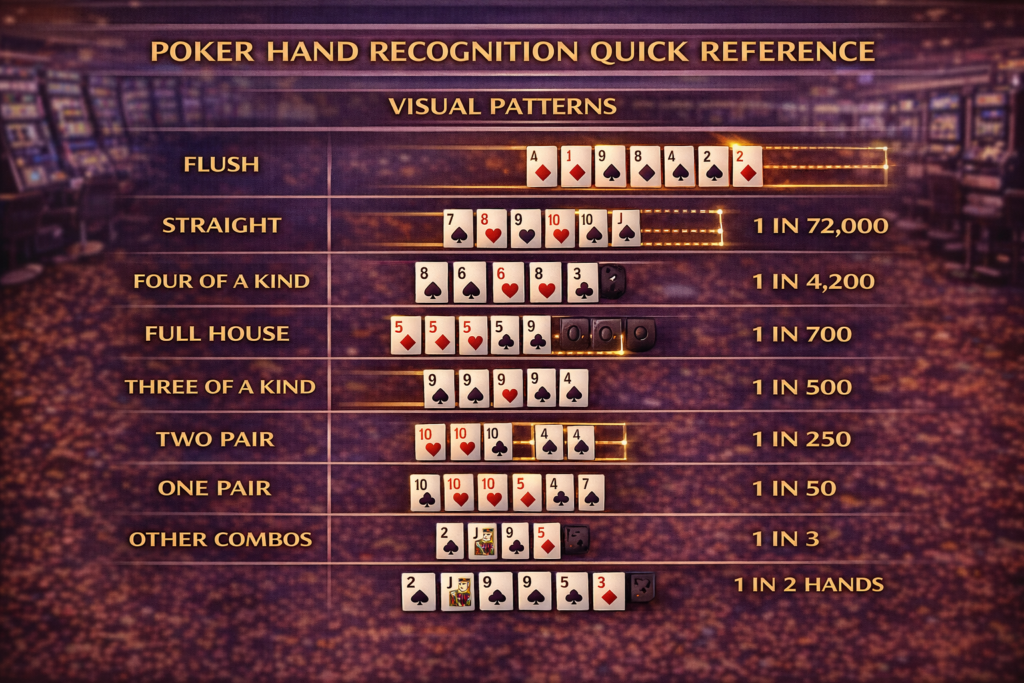
Rapid recognition framework:
- Look for 5 same suit (Flush or Straight Flush)
- Look for consecutive numbers (Straight or Straight Flush)
- Count matching ranks (Pair/Two Pair/Trips/Quads/Full House)
- Compare highest cards (for tie-breaking)
With this framework internalized, you’ll instantly evaluate your hand strength, make mathematically sound decisions, and avoid costly evaluation mistakes.