

The Power of Positional Awareness
Poker position strategy represents one of the most critical yet undervalued concepts separating winning players from losing ones. Understanding why position matters in poker turns seemingly equal starting hands into dramatically different profit opportunities based solely on where you sit relative to the dealer button. Position determines information availability, strategic flexibility, and ultimate profitability more powerfully than any other single factor.
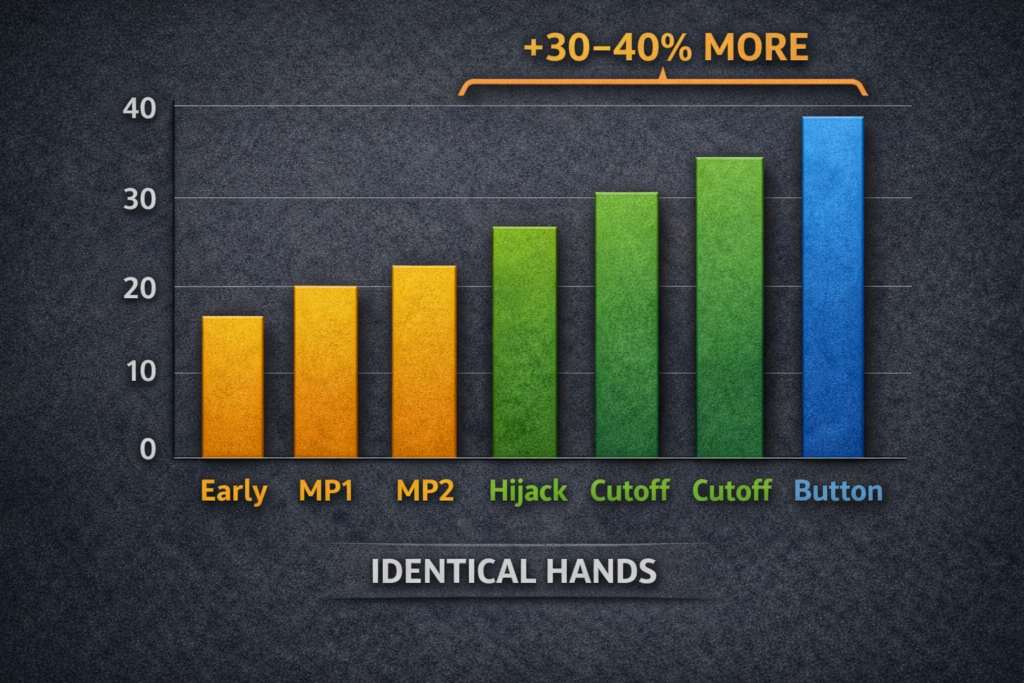
A stronger way to use this material is to compare each decision with the pot size, position, opponent type, and previous action. Those details are observable at the table and give the advice a practical basis without relying on unsupported survey claims.
The fundamental principle: position in poker creates an informational advantage. Acting last sees opponents’ actions before making decisions; acting first commits without knowing opponents’ intentions. This asymmetry generates massive profit differentials—the same hand holding substantial expected value from the button might show negative expected value from early position.
This guide breaks down poker position strategy : explaining position names, informational advantages, strategic adjustments by position, preflop hand selection frameworks, postflop positional leverage, and practical application guidelines. You’ll understand exactly why where you sit matters and how to exploit positional advantages systematically.
Quick Takeaway: Position in poker refers to where you sit relative to the dealer button. Acting last (late position—button, cutoff) provides maximum information advantage; acting first (early position—UTG, UTG+1) provides minimum advantage. Late position enables playing wider hand ranges profitably; early position requires tighter selection. The button is poker’s most profitable seat.
Understanding Poker Positions: The Complete Table Map
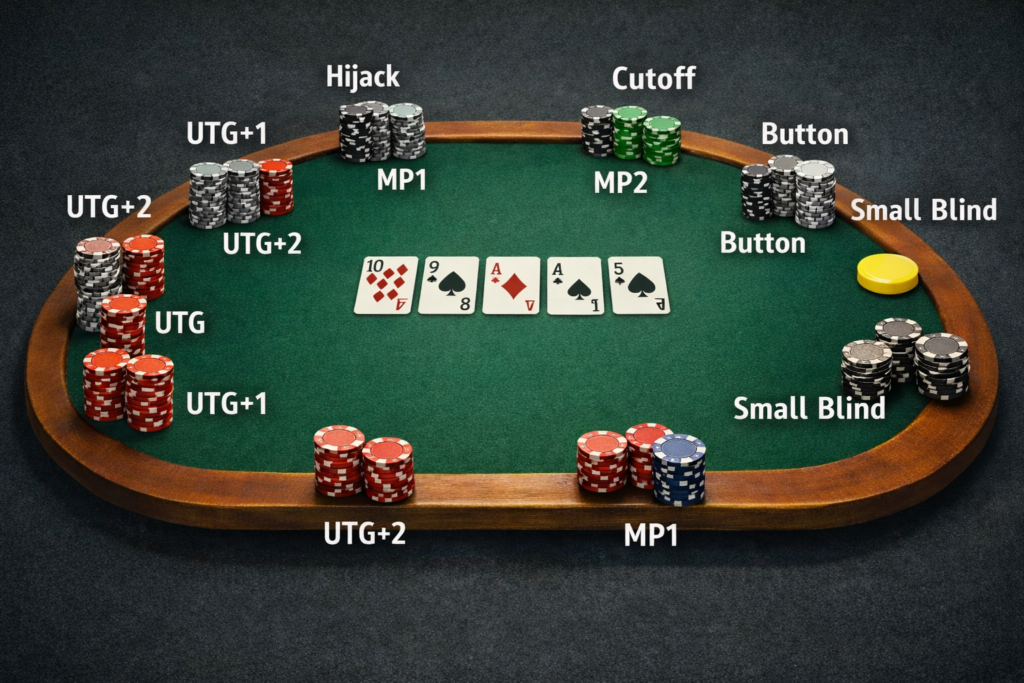
Position Names and Definitions
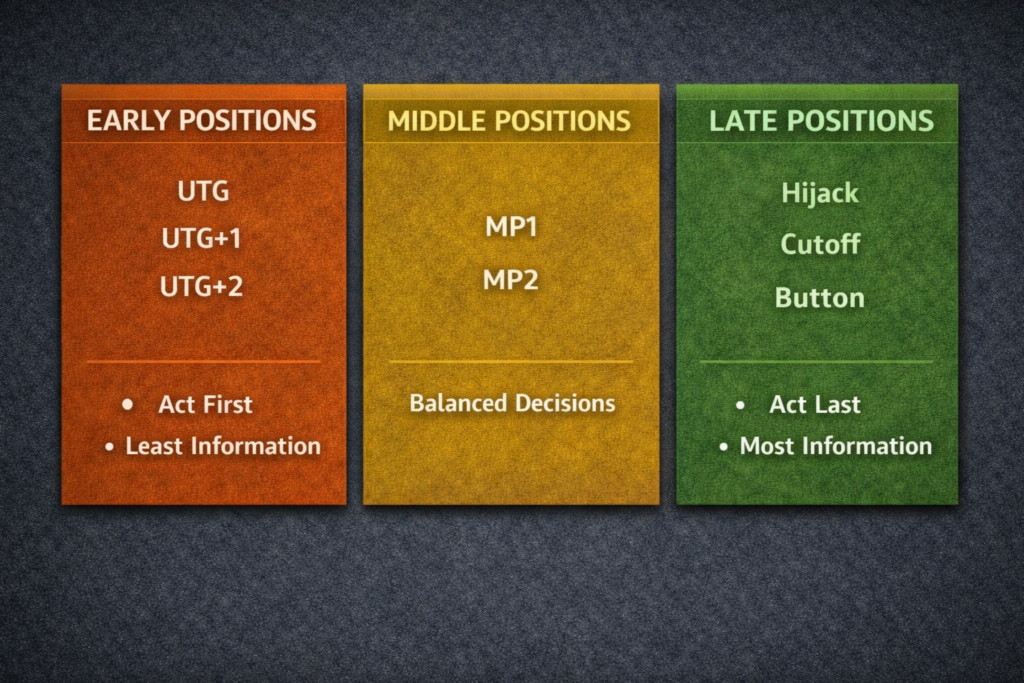
Poker tables feature standardized position names based on action order. In a standard 9-handed game:
Late Position (LP):
- Button (BTN): The dealer position, acts last postflop—the most profitable seat
- Cutoff (CO): One seat right of button, second-best position
- Hijack (HJ): Two seats right of button, still advantageous
Middle Position (MP):
- Lojack (LJ): Three seats right of button
- Middle Position (MP): General term for seats between early and late
Early Position (EP):
- Under the Gun +1 (UTG+1): Second seat left of big blind
- Under the Gun (UTG): First to act preflop, most disadvantaged position
The Blinds:
- Small Blind (SB): Left of button, posts half big blind
- Big Blind (BB): Left of small blind, posts full big blind
Why Position Names Matter
These aren’t arbitrary labels—they reflect strategic importance. “Under the Gun” conveys pressure of acting first with maximum uncertainty. “Hijack” suggests stealing initiative from later positions. “Cutoff” historically refers to cutting off the button’s natural advantage.
Understanding position names enables strategic communication, hand analysis, and deliberate positional exploitation.
The Informational Advantage: Why Position Creates Profit
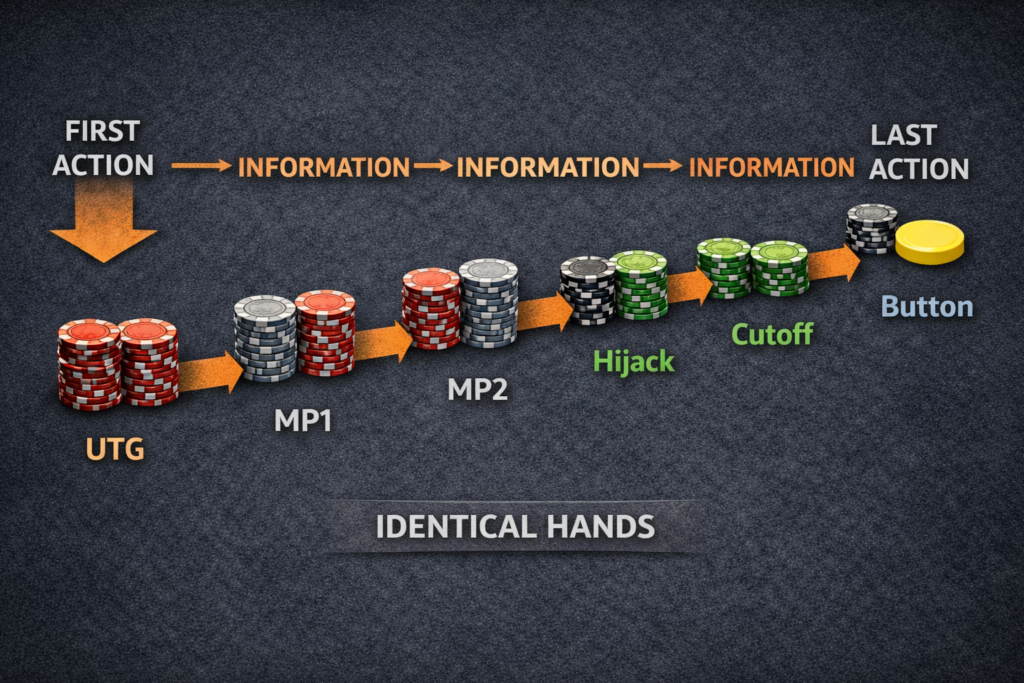
Information Asymmetry Fundamentals
The core principle: When you act last, you see opponents’ actions before deciding. This reveals valuable information about hand strength, intentions, and strategy that first-acting players cannot access.
Real-world example:
You hold A♠ K♣ on the button. The flop comes Q♦ J♥ 5♣. If opponents check, you infer weakness—your bet has high fold equity. If opponents bet, you know aggression exists—you can fold without loss. Acting first with the same hand forces betting without opponent feedback, creating uncertainty and suboptimal decisions.
Quantifying Information Value
Pro Tip: In practical play, the useful signal is the pattern you can observe repeatedly. Position doesn’t require advanced mathematics—only disciplined exploitation.
Preflop Position Strategy: Hand Selection by Position
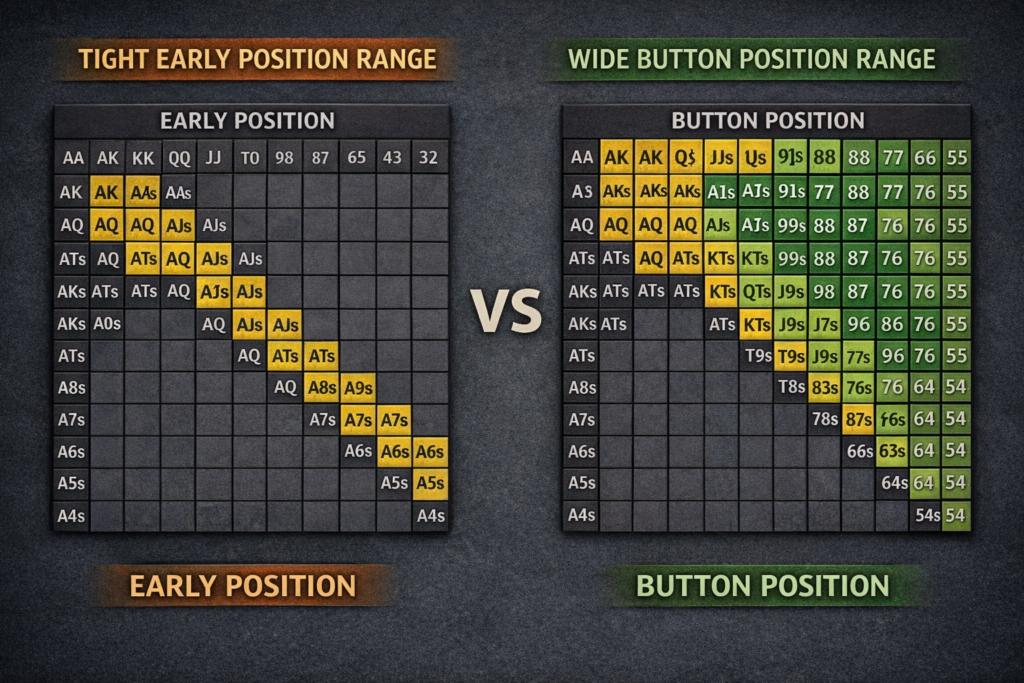
Early Position Hand Selection
The challenge: Acting first preflop with 6-8 players behind means high probability someone holds a premium hand. You must play tight, selecting only hands performing well in multi-way pots without positional advantage.
Recommended early position range:
- Premium pairs: AA, KK, QQ, JJ
- Premium Broadway: AK, AQ (suited preferred)
- Occasionally: TT, 99 (position and table dependent)
Avoid from early position:
- Small pairs (22-77) – difficult to play postflop out of position
- Suited connectors (76s, 87s) – require favorable odds unavailable from EP
- Weak Broadway (KJ, QJ, JT) – dominated too frequently
Middle Position Expansion
The advantage: Fewer players behind reduces confrontation probability. You can expand range modestly, incorporating speculative hands with implied odds potential.
Middle position additions:
- Mid pairs: 99, 88
- Strong suited connectors: JTs, T9s, 98s
- Strong suited Broadway: KQs, KJs
Late Position Freedom
The massive advantage: Acting last preflop with blinds behind enables stealing blinds with wide ranges. If earlier players fold, you frequently take pots uncontested.
Button range: Professional players open 40-50% of hands from button—vastly wider than early position’s 10-15%.
Late position range includes:
- All early/middle position hands
- All pocket pairs (22-AA)
- All suited connectors (54s-KQs)
- Suited Aces (A2s-AKs)
- Broadway combinations (KJ, QJ, JT)
- Many suited one-gappers (86s, 97s, T8s)
Why this works: If opponents fold, you win immediately. If they call, you play postflop with positional advantage—extracting value from marginal holdings through superior information access.
Postflop Positional Leverage: Maximizing Advantage
Information Gathering
The postflop shift: After the flop, button position becomes dramatically more valuable. You see every opponent’s action—checks signal weakness, bets indicate strength, raising patterns reveal hand categories.
Practical application:
Flop: K♠ 9♥ 3♦. You hold A♣ Q♣ (ace high) on button. Opponent checks. This check signals they likely missed—no king, no strong hand. Your continuation bet has high fold equity despite holding only ace high. Acting first with the same hand forces betting without opponent feedback—you’re guessing whether they connected.
Pot Control
Definition: Managing pot size through strategic checking or betting based on hand strength and opponent tendencies.
In position pot control:
You hold T♥ T♠, flop comes Q♦ 9♣ 5♠. Opponent checks. You can check behind for pot control, seeing turn cheaply. If turn completes draws or brings scare cards, you saved money. If turn improves your hand, you can bet for value.
Out of position challenge: Checking out of position enables opponents to bet, forcing difficult decisions. You cannot control pot size effectively when acting first.
Bluffing Opportunities
Positional bluffing advantage: Acting last enables representing strong hands based on opponent actions. They check twice showing weakness—your river bet appears credible regardless of actual holding.
Statistics:
Common Position Mistakes and Prevention
Mistake #1: Playing Too Many Hands From Early Position
The error: Opening weak hands from UTG hoping to “see a flop.”
Why it fails: Multiple players behind with premium hands; postflop play from out of position with marginal holdings creates costly situations.
Prevention: Strict early position discipline—play only premium holdings (top 10-15% of hands).
Mistake #2: Not Exploiting Late Position Enough
The error: Playing identically from button as from UTG.
Why it fails: Late position’s informational advantage enables profitable play with hands unprofitable from early position.
Prevention: Widen button range dramatically—open 40-50% of hands when action folds to you.
Mistake #3: Ignoring Position in Marginal Situations
The error: Calling raises from out of position with hands like KQ, AT, small pairs.
Why it fails: These hands play poorly out of position—difficult postflop decisions, limited profitable outcomes.
Prevention: Fold marginal hands to raises when you’ll be out of position postflop.
Conclusion: Mastering Positional Play
Understanding poker position strategy turns identical starting hands into dramatically different profit opportunities. Position determines information availability, strategic flexibility, and profitability through informational asymmetry favoring later-acting players.
Strategic framework:
- Early position: Play tight (10-15% of hands)—premium pairs, premium Broadway
- Middle position: Moderate expansion (15-20% of hands)—add mid pairs, suited connectors
- Late position: Aggressive expansion (40-50% from button)—play wide ranges, steal blinds
- Postflop leverage: Use positional information for pot control, value extraction, credible bluffing
- Avoid marginal situations: Fold speculative hands to raises when out of position
With these principles internalized, you’ll exploit positional advantage systematically, dramatically improving long-term profitability regardless of card distribution.
Practical Checklist Before You Play
- Start with position, stack depth, and pot size before reading any single tell or betting action.
- Compare each decision with the opponent’s previous hands instead of assuming one universal pattern.
- Review expensive hands after the session and write down the mistake that actually cost money.
- Keep the game social in home settings; a softer table is more valuable than winning one argument.
Editorial Context
For poker articles, the strongest improvement is to connect every tip to a real decision: fold, call, raise, bet size, or table selection. That keeps the advice useful for beginners while still giving experienced readers something concrete to test in their next session.