
Separating Superstition from Statistical Truth


Roulette myths pervade casino culture with remarkable persistence. Lucky numbers supposedly bring fortune. Previous spin results supposedly influence future outcomes. Croupiers supposedly control where the ball lands. Certain betting systems supposedly overcome the house edge.
Yet decades of mathematical research, casino data analysis, and computerized simulations prove these roulette myths fundamentally false. Why do they persist? Because superstition, pattern recognition, and emotional storytelling appeal to players far more than mathematical reality.
The critical issue: distinguishing between what actually matters in roulette versus what merely feels significant. Players regularly lose substantial money implementing systems based on debunked myths. Meanwhile, legitimate factors—like variant selection and bankroll management—receive insufficient attention.
This comprehensive guide deconstructs every major roulette myth, revealing which contain any kernel of truth and which are pure fantasy. You’ll discover why the “hot numbers” myth is mathematically impossible, why previous spins have zero predictive value, and most importantly, which aspects of roulette actually deserve your consideration.
By understanding the difference between myth and fact, you’ll make dramatically better decisions at the table while protecting yourself from costly misconceptions.
Myth #1: “The Previous Spin Results Predict Future Outcomes” – COMPLETE MYTH
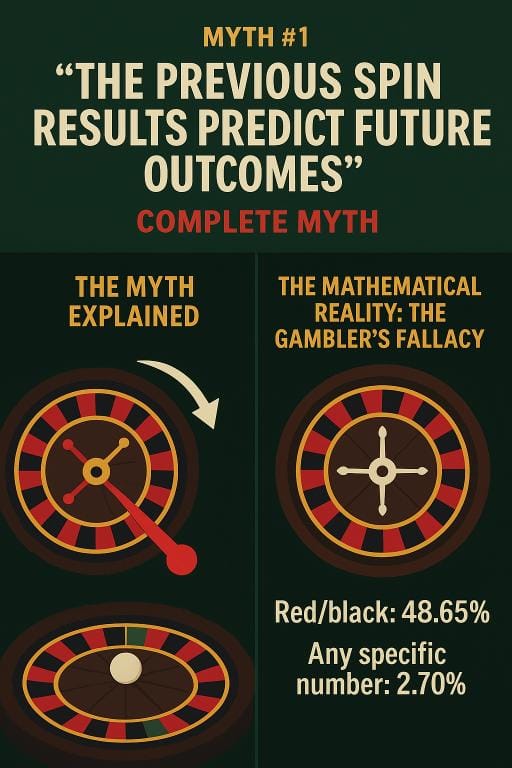

This foundational roulette myth drives countless poor decisions at casinos worldwide.
The Myth Explained
Players observe patterns in previous spins and believe these patterns determine future results. If black has appeared five times consecutively, they believe red is now “due.” If even numbers have appeared frequently, then bet odd numbers are overdue.
This belief underpins dozens of documented roulette systems: hot number systems, cold number systems, streak betting systems, and progression strategies based on previous results.
The Mathematical Reality: The Gambler’s Fallacy
This myth is rooted in the Gambler’s Fallacy—the false belief that past results affect future independent probabilities.
Historical Example: At the Monte Carlo Casino in 1913, the roulette wheel produced black 26 consecutive times. Players observed this pattern and assumed red was “due.” They bet massively on red’s next appearance. The wheel eventually produced red, but not for 26 more spins. Millions of dollars were lost during those intervening spins.
Mathematical Truth: Each roulette spin is completely independent. The outcome of spin 1, 2, or 100 has zero impact on spin 101. The wheel has no memory.
Probability remains identical:
- Red/black: 48.65% (European)
- Any specific number: 2.70%
These odds never change based on previous results.
Quick Takeaway: Previous spins are irrelevant. Every new spin offers identical odds to every other spin. Betting based on past results is mathematically equivalent to random bet selection.
Why This Myth Persists So Strongly
Human brains are hardwired to identify patterns. We see images in clouds, detect patterns in random data, and construct narratives explaining unrelated events. Casino displays showing “hot” and “cold” numbers feed this instinct deliberately.
Research shows approximately 76% of casual roulette players actively use previous results to inform betting decisions. This cognitive bias—not reality—drives the myth’s persistence.
Myth #2: “Hot Numbers Are More Likely to Hit” – COMPLETE MYTH
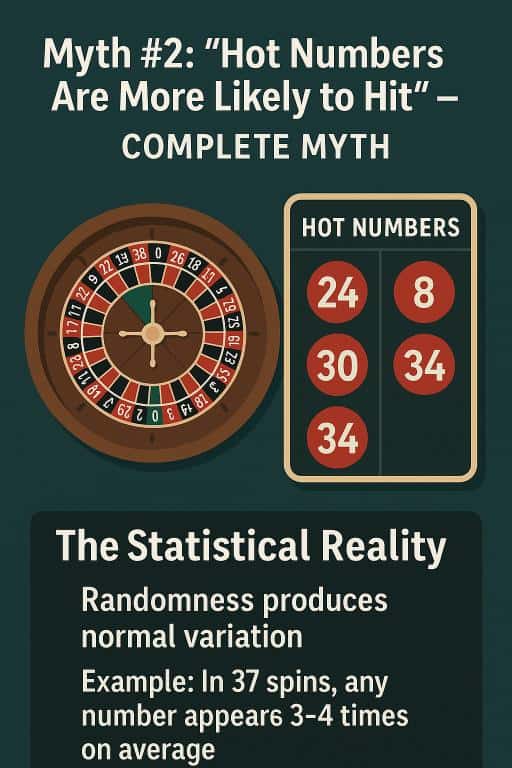
The hot numbers concept represents one of roulette’s most persistent and financially costly roulette myths.
How the Hot Numbers Myth Works
Online casinos display statistics: “In the last 100 spins, number 24 appeared 8 times while number 3 appeared only once.” Players interpret this as number 24 being “hot” and therefore more likely to appear in future spins.
Systems built on this myth recommend betting heavily on hot numbers, assuming their “hot streak” continues.
The Statistical Reality
In 37 spins of a perfect European roulette wheel, each number should appear exactly once. In reality, randomness produces variance:
37-Spin Example:
- Most frequent number: approximately 3-4 appearances
- Least frequent number: 0-1 appearance
- This variation is statistically normal, not indicative of any pattern
300-Spin Example:
- Most frequent number: approximately 14 appearances (instead of perfect 8.1)
- Least frequent number: approximately 3 appearances
This is randomness functioning exactly as expected.
The Critical Misunderstanding
A number being “hot” during spins 1-100 provides zero predictive information about spins 101-200. The number is equally likely to remain hot, go cold, or become lukewarm.
Mathematical proof: After observing any sample size, the probability for the next spin remains:
- Any specific number: 1 in 37 (2.70%)
- Red/Black: 18 in 37 (48.65%)
The observed frequency never changes the mathematical probability of future outcomes.
Real-World Impact
Research shows hot number betting systems lose money identically to random betting strategies. Players lose 2.70% of total wagered money (European roulette) whether chasing hot numbers, cold numbers, or betting completely randomly.
Expert Insight: Casino display of hot/cold statistics serves a specific purpose: encouraging players to make bets based on these statistics. The statistics themselves are completely irrelevant to future outcomes.
Myth #3: “Cold Numbers Are ‘Due’ to Appear” – COMPLETE MYTH
The cold numbers myth represents the inverse—and equally false—version of hot number betting.
The Cold Numbers Logic
If number 5 hasn’t appeared in 50 spins, players believe it’s “due”—that probability now favors its appearance to correct the deviation.
This reasoning ignores a fundamental mathematical truth: the wheel has no obligation to produce any particular distribution in short timeframes.
Mathematical Proof: Why “Due” Numbers Don’t Exist
Consider a 37-spin perfect sequence where each number appears exactly once. Now expand to 74 spins. Mathematical perfection demands each number appear exactly twice total.
But randomness doesn’t work this way. Some numbers will appear 3-4 times in the first 74 spins while others appear 1-2 times. The wheel is not “correcting” toward perfect distribution—it’s simply exhibiting normal random variance.
Over infinitely large sample sizes, numbers eventually equalize. But you’re not playing infinitely. In your finite session, a “cold” number remains equally likely as any other.
Expert Insight: Players confuse long-term statistical reality (all numbers eventually equalize over millions of spins) with short-term session reality (no compensation mechanism exists during your session).
Myth #4: “Lucky Numbers Actually Are Luckier” – PARTIALLY TRUE BUT IRRELEVANT
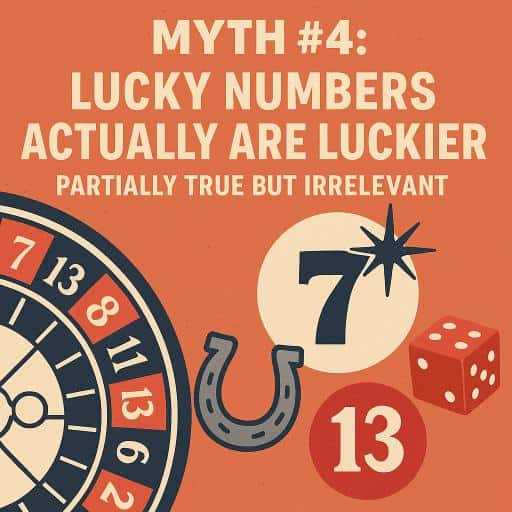
This roulette myth differs from others by containing a grain of truth wrapped in misleading context.
The Culturally “Lucky” Numbers Reality
Number 7 is culturally lucky in Western traditions. Number 8 carries luck in Asian cultures. Number 13 is unlucky throughout the West but lucky in Italy.
Here’s the truth: These numbers appear with identical frequency to all other numbers. Nothing makes them mathematically luckier.
Here’s the partial truth: If multiple players believe in the same lucky number, that number may attract more bets, potentially producing larger payouts due to reduced prize-pool sharing.
Example: The James Bond 17 Effect
Actor Sean Connery allegedly won betting number 17 three times in a row at Monte Carlo—a 1 in 50,653 probability. This win became legend.
Result: Players worldwide now frequently bet on 17, believing it’s “luckier.” It isn’t—it’s just more popular.
Quick Takeaway: Lucky numbers feel meaningful but possess zero mathematical advantage. Cultural superstitions are entertaining but strategically irrelevant.
Myth #5: “Previous Red Results Mean Black is Due” – COMPLETE MYTH
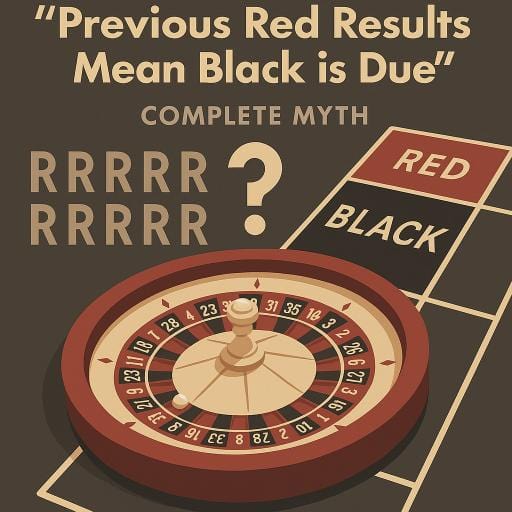
This specific variant of the Gambler’s Fallacy deserves individual attention due to its prevalence and cost.
The Streak Observation
Red appears four times consecutively. Players bet black on spin 5, certain red’s “streak” must end.
Or inversely: alternating results suggest the pattern will continue, so players chase streaks.
Both approaches fail identically.
Mathematical Reality: Independence
Each spin’s result is independent. Red appearing four times consecutively doesn’t influence spin 5’s probability:
- Probability black appears on spin 5: 48.65% (European)
- Probability red appears on spin 5: 48.65% (European)
- Probability zero: 2.70% (European)
The previous sequence is irrelevant.
| Sequence | Spin 5 Red Probability | Spin 5 Black Probability |
| RRRR | 48.65% | 48.65% |
| RRRB | 48.65% | 48.65% |
| RBRB | 48.65% | 48.65% |
| Random pattern | 48.65% | 48.65% |
The probability never changes.
Pro Tip: This myth costs players substantial money because streaks are psychologically compelling. Watching 4 consecutive reds creates powerful pattern-recognition instinct. Resist this instinct—the mathematical reality remains unchanged.
Myth #6: “Croupiers Can Control Where the Ball Lands” – COMPLETE MYTH (WITH RARE ASTERISK)
This roulette myth suggests dealers possess hidden skill enabling outcome prediction or control.
Why This Myth Exists
Experienced croupiers do develop consistency in their technique. Some spin the wheel consistently. Some release the ball consistently. Does this create predictability?
The Honest Answer: Theoretically minimal, practically nonexistent.
The Physics Reality
Modern roulette wheels spin at high speeds with significant momentum. The ball is released while spinning, creating multiple complex variables:
- Wheel rotation speed
- Wheel direction
- Ball release angle
- Ball release force
- Air resistance
- Friction
Predicting exact landing position requires calculating all variables simultaneously. Even professional physicists acknowledge the practical impossibility.
The Historical Reality: Ritz Casino 2004
A team used laser devices and computer predictions to estimate ball landing sectors (not exact numbers) at London’s Ritz Casino. Their success was limited and required illegal technology.
Key Points:
- Exact prediction proved impossible (confirming mathematical reality)
- Sector prediction required sophisticated technology
- Casinos subsequently implemented countermeasures (randomizing ball release, wheel rotation, etc.)
Modern casinos explicitly prevent this through randomization protocols.
The Simple Truth
Croupiers cannot and do not control outcomes. Even if they theoretically could, casino economics make cheating irrational—fair games generate vastly more long-term profit than rigged games.
Myth #7: “All Roulette Wheels Are Identical” – PARTIAL MYTH
This roulette myth contains important truth regarding wheel selection.
The Reality: Variant Differences Matter Significantly
European Wheels: 37 pockets (numbers 1-36 plus single zero), 2.70% house edge
American Wheels: 38 pockets (numbers 1-36 plus 0 and 00), 5.26% house edge
These aren’t minor variations. Wagering $1,000 total:
- European roulette: $27 expected loss
- American roulette: $52.60 expected loss
The 95% Difference: American roulette costs nearly double European roulette.
Wheel Quality Differences (Rare)
Historically, poorly maintained wheels developed bias—certain numbers appearing with unnatural frequency. Modern casinos:
- Regularly service wheels
- Replace worn components
- Audit wheels for bias
- Discard biased wheels
Finding a genuinely biased modern wheel is virtually impossible.
The Actionable Fact
This myth contains important truth: variant selection dramatically matters. Always choose European wheels over American wheels when available. This single decision reduces expected losses by approximately 50%.
Quick Takeaway: Don’t conflate minor wheel quality differences with major variant differences. The European/American distinction absolutely matters; wheel manufacturing differences don’t.
Myth #8: “Even-Money Bets Are Actually 50-50” – COMPLETE MYTH
This roulette myth hides in plain sight at casino tables.
The Misleading Presentation
Casinos highlight red/black, odd/even, and high/low as “even-money wagers.” The terminology implies 50% winning probability.
The Reality: Not even close.
The Mathematics
European Roulette:
- Red/black coverage: 18 numbers
- Total pockets: 37
- Actual probability: 18 ÷ 37 = 48.65% (not 50%)
The missing 1.35% represents:
- Zero pocket (neither red nor black)
- The source of house edge
American Roulette: Even worse
- Red/black coverage: 18 numbers
- Total pockets: 38 (includes 00)
- Actual probability: 18 ÷ 38 = 47.37% (not 50%)
Why This Matters
You receive 1:1 payouts (your original stake returned plus equal winnings) despite possessing less than 50% winning probability. This is the definition of negative expected value.
Betting $100 on red:
- 48.65% chance: Receive $100 (1:1 payout) plus recover $100 stake = $200 total
- 51.35% chance: Lose $100 entirely
Expected value: (0.4865 × $100) − (0.5135 × $100) = −$2.70
You lose $2.70 per $100 wagered—exactly the 2.70% house edge.
Pro Tip: Never trust “even-money” terminology. Calculate actual probability based on wheel configuration. European roulette even-money bets: 48.65% (not 50%). American: 47.37% (not 50%).
Myth #9: “Betting Systems Can Beat House Edge” – COMPLETE MYTH
This foundational roulette myth drives most other misconceptions.
The False Promise
Martingale, Fibonacci, D’Alembert, and dozens of other systems promise systematic profit through mathematical progression. Proponents claim systems “manage variance” into consistent wins.
Mathematical Impossibility
House edge depends exclusively on:
- Number of pockets (37 or 38)
- Payout ratios (35:1 instead of 36:1 for straight bets)
Betting progression cannot change either factor. Whether you bet $1 consistently, double after losses (Martingale), follow Fibonacci sequences, or any other pattern—house edge remains unchanged.
Research proof: Academic studies from University of Dortmund (2019), MIT (2015), and multiple casino data analyses confirm: no betting system reduces house edge.
Expected loss with any system on $1,000 wagered:
- European roulette: $27
- American roulette: $52.60
Systems may reduce volatility or extend session duration, but they never produce positive long-term expected value.
Why Systems Fail Predictably
Table Limits: Martingale requires doubling progressively. After 10 losses, bets reach $5,120. Casino table limits (typically $5,000-$25,000) prevent continuation. System fails catastrophically.
Insufficient Bankroll: Even $100,000 bankrolls cannot survive 15+ consecutive losses. Martingale requires $163,840 to continue after 15 losses. Most players lack adequate bankroll.
House Edge Persistence: Even with unlimited table limits and bankroll, you still lose 2.70% of total wagered money. Systems don’t overcome this mathematical certainty.
Expert Insight: Systems are bankroll management tools, never profit generators. Professional players use systems for psychological structure and variance reduction, never expecting positive expected value.
Myth #10: “Roulette Wheels Are Rigged (Especially Online)” – MOSTLY FALSE, BUT VERIFY LEGITIMACY
This roulette myth contains important nuance.
Land-Based Casinos: Rigging Reduces Profit
Rigging wheels severely damages casinos’ long-term business. Fair games generate vastly more profit than rigged games. Casinos make money through house edge persistence—rigging is economically irrational.
Occasionally, old wheels develop unintentional bias (wear, poor maintenance). Casinos immediately remove these wheels.
Online Roulette: RNG Audits Verify Fairness
Legitimate online casinos use certified random number generators. Third-party auditors (eCOGRA, GLI, iTech Labs) regularly test RNGs for randomness and fairness.
How to Verify:
- Check casino’s operator licenses
- Verify third-party RNG audits
- Review player complaint histories
- Only play at established casinos
Legitimate casinos don’t rig games. Illegal casinos do—but legitimate platforms protect player interests.
Pro Tip: Before depositing, verify casino licensing, audit certifications, and reputation. Regulated casinos maintain RNG integrity; unregulated ones don’t.
Myth #11: “Superstitious Rituals Influence Outcomes” – COMPLETE MYTH
This roulette myth proliferates through player superstitions worldwide.
Common Superstitious Rituals
- Blowing on dice before betting
- Avoiding the number 13
- Betting on birthdays and anniversaries
- Touching lucky charms
- Betting only on “lucky” days
The Mathematical Reality
None of these rituals possess any physical mechanism to influence outcomes. The roulette wheel spins regardless of superstitious behavior. Ball trajectory is determined by physics, not psychology.
Psychological Value (Limited)
Superstitions provide:
- Perceived control in an uncontrollable game
- Comfort through routine
- Community through shared beliefs
These psychological benefits don’t translate to improved odds or increased profits—they’re purely emotional phenomena.
Quick Takeaway: Superstitions are harmless entertainment provided they don’t lead to irrational betting decisions. Avoid letting superstition increase stakes or override bankroll discipline.
Myth #12: “You Can Predict Roulette Ball Landing Spots” – COMPLETE MYTH (WITH RARE HISTORICAL EXCEPTIONS)
This roulette myth claims mathematical analysis enables prediction.
The Theoretical Possibility
Roulette involves physics: wheel spin, ball release, friction, air resistance, gravity. Theoretically, someone calculating all variables simultaneously might predict landing zones.
The Practical Impossibility
Variables require measurement in real-time:
- Wheel rotation speed and direction
- Ball release angle and force
- Air density
- Micro-vibrations
- Friction coefficients
Even slight measurement errors compound dramatically, rendering predictions useless.
Historical Exceptions: Extremely Rare
1970s Wheel Bias: Mathematician Richard Jarecki exploited unintentionally biased wheels on the French Riviera. Success required specific conditions (old wheels with visible bias) that no longer exist.
2004 Ritz Casino: A team used illegal laser devices to measure ball and wheel movement, enabling sector prediction (not exact number prediction). Casinos implemented countermeasures immediately.
Modern Reality
Contemporary casinos prevent prediction through:
- Regular wheel maintenance and replacement
- Random wheel orientation between spins
- Randomized ball release procedures
- Unpredictable dealer techniques
Prediction is mathematically impossible in modern casinos.
What Actually Matters: The Facts That Do Impact Roulette
Amid the myths lies a short list of genuine factors:
Factor #1: Variant Selection (European > American)
European roulette (2.70%) beats American roulette (5.26%) substantially. This decision alone reduces expected losses by 50%.
Factor #2: Table Limits Don’t Matter (Much)
Choose tables matching your bankroll and desired progression (if using systems). Limits prevent Martingale abuse but don’t affect expected value.
Factor #3: Bankroll Management Matters Enormously
Proper bankroll sizing (unit size 1-2% of total bankroll, session bankroll 5-10%) extends gameplay duration and reduces catastrophic loss risk.
Factor #4: House Edge Is Unchangeable
Accept 2.70% (European) or 5.26% (American) house edge as mathematical reality. No system, superstition, or strategy modifies this.
Factor #5: Session Discipline Separates Winners From Losers
Strict stop-loss limits (exit at 50% session loss) and profit targets (exit at 100% session profit) prevent emotional escalation.
Conclusion: Myth vs Fact Summary
| Claim | Reality | Impact |
| Previous results predict future | Gambler’s Fallacy; each spin independent | Lose money chasing patterns |
| Hot numbers more likely to hit | Normal variance, not predictable | Lose money chasing false patterns |
| Cold numbers “due” to appear | No correction mechanism exists | Lose money betting on “overdue” numbers |
| Lucky numbers actually lucky | Culturally meaningful, mathematically identical | Psychological comfort only |
| Red/black are 50-50 bets | Actually 48.65% (European), 47.37% (American) | Lose 2.70% expected value |
| Systems beat house edge | Mathematically proven impossible | Lose same 2.70% regardless of system |
| Roulette wheels are rigged | Regulated casinos maintain integrity | Safe to play at legitimate casinos |
| Superstitions influence outcomes | No physical mechanism exists | Psychological comfort only |
| Ball landing can be predicted | Modern casinos prevent prediction | Prediction impossible today |
The most profitable approach combines acknowledgment of unchangeable house edge with intelligent bankroll management and disciplined session structure. Accept roulette as entertainment requiring expected loss, not an income opportunity. Within this realistic framework, enjoy the game while minimizing financial risk.