
Introduction: Two Critical Metrics Shaping Your Slot Experience
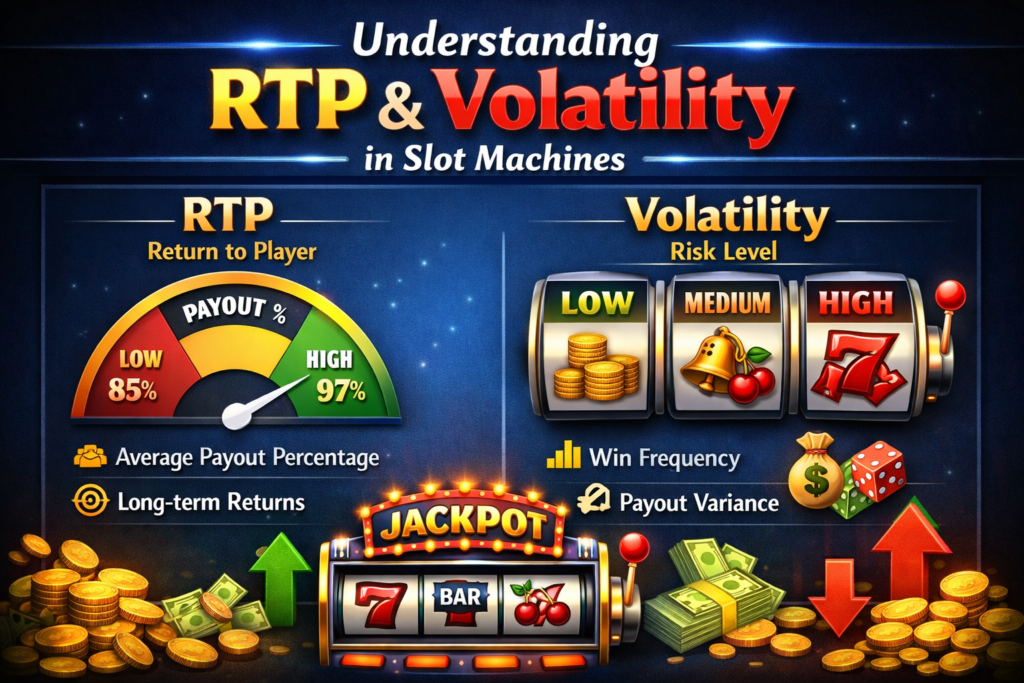
Slot machine RTP (Return to Player) and volatility represent two completely different concepts that most players confuse or misunderstand. While RTP determines long-term payout percentages, volatility defines how those payouts distribute across individual sessions. Understanding both metrics transforms your slot experience from confused guessing to informed strategy.
Research shows approximately 64% of casual slot players cannot distinguish between RTP and volatility, treating them as interchangeable concepts despite their fundamental differences. This confusion leads to poor machine selection, unrealistic outcome expectations, and bankroll depletion through inappropriate strategy.
Slot machine RTP ranges 85-98% depending on machine type and location. Volatility ranges from low (frequent small wins) through medium to high (infrequent large wins). These metrics are completely independent—a machine can have excellent RTP with terrible volatility, or mediocre RTP with comfortable volatility.
This comprehensive guide deconstructs both RTP and volatility completely: explaining mathematical foundations, calculating real-world impact on your bankroll, distinguishing between the two concepts, providing practical machine selection frameworks, and addressing common misconceptions. You’ll master both metrics, enabling intelligent slot selection aligned with your bankroll and risk tolerance.
Quick Takeaway: RTP is average long-term payout percentage (96% RTP = $96 return per $100 wagered over millions of spins). Volatility is win distribution pattern (high = rare large wins, low = frequent small wins). Both matter, but they operate independently—don’t confuse them.
What Is RTP? Understanding Return to Player
The Mathematical Definition
Return to Player (RTP) is the percentage of total wagered money machines are programmed to return to players over extended play. A machine with 96% RTP returns $96 of every $100 wagered to players across millions of spins, with the casino keeping $4.
Mathematical formula:
RTP = (Total Amount Won by Players ÷ Total Amount Wagered) × 100
Real-world example: A machine programmed for 96% RTP played for $1,000,000 total wagers:
- Total wagered: $1,000,000
- Expected return to players: $960,000
- Casino retention: $40,000
- Verified RTP: $960,000 ÷ $1,000,000 = 96%
RTP Ranges and What They Mean
Typical RTP ranges by machine type:
- Penny slots: 85-92% RTP (highest house edge)
- Standard slots: 92-96% RTP (moderate house edge)
- Premium slots: 96-98% RTP (lowest house edge)
- Video poker: 95-99.5% RTP (depends on strategy)
Inverse relationship to house edge:
- 96% RTP = 4% house edge (casino keeps $4 per $100)
- 92% RTP = 8% house edge (casino keeps $8 per $100)
- 98% RTP = 2% house edge (casino keeps $2 per $100)
Why RTP Matters for Your Bankroll
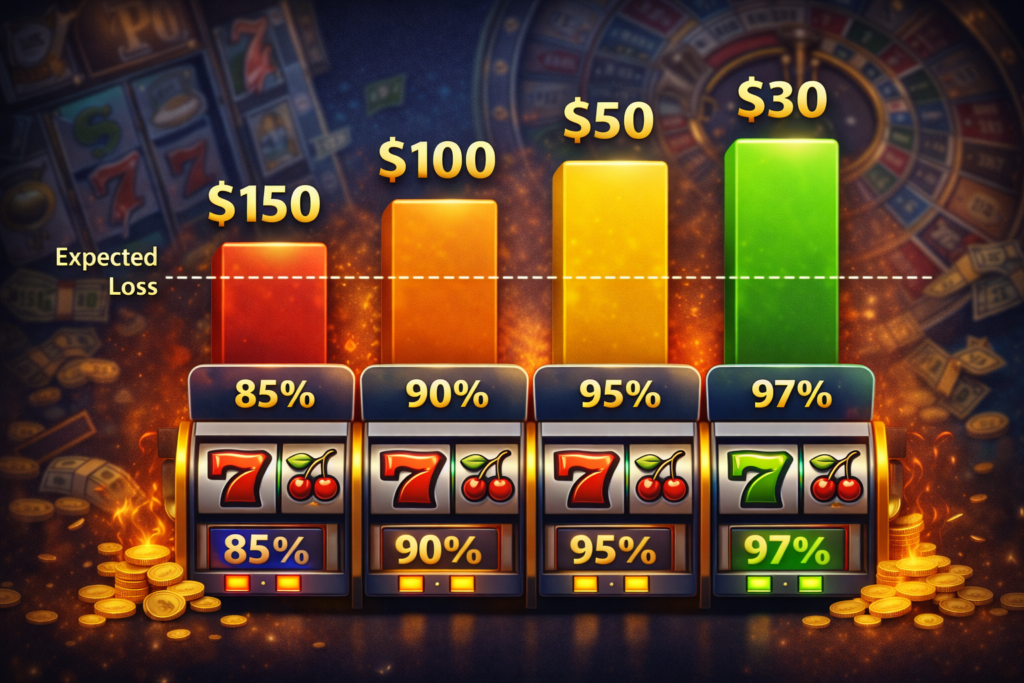
Real-world impact over $1,000 wagered:
| RTP | House Edge | Expected Loss |
| 85% | 15% | $150 |
| 90% | 10% | $100 |
| 96% | 4% | $40 |
| 98% | 2% | $20 |
Annual impact (50 × $1,000 sessions):
- 85% RTP: $7,500 expected annual loss
- 96% RTP: $2,000 expected annual loss
- Difference: $5,500 annual savings through machine selection
Professional insight: In my experience, most players underestimate RTP’s long-term impact. Single session variance dominates short-term results, but machine selection becomes increasingly important across multiple sessions.
Critical RTP Limitations
Pro Tip: RTP is calculated over millions of spins. Your individual sessions will experience enormous variance regardless of RTP. A 96% RTP machine can produce either massive losses or jackpots in short play—RTP only predicts average long-term direction, not individual session outcomes.
What Is Volatility? Understanding Win Distribution
The Volatility Concept
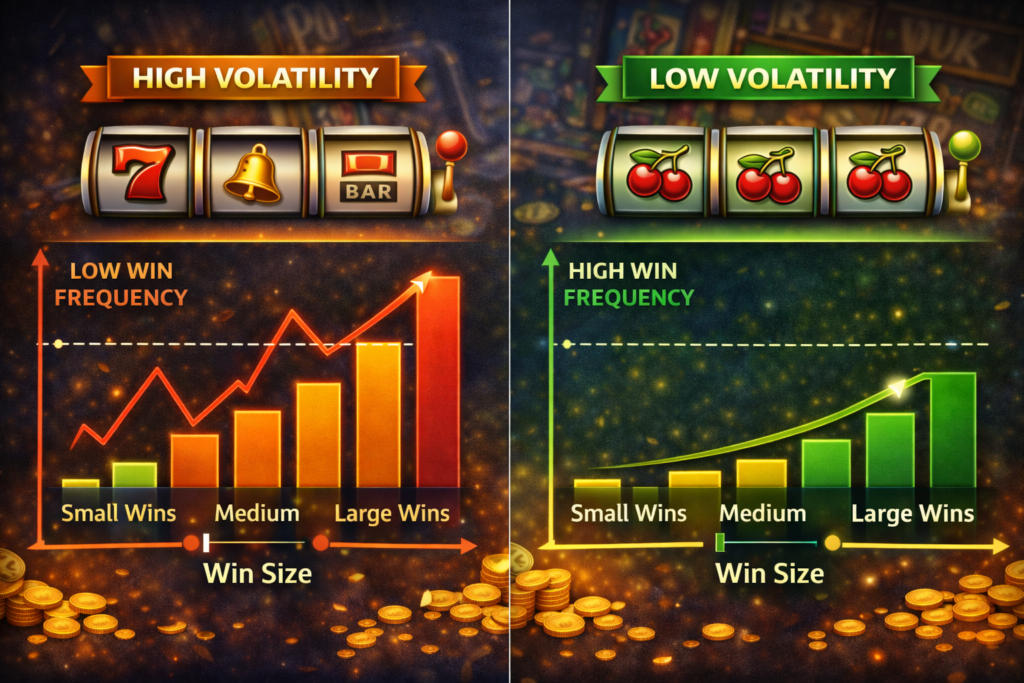
Volatility (also called variance) describes how wins distribute across gameplay. High volatility means infrequent but large wins; low volatility means frequent but small wins. Importantly, volatility is independent of RTP—two machines with identical 96% RTP can have completely different volatility profiles.
Volatility determines:
- How often you experience wins
- Win sizes when they occur
- Losing streaks between winning events
- Emotional experience during play
The Three Volatility Categories
Low Volatility Slots:
- Win frequency: Very frequent (multiple wins per session typical)
- Average win size: Small ($1-$10 typical)
- Losing streak length: Brief (few spins)
- Bankroll duration: Extended (50+ spins with moderate bankroll)
- Player type: Risk-averse, conservative players
Medium Volatility Slots:
- Win frequency: Moderate (wins several times per session)
- Average win size: Moderate ($10-$50 typical)
- Losing streak length: Medium (10-20 spins typical)
- Bankroll duration: Balanced (30-40 spins sustainable)
- Player type: Balanced players seeking stability with occasional excitement
High Volatility Slots:
- Win frequency: Infrequent (few or no wins per session typical)
- Average win size: Large ($50-$500+ typical)
- Losing streak length: Extended (30+ spins common)
- Bankroll duration: Short (10-15 spins before depletion likely)
- Player type: Aggressive players with large bankrolls chasing jackpots
Real-World Volatility Impact
Scenario: $200 bankroll, 96% RTP, different volatility types
Low volatility machine:
- Typical session: Win $5, lose $3, win $8, lose $2, win $4…
- Likely outcome: Moderate loss around $8 expected
- Session duration: 45-60 minutes average
- Emotional arc: Steady, predictable, frequent engagement
High volatility machine:
- Typical session: Lose $50, lose $40, lose $50, win $300 (or: Lose $150 with no significant wins)
- Likely outcome: Either $100+ gain or total bankroll loss
- Session duration: 15-25 minutes average
- Emotional arc: Frustration followed by excitement, or complete disappointment
Same RTP (96%), dramatically different experiences.
RTP vs. Volatility: Understanding the Distinction
How They Differ Fundamentally
RTP = Total return percentage over millions of spins (what you average long-term)
Volatility = How returns distribute (what you experience per session)
Analogy: Imagine two investment portfolios both returning 8% annually. Portfolio A returns 0.67% monthly consistently; Portfolio B returns -5% most months, occasionally +35%. Both average 8% yearly, but feel completely different. That’s RTP vs. volatility.
Why Confusing Them Is Costly
Common mistake: Assuming high RTP guarantees good short-term results.
Reality: A 98% RTP high-volatility slot can produce 20-spin total losses despite excellent long-term odds. Conversely, a 92% RTP low-volatility slot provides steady entertainment value despite inferior average returns.
Professional insight: Industry experts agree that both metrics matter independently. Players prioritizing entertainment value might prefer moderate-RTP low-volatility machines over high-RTP high-volatility machines.
Interaction Between RTP and Volatility
Understanding the interaction:
The combination determines overall player experience. A 96% RTP slot with low volatility provides excellent value with comfortable gameplay. A 96% RTP slot with high volatility provides equal long-term value with stressful short-term experience.
Matrix showing combinations:
| Low Volatility | Medium Volatility | High Volatility | |
| High RTP (96%+) | Ideal (value + comfort) | Excellent | Good (value, stress) |
| Medium RTP (92-95%) | Good | Acceptable | Poor |
| Low RTP (85-91%) | Acceptable | Poor | Avoid |
Machine Selection: Practical Framework

Step 1: Identify Target RTP
Selection criteria: Always choose the highest available RTP possible.
Practical approach:
- Online casinos typically display RTP publicly
- Land-based casinos may require asking staff or checking posted information
- Target minimum 95% RTP; 96%+ is excellent
Expected impact: 95% RTP vs. 92% RTP saves $30 per $1,000 wagered—significant over time.
Step 2: Assess Your Volatility Comfort
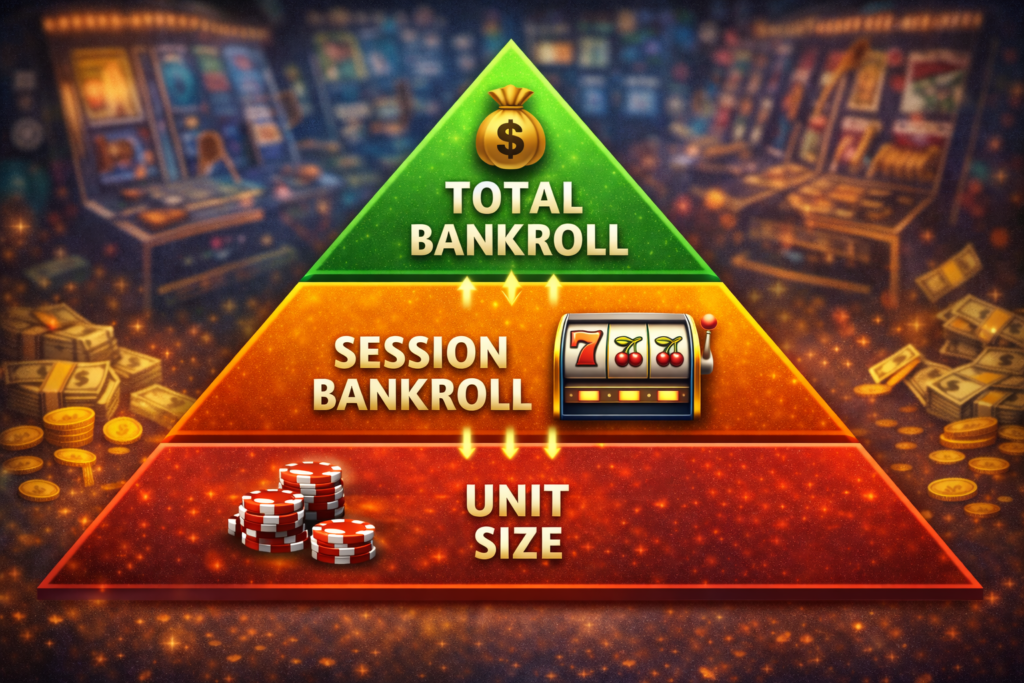
Bankroll assessment: Match volatility to your total bankroll capacity.
Framework:
- Bankroll <$300: Low volatility strongly preferred
- Bankroll $300-1,000: Low-medium volatility comfortable
- Bankroll >$1,000: Medium-high volatility manageable
Stress tolerance: High volatility requires emotional resilience for extended losing streaks. Select accordingly.
Step 3: Prioritize Entertainment Value
Final selection criterion: Does this machine interest you?
Why it matters: You’ll play longer when engaged, allowing variance to normalize toward mathematical expectations. Boredom causes early exits before RTP/volatility dynamics fully manifest.
Common RTP and Volatility Mistakes
Mistake #1: Ignoring RTP Differences
Error: Assuming all slots have identical RTP.
Reality: 85% vs. 98% RTP represents 15% difference—enormous over extended play.
Prevention: Always ask about or research RTP before extended play.
Mistake #2: Expecting RTP Results Short-Term
Error: Believing 96% RTP guarantees near-break-even results in sessions.
Reality: RTP requires millions of spins to manifest. Individual sessions are governed by variance.
Prevention: Accept session results as random variance independent of theoretical RTP.
Mistake #3: Choosing High RTP Without Volatility Consideration
Error: Selecting 98% RTP high-volatility slot without bankroll for extended losing streaks.
Reality: You’re bankrupt before RTP manifests, making RTP irrelevant.
Prevention: Match volatility to bankroll before prioritizing RTP.
Mistake #4: Confusing Volatility With RNG Independence
Error: Believing high volatility means machines are “rigged” or “hot/cold.”
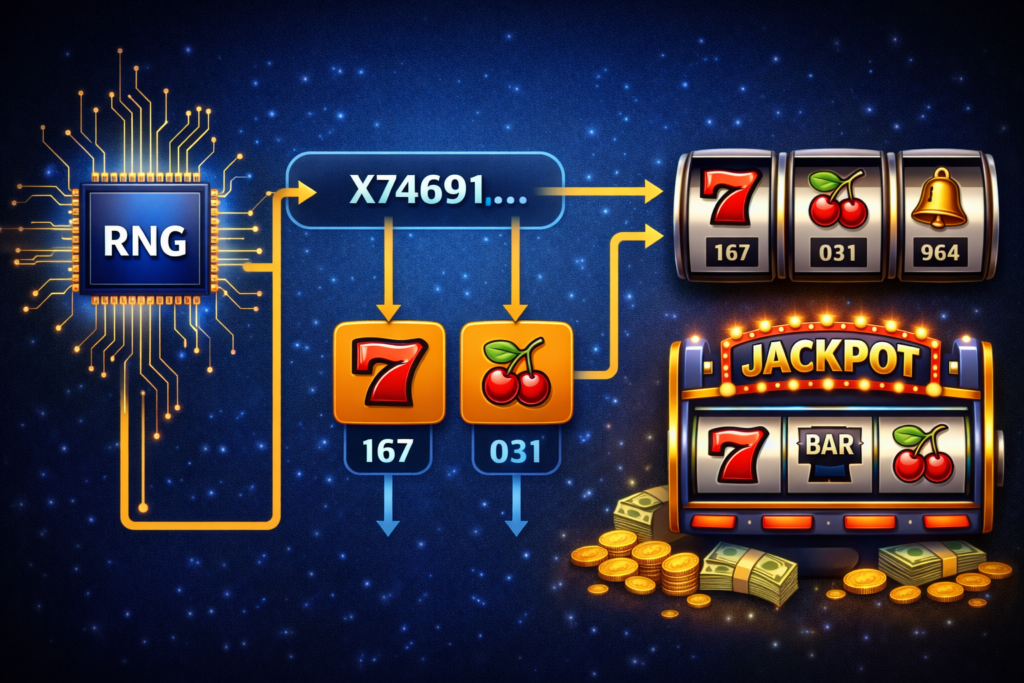
Reality: Volatility is programmed distribution pattern using independent RNG each spin.
Prevention: Understand volatility as intentional design, not deception.
Conclusion: Making Informed RTP and Volatility Decisions
Understanding both RTP and volatility independently enables intelligent slot selection. RTP determines long-term payout percentages; volatility determines short-term experience.
Actionable principles:
- Prioritize RTP above 95% for superior long-term value
- Match volatility to your bankroll for sustainable play
- Don’t confuse concepts—high RTP doesn’t guarantee short-term results
- Accept variance reality—individual sessions deviate from mathematical expectations
- Combine metrics for selection: Highest feasible RTP + comfortable volatility + engaging gameplay
With these frameworks applied, you’ll select machines optimized for your specific bankroll, risk tolerance, and entertainment goals. Neither metric beats house edge long-term, but proper understanding enables maximum value extraction within realistic constraints.