

Understanding Betting Structure in Texas Hold’em
Texas Hold’em betting rounds form the backbone of gameplay strategy. Understanding how each betting round functions—from initial preflop action through the final river decision—separates competent players from confused beginners. Each round of betting presents unique strategic opportunities, information asymmetries, and decision points requiring different approaches.
A stronger way to use this material is to compare each decision with the pot size, position, opponent type, and previous action. Those details are observable at the table and give the advice a practical basis without relying on unsupported survey claims.
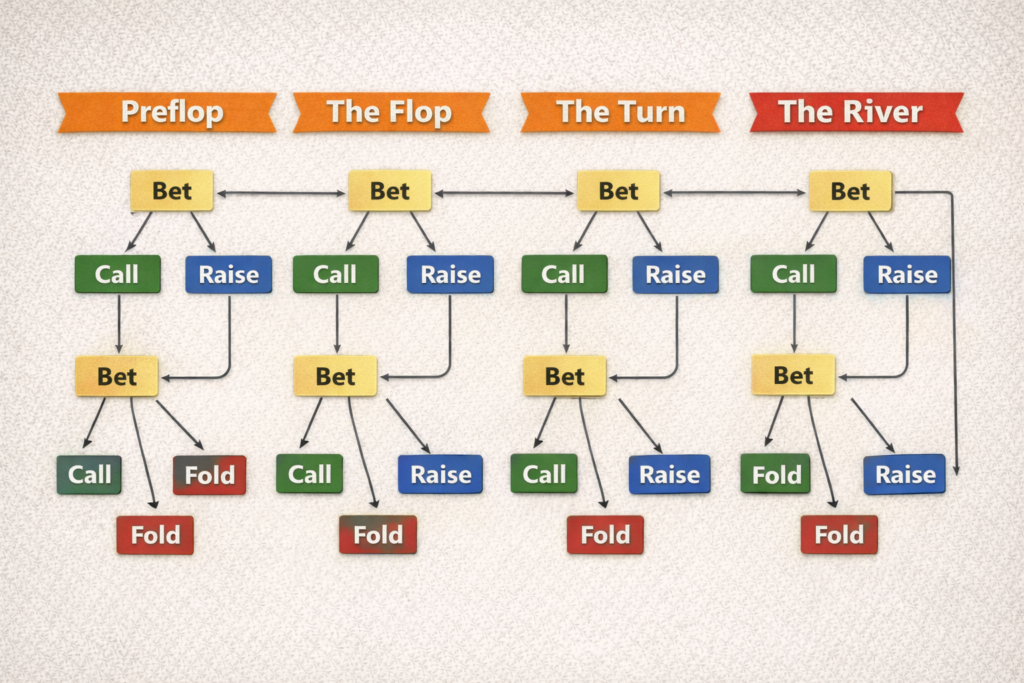
The beauty of Texas Hold’em lies in its four distinct betting rounds, each revealing progressively more community cards and requiring dynamic strategy adjustment. The preflop operates with limited information; the flop introduces three cards dramatically shifting hand strength; the turn adds crucial decisions with six visible cards; the river presents final decisions with complete information.
This guide breaks down all four Texas Hold’em betting rounds : explaining action sequence, blind structures, available actions, strategic considerations, information progression, and practical decision frameworks. You’ll understand exactly how each round functions and how to approach each strategically within the broader hand context.
Quick Takeaway: Texas Hold’em betting rounds progress sequentially: (1) Preflop—blinds posted, hole cards dealt, first action begins left of big blind, (2) Flop—three community cards revealed, action begins left of dealer button, (3) Turn—fourth community card revealed, action continues from dealer button position, (4) River—fifth community card revealed, final betting round, followed by showdown. Each round offers check/call/raise/fold options (check only if no bet has occurred).
Understanding Blinds: The Foundation of Hold’em Betting Structure
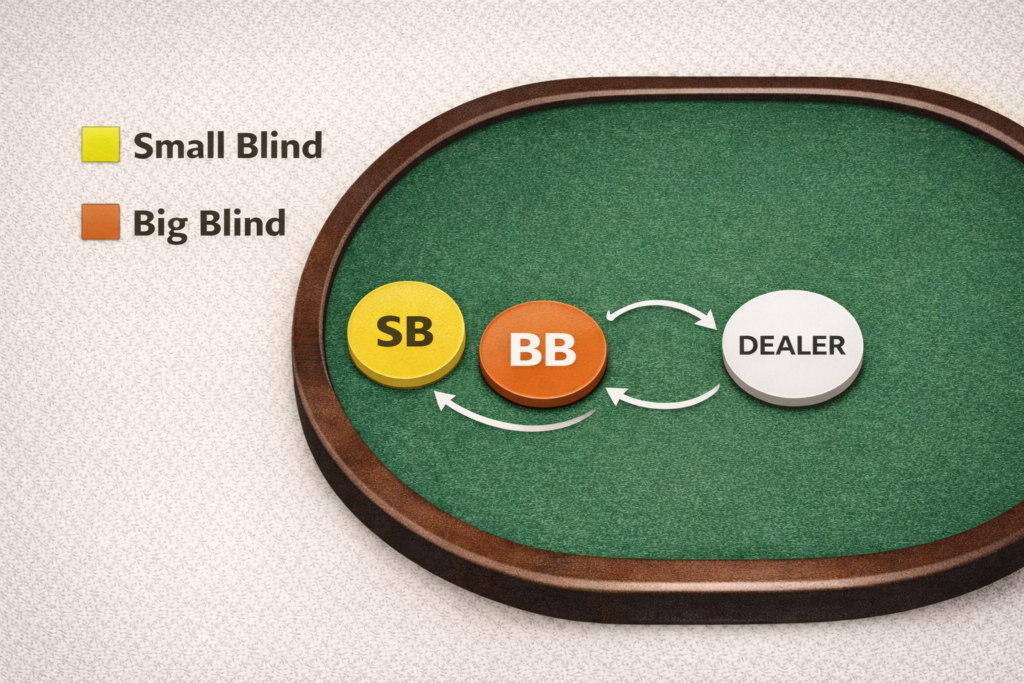
What Are Blinds?
Blinds are forced bets posted before cards are dealt, creating initial pot incentive and action initiation. Without blinds, players could fold every weak hand indefinitely, requiring antes to force participation. Blinds solve this by forcing specific positions to contribute before cards are known.
Structure:
- Small blind: Posted by player left of dealer button, typically half big blind
- Big blind: Posted by player left of small blind, typically the minimum bet amount
- Example: $1/$2 game = $1 small blind, $2 big blind
Why Blinds Matter
Blinds create several strategic implications: positions relative to blinds determine action order; blind sizes determine bet sizes in limit games; blind progression controls tournament pacing. Understanding blind structure is essential for position-aware strategy.
Heads-up exception: When only two players remain, button posts small blind and acts first preflop (but acts last postflop).
The Preflop Betting Round: First Action
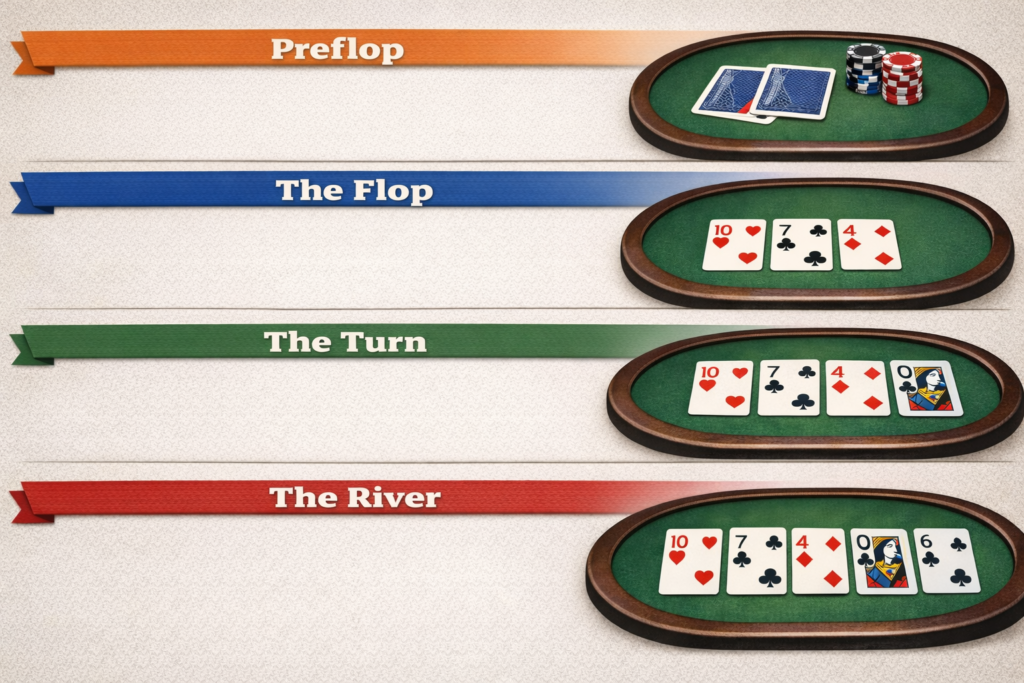
Preflop Position and Action Order
Action begins with the player left of big blind (called “under the gun” or UTG). This player acts first with only hole cards visible, maximum information disadvantage, and blind values as only known amounts.
Action proceeds clockwise around the table, with each player making three possible decisions:
Option #1: Call – Match the current bet (typically big blind if no previous raises)
Option #2: Raise – Increase the bet (minimum raise = previous bet amount doubled)
Option #3: Fold – Surrender cards and withdraw from hand
Preflop Strategy Considerations
Position advantage: Early position (close to blinds) acts with information disadvantage—you don’t know later players’ intentions. Late position (close to button) acts with information advantage—you see earlier players’ decisions before committing.
Hand selection: Strong hands (premium pairs, high cards) warrant early position commitment. Weaker hands require late position and favorable odds before commitment. Blind positions have forced participation regardless of hand quality.
Raising dynamics: Preflop raises narrow hand ranges. Strong players distinguish between early position raises (premium hands only) and late position raises (wider range). Three-bet scenarios occur when earlier raise meets re-raise.
Pro Tip: In practical play, the useful signal is the pattern you can observe repeatedly. The same hand holding huge profit in late position creates difficult situations in early position. Learn positional awareness before attempting advanced preflop strategy.
The Flop Betting Round: Three Community Cards
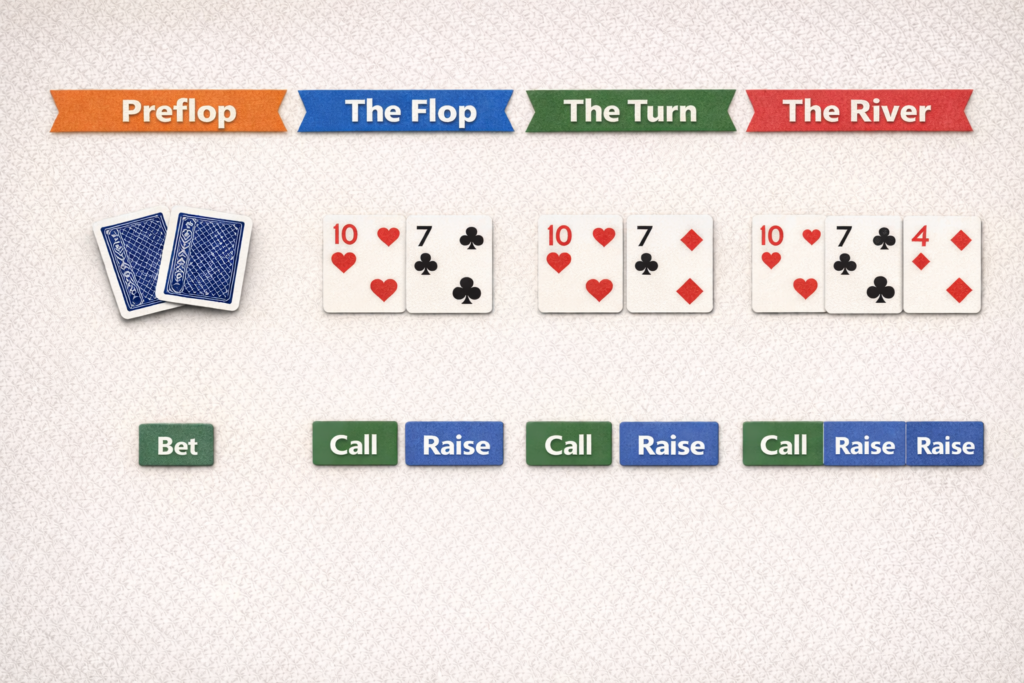
Strategic Transition at the Flop
The flop represents a massive information shift. Three community cards transform situations completely—hands improve dramatically or disappoint entirely. A preflop raise that appeared strong might face overwhelming flop aggression; conversely, weak hole cards might connect perfectly.
Action now begins with the first active player left of dealer button (not under the gun anymore). Action order shifts after flop due to positional advantages changing with known community cards.
Flop Betting Dynamics
Available actions expand to include checking—the new action where you pass without betting. Check is only available when no bet has occurred in the round.
Typical sequences:
- Bet → Call → Call (aggressive opener, cautious callers)
- Check → Check → Check (everyone playing cautiously, showing weakness)
- Bet → Raise → Fold (aggressive poker, weaker hand exits)
- Check → Bet → Call (position aggression after cautious play)
Hand Strength Reassessment
After the flop appears, players dramatically reassess hand strength. A premium preflop pair might face a three-flush board, becoming vulnerable. A speculative hand might catch two-pair or a draw, gaining strength.
Professional approach: Evaluate flop texture (all one suit, many high cards, connected cards) and how your hand relates to likely preflop raising ranges. Premium pairs often bet for value and protection; draws often check or call drawing to improvement.
The Turn Betting Round: Fourth Community Card
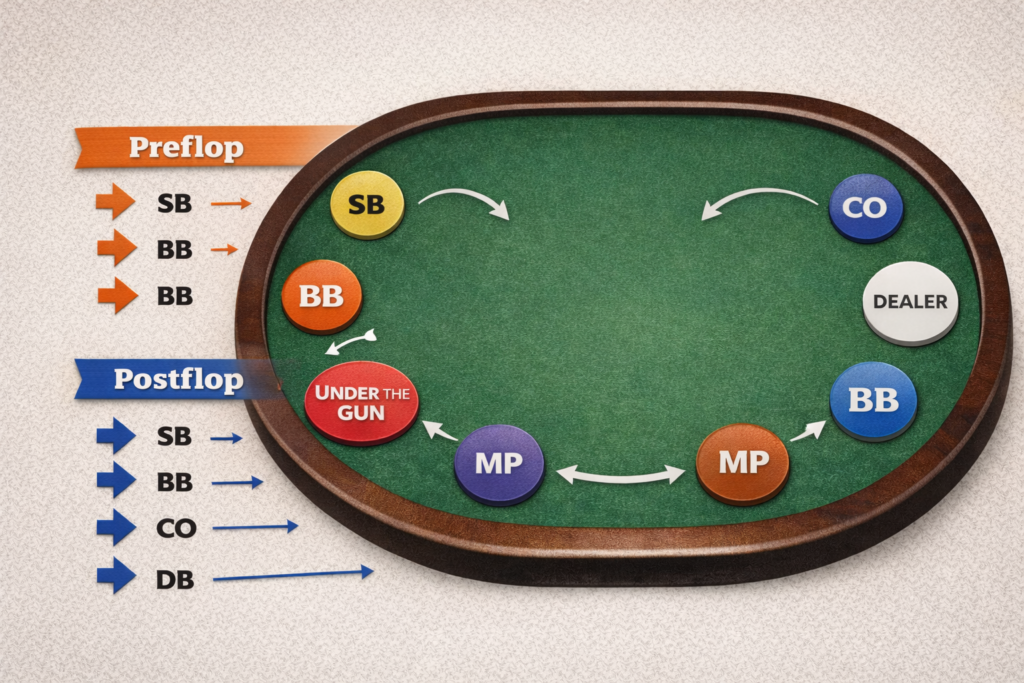
Increased Information and Stakes
The turn adds the fourth community card. By now, five of seven cards are known—players have clearer hand clarity. Draws have either completed or missed; hands are increasingly defined.
Action order remains consistent—starts with first active player left of dealer button.
Bet Sizing Changes
In limit games, bet sizes typically double on the turn. A $2 big blind produces $2 preflop bets and flop bets, but $4 turn bets. This structural increase dramatically changes pot odds and implied odds calculations.
No-limit games feature variable bet sizing, but turn aggression typically increases as stronger hands emerge and weaker hands fold.
Turn Strategic Dynamics
Information advantage: Turn represents the last card before final river card. Opponents’ ranges narrow as information accumulates—their decisions reveal hand types more clearly.
Drawing considerations: Hands with one card to complete (flush draws with four-flush, straight draws with four-straight) now clearly see their completion odds for the river.
Value comparison: Your hand’s strength relative to likely opponent holdings determines turn strategy. Value-bet strong hands; check marginal hands; bet draws that benefit from fold equity.
The River Betting Round: Final Community Card
Complete Information and Final Decisions
The river presents the final community card—all seven cards are now known (your two hole cards plus five community cards). This represents the last action point before showdown.
Action sequence follows identical pattern to turn—starts with first active player left of dealer button.
River Finality
No more cards will appear. Hands are now completely defined. Draws have either completed or failed irreversibly. The river represents final opportunity to extract value, protect against bluffs, or maximize remaining chips.
Typical river scenarios:
- Strong hand: Bet for value expecting calls from marginal hands
- Bluff candidate: Bet hoping to fold stronger hands that will check behind
- Marginal hand: Check-call expecting stronger hands to bet
- Weak hand: Check-fold if opponent bets, minimizing losses
River Showdown
If action completes with multiple remaining players, showdown occurs. All remaining players reveal hole cards; best five-card combination wins the pot according to poker hand rankings.
Betting Actions Across All Rounds: Complete Options
Check: Pass Without Betting
Definition: Decline betting while remaining in hand, passing action to next player.
Availability: Only available when no one has bet in current round.
Strategic uses:
- Weakness display (hoping opponent checks, ending round inexpensively)
- Slowplay (checking strong hand to encourage aggression)
- Pot control (checking marginal hand to avoid committing more chips)
- Trap (checking intending to check-raise if opponent bets)
Call: Match Current Bet
Definition: Contribute enough chips to match most recent bet or raise, staying in hand.
Usage: After someone bets or raises, calling is the option to remain without increasing bet size.
Strategic considerations:
- Pot odds (current pot size justifies implied odds of calling)
- Hand strength (marginal hands warrant calling over raising)
- Implied odds (future streets might improve hand enough to win larger pot)
Raise: Increase the Bet
Definition: Increase the current bet beyond minimum call amount, forcing opponents to call new amount or fold.
Minimum raise: At least equal to previous bet amount. $10 bet → $20 minimum raise.
Strategic purposes:
- Value extraction (strong hands getting maximum chips)
- Pressure application (forcing weak hands to fold)
- Information gathering (seeing how opponents respond to aggression)
- Bluffing (betting weak hand hoping to fold stronger holdings)
Fold: Surrender Hand
Definition: Throw away hole cards, surrendering all chances to win current pot and all chips previously contributed.
When to fold:
- Hand is unlikely to win (high probability opponent is stronger)
- Risk-reward is unfavorable (investment required exceeds winning probability)
- Better hands are available in future pots (long-term perspective)
Conclusion: Mastering Each Betting Round
Understanding Texas Hold’em betting rounds enables strategic progression through hands, adjusting strategy as information accumulates and community cards are revealed.
Strategic framework:
- Preflop: Play position-aware with hand strength appropriate to position; be aggressive from late position, tight from early position
- Flop: Reassess hand strength against flop texture and likely preflop ranges; value bet strong hands, fold weak ones, pursue draws with favorable odds
- Turn: React to fourth card with doubled bet sizing (limit) or escalated aggression (no-limit); finalize decisions about hand viability
- River: Make final decisions with complete information; extract maximum value from strong hands or minimize losses with weak hands
With these frameworks internalized, you’ll approach each betting round strategically, adjusting to information progression and making mathematically sound decisions throughout the hand.
Practical Checklist Before You Play
- Start with position, stack depth, and pot size before reading any single tell or betting action.
- Compare each decision with the opponent’s previous hands instead of assuming one universal pattern.
- Review expensive hands after the session and write down the mistake that actually cost money.
- Keep the game social in home settings; a softer table is more valuable than winning one argument.