

The Allure and Reality of Roulette Betting Systems
Roulette betting systems promise what every gambler dreams of: a structured approach to predictable profits. The Martingale system seems foolproof in theory. The Fibonacci strategy sounds mathematically sophisticated. The D’Alembert system feels gentler and more sustainable.
Yet thousands of experienced players have lost substantial money implementing these systems. Why? Because understanding how roulette betting systems work differs fundamentally from understanding what they can actually achieve.

The critical distinction separates legitimate bankroll management tools from false “beating the house” systems. Professional players recognize this difference. Uninformed gamblers conflate the two, leading to systematic bankroll devastation.
This guide breaks down every major roulette betting system, revealing exactly how each works, why they appeal to players, what mathematics actually permits them to accomplish, and most importantly—what they absolutely cannot do. You’ll discover why the Martingale system fails despite its elegant logic, how the Fibonacci strategy reduces bankroll damage without beating house edge, and when D’Alembert provides genuine value versus when it creates false security.
Master these distinctions and you’ll play with dramatically improved decision-making, realistic expectations, and bankroll discipline—the actual foundations of sustainable roulette play.
The Fundamental Truth: Why No Roulette Betting System Can Beat House Edge
Before exploring specific systems, you must understand the mathematical ceiling limiting every possible system ever conceived.
The House Edge: An Unbeatable Mathematical Certainty
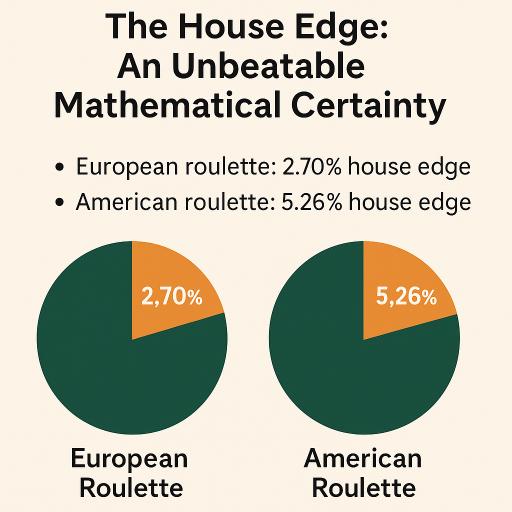
European roulette carries a 2.70% house edge. This means that across infinite spins, the casino captures 2.7% of all money wagered. Not 2.7% of your bankroll—2.7% of every dollar that changes hands.
Real-World Impact: Wagering $1,000 total across a session
- Expected loss: $27
- American roulette: $52.60 expected loss (5.26% edge)
This house edge exists independent of your betting system. Mathematicians have mathematically proven that no progressive betting system can reduce house edge. Not Martingale. Not Fibonacci. Not D’Alembert. Not any system conceived or yet to be invented.
Why Betting Systems Can’t Modify House Edge
The house edge depends on two factors alone:
- Number of outcomes: European wheel has 37 pockets; American has 38
- Payout ratios: Straight bets pay 35:1 instead of mathematically fair 36:1
Your betting pattern—doubling, Fibonacci sequences, unit increases—doesn’t change either factor. Whether you bet $1 or $100, the casino’s mathematical advantage remains identical.
Expert Insight: Roulette decisions should start with the wheel type, table rules, and house edge. European and French rules are usually more player-friendly than American double-zero roulette, while betting systems cannot change the underlying expectation.
This fundamental misconception drives most system adoption. The reality: systems manage bankroll and psychological factors, not mathematical probabilities.
The Gambler’s Fallacy: Believing Systems Exploit “Patterns”
Many players adopt systems believing roulette wheels produce exploitable patterns: hot numbers, cold numbers, sequences that “should” reverse.
Mathematical Reality: Each spin is completely independent. Previous results have zero predictive value. Red hitting five times consecutively doesn’t make black “due.” The wheel has no memory.
Systems based on this fallacy—like betting heavily on “overdue” numbers—face the same 2.70% house edge as any other approach.
Quick Takeaway: Systems manage psychology and bankroll, never probability. Understanding this distinction separates informed players from system addicts.
The Martingale System: History, Mechanics, and Fatal Flaws
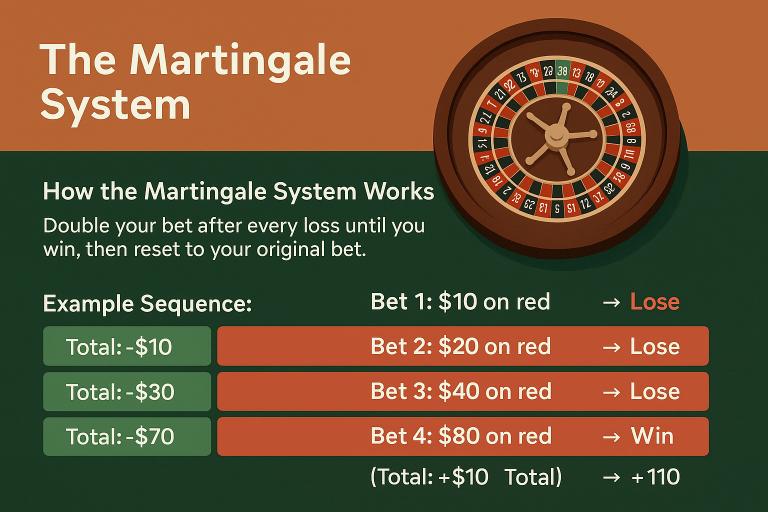
The Martingale system ranks among gambling’s most famous strategies. Its logic seems irrefutable, yet it destroys bankrolls with mathematical inevitability.
How the Martingale System Works
Core Principle: Double your bet after every loss until you win, then reset to your original bet.
Example Sequence:
- Bet 1: $10 on red → Lose (Total: -$10)
- Bet 2: $20 on red → Lose (Total: -$30)
- Bet 3: $40 on red → Lose (Total: -$70)
- Bet 4: $80 on red → Win (Receive $80, Total: +$10)
After losing three consecutive bets (losing $70 total), your fourth bet of $80 produces $80 profit, leaving you ahead exactly $10—equal to your original bet.
The Appeal: In theory, you recover all losses plus your initial stake with every eventual win.
Why the Martingale System Fails in Practice
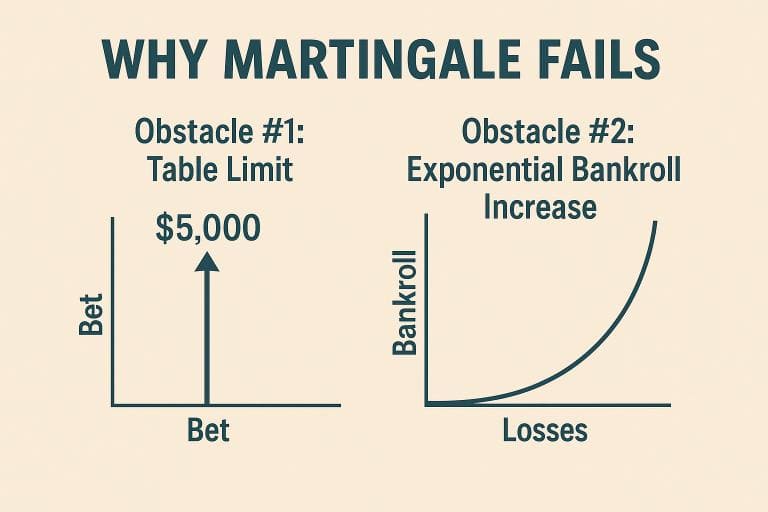
Despite elegant logic, the Martingale system confronts three insurmountable obstacles in real-world casino play.
Obstacle #1: Table Limits
Modern casinos impose maximum bet limits—typically $5,000-$25,000 on even-money bets. These limits exist specifically to prevent Martingale exploitation.
Example: You start with a $10 bet on European roulette
| Spin | Bet | Total Wagered | Result |
| 1 | $10 | $10 | Loss |
| 2 | $20 | $30 | Loss |
| 3 | $40 | $70 | Loss |
| 4 | $80 | $150 | Loss |
| 5 | $160 | $310 | Loss |
| 6 | $320 | $630 | Loss |
| 7 | $640 | $1,270 | Loss |
| 8 | $1,280 | $2,550 | Loss |
| 9 | $2,560 | $5,110 | Loss |
| 10 | $5,120 | EXCEEDS TABLE LIMIT | Cannot Place |
After just 9 losses—roughly a 0.4% probability, which happens regularly—you’ve exceeded the table maximum and cannot continue the system.
Obstacle #2: Insufficient Bankroll
Continuing the above sequence without table limits:
- After 10 losses, you’d need $5,120 for the next bet
- After 15 losses, you’d need $163,840
- After 20 losses, you’d need $5,242,880
Virtually no individual possesses the bankroll to survive 15+ consecutive losses. Even players with $100,000 bankrolls cannot sustain the exponential growth.
Obstacle #3: The Probability Still Doesn’t Improve
Even if table limits and bankroll somehow allowed unlimited doubling, the house edge remains untouched. You’re guaranteed to lose money on even-money bets at 2.70% house edge, regardless of your betting progression.
The Reverse Martingale (Paroli System): The “Safe” Alternative
Some players adopt reverse Martingale, doubling bets after wins (not losses).
How It Works:
- Bet $10, win → Next bet: $20
- Win again → Next bet: $40
- Lose → Reset to $10
Appeal: You ride winning streaks for larger profits while keeping losses minimal.
Reality: This also fails to beat house edge. You’re still losing 2.70% of total wagered money. Winning streaks are statistically normal events, not predictable patterns. You’re essentially trading profit consistency for volatility.
Expert Insight: Reverse Martingale produces more entertaining sessions with occasional larger wins, but identical long-term losses. Players often prefer it psychologically despite identical mathematical outcomes.
The Fibonacci System: Mathematical Beauty Meets Casino Mathematics
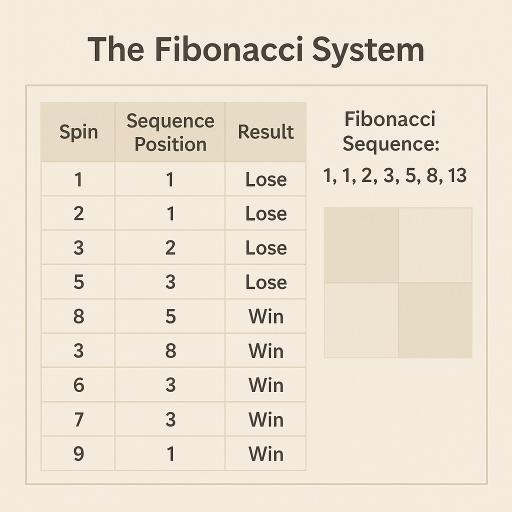
The Fibonacci sequence captivates mathematicians and gambling enthusiasts alike. When applied to roulette betting, does this famous mathematical progression offer genuine advantages?
Understanding the Fibonacci Sequence
The Fibonacci sequence is:
1, 1, 2, 3, 5, 8, 13, 21, 34, 55, 89, 144…
Each number is the sum of the previous two numbers. This sequence appears throughout nature—spiral shells, flower petals, galaxy formations—lending it mystical appeal to gamblers.
How the Fibonacci Betting System Works
Core Principle: After losses, advance one step forward in the Fibonacci sequence. After wins, move two steps backward.
Example Sequence ($1 base unit):
| Spin | Sequence Position | Bet | Result | Net Profit/Loss |
| 1 | 1 | $1 | Lose | -$1 |
| 2 | 1 | $1 | Lose | -$2 |
| 3 | 2 | $2 | Lose | -$4 |
| 4 | 3 | $3 | Lose | -$7 |
| 5 | 5 | $5 | Lose | -$12 |
| 6 | 8 | $8 | Win | -$4 |
| 7 | 3 | $3 | Win | -$1 |
| 8 | 1 | $1 | Win | $0 |
| 9 | 1 | $1 | Win | +$1 |
The Appeal: Bet progression increases more gradually than Martingale (doubling), creating smaller bet escalation and lower bankroll risk. The mathematical elegance attracts strategic thinkers.
Why Fibonacci Provides Limited Advantage
Advantage #1: Gentler Bet Progression
After 8 consecutive losses, Martingale requires betting $1,280 (to bet 10 × original stake). Fibonacci at the same point requires betting $21 (a 10th number in the sequence).
This dramatic difference preserves bankroll significantly better during losing streaks.
Advantage #2: Occasional Winning Streaks Provide Recovery
In the example above, a 4-win sequence recovered losses and produced +$1 profit from an 8-bet sequence. Fibonacci’s two-step-back mechanism capitalizes on these normal winning streaks.
Critical Limitation: It Still Doesn’t Beat House Edge
Over infinite spins, you’ll lose exactly the same percentage as any other progression betting system.
Fibonacci vs Martingale: Practical Comparison
| Aspect | Martingale | Fibonacci |
| Bet Growth | Exponential (doubles) | Linear (sequence-based) |
| Bankroll Risk | Extreme | Moderate |
| Recovery Speed | Fast (eventual large bets) | Slow (gradual progression) |
| Long-term Expected Loss | 2.70% (European) | 2.70% (European) |
| House Edge Impact | Zero reduction | Zero reduction |
| Sustainability | Fails with 10-15 losses | Fails with 20-25 losses |
The D’Alembert System: The “Balanced” Approach
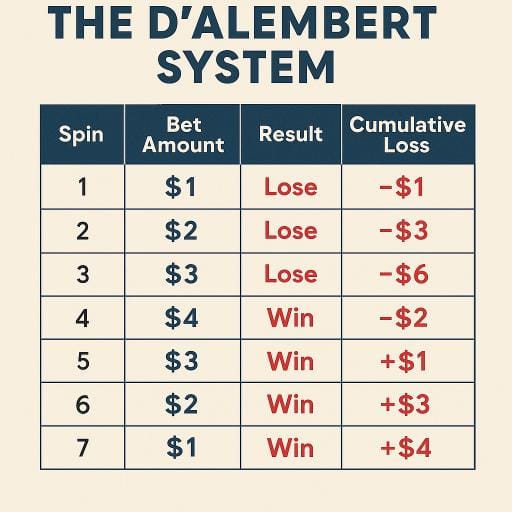
Created by 18th-century French mathematician Jean le Rond d’Alembert, this system claims gentler, more balanced progression.
How the D’Alembert System Works
Core Principle: Increase your bet by one unit after losses; decrease by one unit after wins.
Example Sequence ($1 base unit):
| Spin | Bet Amount | Result | Cumulative Loss |
| 1 | $1 | Lose | -$1 |
| 2 | $2 | Lose | -$3 |
| 3 | $3 | Lose | -$6 |
| 4 | $4 | Win | -$2 |
| 5 | $3 | Win | +$1 |
| 6 | $2 | Win | +$3 |
| 7 | $1 | Win | +$4 |
The Appeal: Linear progression (adding one unit) feels balanced. After equal wins/losses, bets normalize. The system seems to “even out” naturally.
Why D’Alembert Outperforms Martingale
After 6 losing spins in sequence:
- Martingale: Requires $64 bet (2^6); total losses: $127; requires $64 to recover
- D’Alembert: Requires $7 bet; total losses: $21; requires modest betting to recover
D’Alembert’s linear progression creates dramatically lower bust risk.
The D’Alembert Illusion: Why Balance Doesn’t Equal Beating House Edge
Despite superior bankroll preservation, D’Alembert still operates under 2.70% house edge.
Example Reality: Over 1,000 even-money bets of varying sizes following D’Alembert:
- Total amount wagered: ~$1,500 (accounting for variable bet sizing)
- Expected loss: $1,500 × 2.70% = $40.50
- Actual results vary, but mathematical expectation never changes
Expert Insight: D’Alembert excels at bankroll management and reducing volatility. It fails completely at beating house edge or producing long-term profit. This distinction matters enormously—better bankroll management extends gameplay but doesn’t create advantage.
Other Notable Roulette Betting Systems Worth Understanding
The Labouchère System (The “Cancellation” System)
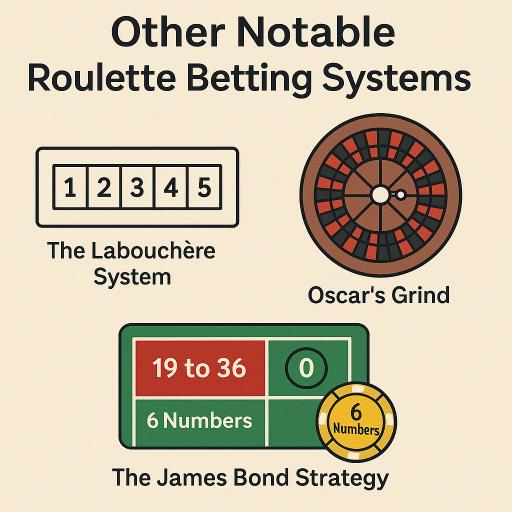
Players write a line of numbers (e.g., 1, 2, 3, 4, 5) and bet the sum of first/last numbers.
When you win, cancel those numbers. When you lose, add the bet to the line’s end.
Example:
- Line: 1-2-3-4-5
- Bet: 1+5 = $6
- Win: Cancel 1 and 5, leaving 2-3-4
- Lose: Add 6 to end, creating 1-2-3-4-5-6
Appeal: Mathematical elegance and quick “cancellations” producing profit.
Reality: Identical 2.70% house edge. Bet progression can escalate rapidly on extended losing streaks.
Oscar’s Grind: The “Slow Grind” System
Players increase bets by one unit after wins, maintain same bet after losses, until profits reach one unit.
Appeal: Extremely conservative, producing tiny profits but rarely requiring large bets.
Reality: Requires extended play sessions with identical house edge. Profits are minimal relative to time invested.
The James Bond Strategy: Fixed Flat Betting
Place fixed bets on high (19-36), six numbers, and green zero in fixed proportions.
Appeal: “Covers” large portions of the wheel with consistent bets.
Reality: Identical 2.70% house edge. Flat betting offers no progression advantage.
What Roulette Betting Systems Actually Accomplish
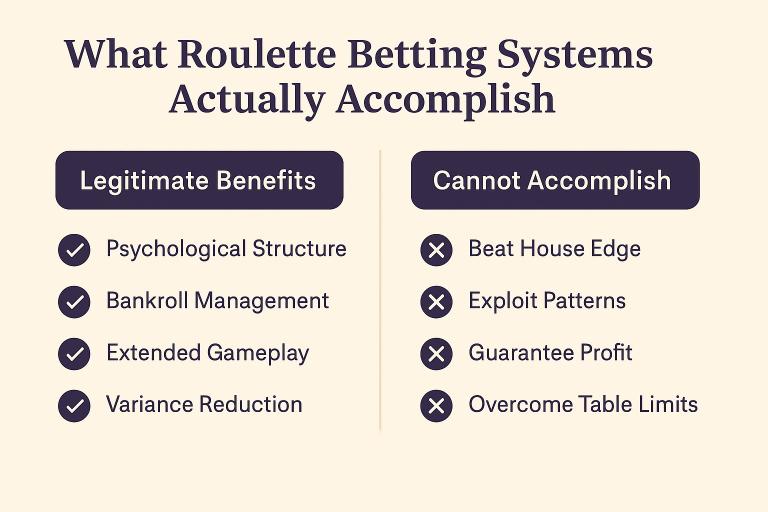
Understanding what systems genuinely provide separates informed play from delusion.
Legitimate Benefits: What Systems Actually Deliver
Benefit #1: Psychological Structure
Systems provide betting framework, reducing emotional decision-making and random “gut feel” wagers. This psychological anchoring helps some players maintain discipline.
Benefit #2: Bankroll Management
Progressive systems like D’Alembert and Fibonacci structure bet sizing, reducing catastrophic losses during inevitable losing streaks. You don’t risk your entire session bankroll on single bets.
Benefit #3: Extended Gameplay
Intelligent bet sizing extends your playing duration—not by improving odds, but by preserving capital through losing sequences. More spins = more entertainment per dollar.
Benefit #4: Variance Reduction
Gradual progression creates less volatile sessions. You experience smaller wins/losses than flat betting, reducing emotional roller-coasters.
What Systems Absolutely Cannot Accomplish
Cannot Beat House Edge: 2.70% loss rate remains identical regardless of betting progression.
Cannot Exploit Patterns: Each spin is independent. Betting pattern changes don’t alter probability.
Cannot Guarantee Profit: Long-term mathematical expectation remains negative. You’ll lose money given infinite time.
Cannot Overcome Table Limits: Casino maximum bets prevent escalating systems from functioning indefinitely.
Common Mistakes: System Misuse and False Expectations
Mistake #1: Believing Systems Reduce House Edge
Many players adopt systems believing they’ll somehow improve from 2.70% to positive expectation.
Reality: House edge depends on wheel pockets and payouts, never betting patterns.
Solution: Accept house edge as unchangeable reality. Systems provide bankroll management, not edge reduction.
Mistake #2: Underfunding the System (Insufficient Bankroll)
Players attempt Martingale with $200 bankrolls. After 5-6 losses, they’ve exhausted funds requiring system continuation.
Solution: Bankroll size must be 50-100x your base bet unit to sustain realistic losing streaks (10-15 consecutive losses).
Mistake #3: Playing Beyond System Limits
Players ignore table limits, assuming “eventually” will overcome them. When casino maximum is reached, system fails catastrophically.
Solution: Calculate maximum progression your starting bankroll allows given table limits. Never exceed realistic boundaries.
Mistake #4: Chasing Losses with System Escalation
After experiencing losing sessions, players increase unit sizes, hoping to recover losses faster.
Solution: Systems work only with consistent unit sizing. Escalation turns measured progression into dangerous Martingale clone.
Mistake #5: Playing Too Long
Sessions exceeding 4-6 hours virtually guarantee house edge grinding results. Initial luck evaporates.
Solution: Set time limits (2-3 hours) and strict profit targets ($50 or session bankroll doubling). Exit when targets are met.
Practical System Implementation: When and How to Use Them Effectively
If you choose to implement systems, maximize their genuine benefits while avoiding false expectations.
The Optimal System Framework
Step 1: Choose Appropriate Bets
Only apply systems to even-money bets (red/black, odd/even, high/low). These provide ~48.65% winning probability (European roulette), aligning with system mathematics.
Inside bets (straight-ups, corners) create poor system compatibility—use flat betting instead.
Step 2: Determine Your Bankroll and Unit Size
- Total bankroll: Money you can afford to lose entirely
- Unit size: Typically 1-2% of total bankroll
- Session bankroll: 5-10% of total bankroll
Example: $1,000 total bankroll
- Unit size: $10-20
- Session bankroll: $100-200
Step 3: Select Appropriate System
| If You Want | System Choice | Reason |
| Maximum simplicity | Martingale (modified) | Easy to track |
| Lowest volatility | D’Alembert | Gentlest progression |
| Mathematical appeal | Fibonacci | Lower escalation |
| Flat betting | James Bond strategy | No progression risk |
Step 4: Set Stop-Loss and Target Profit
- Stop-Loss: Lose 50% of session bankroll, exit session
- Profit Target: Win 100% of session bankroll or predetermined amount ($50-100)
Exit immediately when either threshold is reached.
Pro Tip: In practical play, the useful signal is the pattern you can observe repeatedly. Most players violate their own limits, chasing losses into catastrophe.
Session Structure: Building Around Systems
Recommended Session:
- Session bankroll: $100 (on $1,000 total)
- Unit size: $10
- System: D’Alembert
- Time limit: 2 hours
- Stop-loss: -$50 (exit when session bankroll reaches $50)
- Profit target: +$50-100 (exit when session bankroll reaches $150-200)
This framework balances entertainment, bankroll preservation, and realistic expectations.
Advanced Considerations: Variant Systems and Modifications
The “Soft” Martingale: Reduced Doubling
Rather than full doubling (×2), increase by 50% (×1.5) after losses.
Advantage: Slower escalation than pure Martingale.
Disadvantage: Doesn’t fully recover losses on single wins. Requires longer winning sequence for profitability.
The “Reverse” D’Alembert: Opposite Progression
Decrease bets after losses; increase after wins.
Advantage: Reduces exposure during losing streaks.
Disadvantage: Misses high-probability winning situations with small bets.
The “Sideways” Martingale: Horizontal Betting
Rather than vertical progression (doubling one bet), place additional bets on different outcomes simultaneously.
Advantage: Diversification reduces single-point failure.
Disadvantage: Requires larger total bankroll and more complex tracking.
The Mathematical Truth: House Edge Persistence
Independent academic research confirms what casinos know through centuries of data: no betting system modifies house edge.
A 2019 statistical analysis by University of Dortmund researchers tested thousands of Martingale simulations. Their findings: house edge remained precisely -2.70% (for single-zero European roulette) regardless of betting progression.
The mathematics are ironclad: betting systems affect distribution of winnings/losses (volatility), never expected value (average loss). You’ll lose 2.70% of total wagered money over infinite spins, whether betting $1 consistently, Martingale doubling, or any other progression.
Conclusion: Betting Systems as Tools, Not Solutions
Roulette betting systems are neither miraculous profit generators nor complete frauds. They’re tools for bankroll management and psychological structure—valuable within realistic scope.
The Martingale system’s exponential growth makes it dangerous but occasionally profitable in short sessions before inevitable losses occur. The Fibonacci system provides superior bankroll protection with similar long-term outcomes. The D’Alembert system excels at reducing volatility while maintaining identical expected losses.
What separates informed players from delusional ones is recognizing these distinctions. Systems manage variance and psychology; they don’t beat mathematics. House edge persists unchanged regardless of betting progression. Table limits and insufficient bankrolls prevent systems from functioning indefinitely.
The most sustainable approach combines realistic expectations with intelligent system selection. Acknowledge house edge as unchangeable, accept long-term loss as mathematical certainty, and use systems purely for bankroll management and volatility reduction.
With this perspective, you’ll play smarter roulette sessions, extend your entertainment budget, and avoid the catastrophic losses system addicts experience when they conflate bankroll management with beating house edge.
Remember: no system beats roulette. But intelligent bankroll management, system structure, and realistic expectations transform roulette from financially reckless entertainment into something approaching manageable entertainment with extended play duration.
Responsible Play Note
Casino strategy can reduce avoidable mistakes, but it cannot remove variance or guarantee profit. Set a budget before you play, keep gambling separate from income or bills, and stop when the session limit is reached. If gambling stops feeling recreational, take a break and use local support resources.
Practical Checklist Before You Play
- Choose European or French roulette when available because the house edge is lower.
- Understand that inside and outside bets have different variance, not different long-term edge on the same wheel.
- Avoid progression systems that require larger bets after losses.
- Set a spin budget and keep bet size small enough to survive normal variance.