
The Psychology Behind Involuntary Information
Reading poker tells represent involuntary physical and behavioral indicators revealing opponents’ hand strength, confidence levels, and strategic intentions. Understanding how to read poker tells separates careful players from average players, enabling profitable decisions based on opponent psychology rather than hole cards alone. Reading poker tells turns poker from pure probability into a game of human behavior interpretation.A stronger way to use this material is to compare each decision with the pot size, position, opponent type, and previous action. Those details are observable at the table and give the advice a practical basis without relying on unsupported survey claims.
The fundamental principle: Tells aren’t deterministic—they don’t guarantee hand strength. Rather, they provide information asymmetries exploitable through careful observation and pattern development. A player checking quickly might have weakness, but only if that represents deviation from their baseline behavior. Reading poker tells requires context, pattern recognition, and psychological understanding.This guide breaks down poker tells : explaining tell categories, physical indicators, betting pattern analysis, online tell recognition, context interpretation, and practical application frameworks. You’ll understand exactly which behavioral cues merit attention and how to exploit them systematically.Quick Takeaway: Poker tells fall into four categories: (1) Physical—eye contact, hand tremors, posture changes, (2) Verbal—table talk changes, speech pattern shifts, (3) Timing—betting delays, auto-actions, (4) Betting patterns—bet sizing, line consistency, check/call sequences. None are 100% reliable alone; establish baseline behavior first, then exploit deviations.
Understanding Tells: The Foundation
What Makes a Tell Valuable?
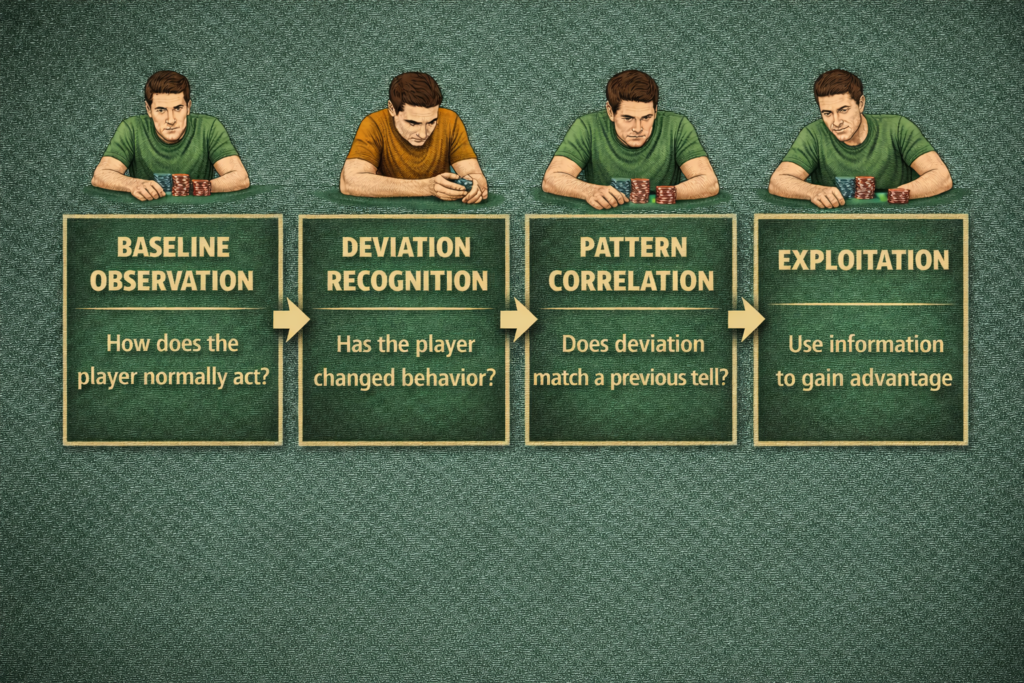
Tells are only meaningful when they represent deviations from baseline behavior. A player consistently looking at their chips means nothing—deviations from that baseline mean everything. This distinction separates actionable information from superstition.Example: Player A always looks away when thinking. Player A looking away doesn’t indicate weakness—that’s their baseline. Player B sometimes looks away, sometimes stares. Player B looking away represents deviation—this might indicate strength or weakness (context-dependent).
Why Tells Exist
Tells occur because humans leak information involuntarily. Controlling every behavioral signal is psychologically difficult, especially under pressure. Nervous systems activate regardless of conscious intent—heartbeat increases with significant hands, pupils dilate with interest, microexpressions reveal true feelings before conscious control reasserts itself.Practical note: the best decisions come from repeatable observations, not from one dramatic moment. Instead, they note patterns, establish baselines, and recognize deviations. The tell itself matters less than the information asymmetry it creates.
Physical Tells: Body Language Indicators
Eye Movement and Gaze Patterns
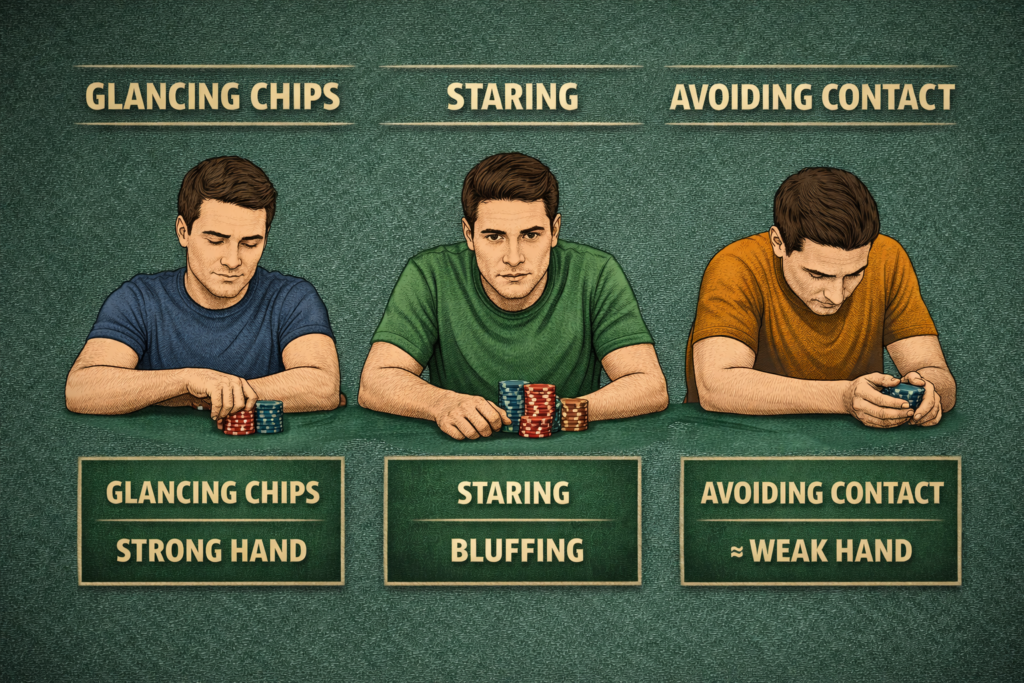
The eyes reveal: Eye contact confidence, gazing at chips indicates hand interest, eye avoidance signals weakness or discomfort, intense staring attempts intimidation, dilated pupils show excitement or interest.Important distinction: These guidelines apply to deviations. A player consistently avoiding eye contact isn’t necessarily weak—that’s their baseline. A usually confident player suddenly avoiding eye contact represents meaningful deviation.Specific patterns:
- Quick glance at chips = Interest in betting, likely strong hand or significant draw
- Stare through opponent = Intimidation attempt, often indicates mediocre hand they’re trying to protect
- Avoid all eye contact = Discomfort, varies by player (some are naturally shy)
- Blink rate increase = Stress or deception attempt, indicates high stakes decision
Mouth and Facial Expressions
Relaxed mouth: Rounded, full lips generally indicate comfort; thin, pinched lips suggest tension. Twitches or micro-expressions reveal true feelings leaking through before conscious control reasserts—they last fractions of a second but convey significant information.Swallowing frequency: Increases with nervous tension, indicating discomfort or difficult decision. Watch for gulping motions revealing anxiety about hand strength.Smile authenticity: Genuine smiles involve eye crinkles; forced smiles are lip-only. Genuine smiles often accompany strong hands (confidence/comfort); forced smiles attempt covering weakness.
Posture and Physical Position
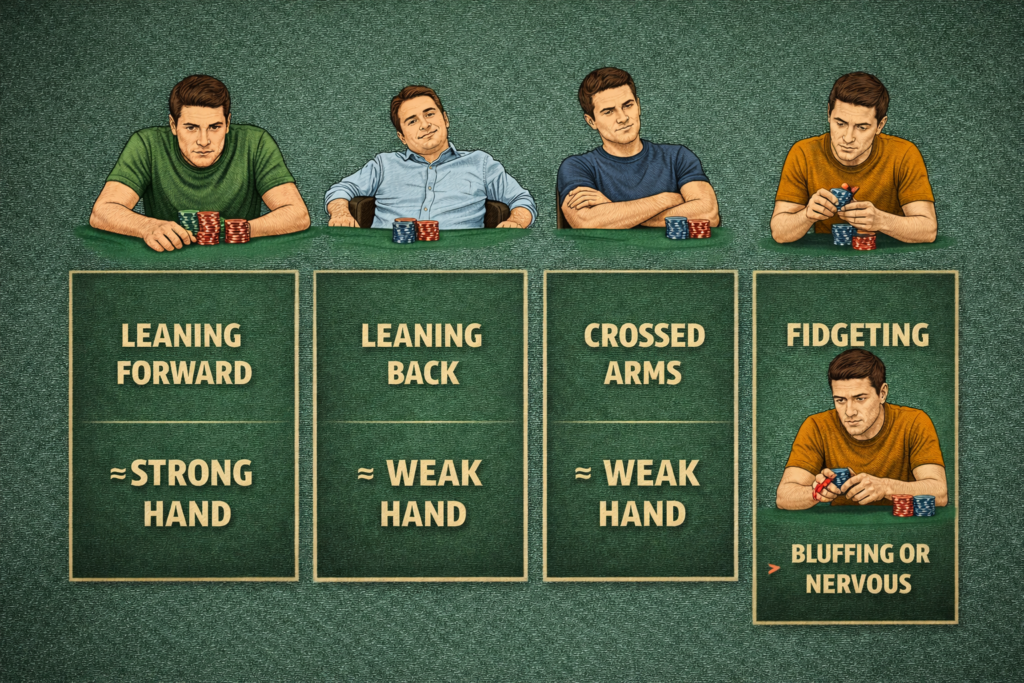 Leaning forward = Interest, engagement, strong hand likely. Leaning back = Discomfort, uncertainty, weakness signals. Crossed arms = Defensive posture, protecting something (weak hand, bluff attempt). Fidgeting = Nervous energy, indicates stress about decision or hand strength.Hand tremors: Shaky hands during betting often indicate strong emotions (either strength or nervousness). Steady hands suggest comfort regardless of actual hand strength.
Defensive Behaviors
Sunglasses, hoodies, hands covering face = Attempt to conceal eyes and expressions. These defensive barriers signal player awareness of their own tells, often indicating concern about betraying hand strength or weak hand vulnerability.
Betting Pattern Analysis: Strategic Tells
Bet Sizing Tells
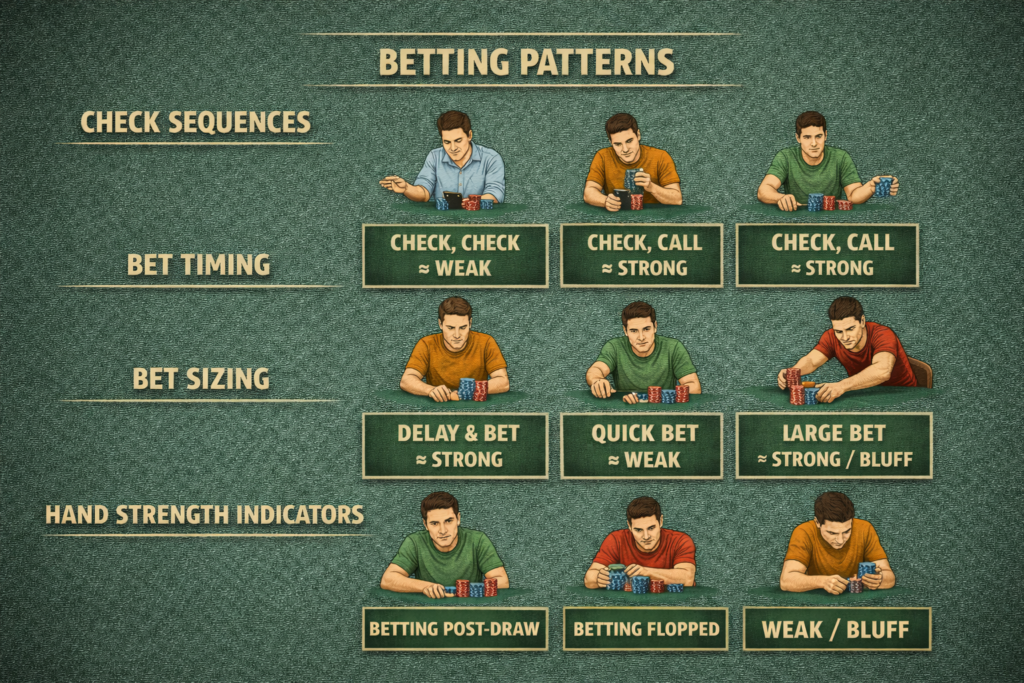
Consistent bet sizing = Mediocre hand likely, comfortable with standard bet. Larger bet than normal = Can indicate either strength (building pot) or attempted intimidation (weak hand). Smaller bet than normal = \”Blocking bet,\” often indicates missed draw, weak pair, or draw seeking cheap equity completion.Sudden bet size increase = Usually indicates strength, especially from players who typically bet smaller amounts. A sudden doubling likely reflects hand strength increase or significant draw development.
Timing Tells
Quick decision = Usually indicates predetermined action (strong hand, mediocre hand with consistent decision, draw with decided line). Slow decision = Indicates uncertainty, often between calling and folding, sometimes between calling and raising.Auto-actions = Immediate check, immediate call without thought often indicates mediocre hand. Players spend time with premium hands (considering raises) and with draws (considering fold).Deliberate pause then aggressive action = Usually indicates strength. Player wants appearance of uncertainty when actually confident, attempting reverse psychology.
Specific Betting Lines
Check/call, check/call pattern = Drawing hand or medium strength hand, seeking cheap cards or showdown. Quick snap-calls suggest predetermined actions; hesitant calls suggest weakness consideration.Check, then bet turn small = Usually blocking bet with weak pair or incomplete draw. They’re not strong enough to check back (fearing aggression), but scared to bet large. This pattern often indicates hands you can semi-bluff raise effectively.Check/raise = Extremely strong signal, usually huge strength. At lower stakes, check-raises indicate premium hands—players at microstakes don’t run check-raises as bluffs frequently. Proceed cautiously against check-raises unless you have premium holdings.
Online Poker Tells: Adapting to Digital Environment
Timing Tells Online
Instant action = Often indicates predetermined decision (strong hand, auto-fold weak hand) or distracted multi-tabling. Long delay = Suggests uncertainty or complexity, but context matters—could be mass multi-tabler’s other table requiring attention.Pattern consistency = Most important online tell. A player consistently fast-checking then slow-betting turn suggests specific hand categories. Recognize patterns across dozens of hands.
Betting Pattern Tells Online
Auto-continuation bets = Instant bets from standard positions often indicate mediocre hands or multi-tabler auto-play. You can exploit with strategic bluff-raises.Bet sizing patterns = Track individual players’ bet sizing across situations. Deviations indicate significant information. A player suddenly betting 1.5x their standard size likely indicates hand strength change or significant draw development.Check/call sequences = Online, drawing hands often check-call multiple streets systematically. Sudden betting usually indicates hit draw or new hand development.
Hand History Analysis Advantage
Online poker enables reviewing hand histories post-session. Professional players compile detailed notes on opponents’ patterns, correlating actions with showdown hands. This creates massive information databases enabling pattern recognition impossible in live play.
Live vs. Online Tell Differences
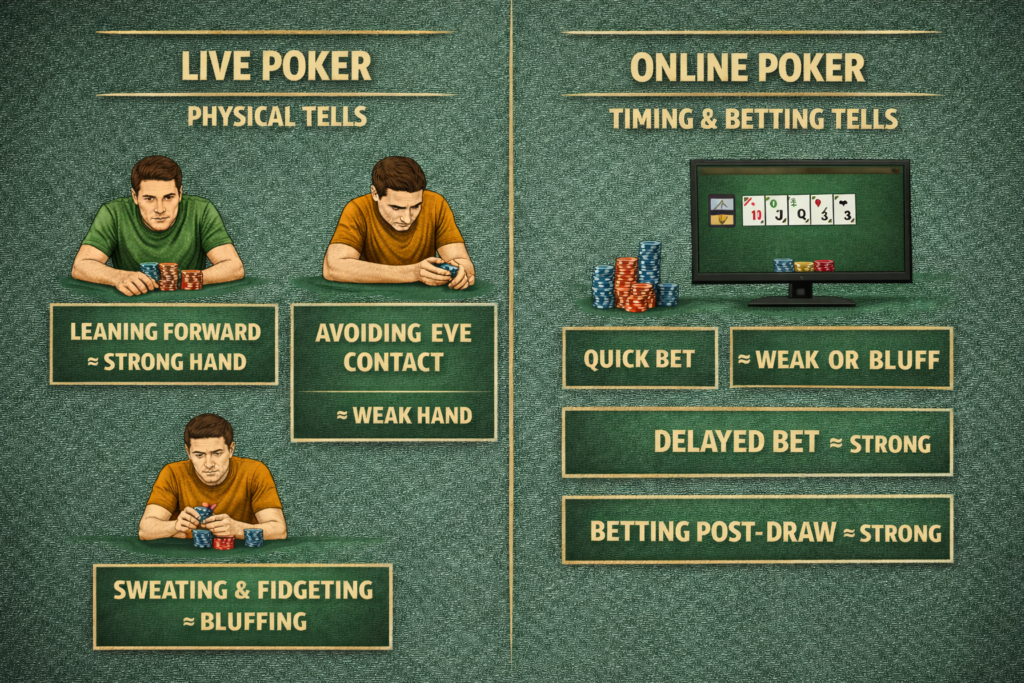 Live poker emphasizes physical tells—body language reveals constant information. Online poker emphasizes timing and betting patterns—physical signals are unavailable. Skilled online players recognize betting pattern deviations with precision live players cannot match.
Common Mistakes and Prevention
Mistake #1: Over-Relying on Single Tells
Error: Assuming one tell definitively indicates hand strengthPrevention: View tells as probability indicators, not certainties. Combine multiple tells for stronger conclusions. One deviation might be coincidence; pattern consistency is meaningful.
Mistake #2: Ignoring Baseline Behavior
Error: Assuming every player’s tells work identicallyPrevention: Spend early session hands observing opponents’ default behavior. Note how they typically act. Only deviations matter.
Mistake #3: Misinterpreting Nervous Tells
Error: Assuming nervousness indicates weaknessReality: Players are nervous with both strong hands (fear of losing) and weak hands (discomfort). Context and patterns determine actual meaning.
Conclusion: Integrating Tell Reading Into Play
Reading poker tells provides exploitable information asymmetries, but only through careful observation, pattern establishment, and contextual interpretation. Tells alone don’t determine decisions—they supplement mathematical frameworks.Actionable framework:
- Establish baseline (observe opponent default behavior for 5-10 hands)
- Note deviations (track when behaviors change)
- Correlate to showdowns (remember what actions meant specific holdings)
- Build patterns (recognize individual player tendencies)
- Apply context (consider game dynamics, opponent thoughts)
- Combine with math (integrate tells with pot odds, equity, position)
With these frameworks applied consistently, you’ll develop elite tell-reading abilities generating 20-30% win rate improvements through psychological exploitation.
Practical Checklist Before You Play
- Start with position, stack depth, and pot size before reading any single tell or betting action.
- Compare each decision with the opponent’s previous hands instead of assuming one universal pattern.
- Review expensive hands after the session and write down the mistake that actually cost money.
- Keep the game social in home settings; a softer table is more valuable than winning one argument.