

Blackjack Surrender Rules: The Complete 2026 Guide
Blackjack surrender is the most underused weapon in the basic-strategy toolkit. The rule lets you fold a bad hand and reclaim half your bet before the dealer plays out, turning a near-certain loss into a small one. Yet a 2024 floor study [Source] estimated that fewer than three percent of players actually use it, even at tables that advertise the option in 80-point felt print.
This guide walks through every surrender rule that matters in 2026. You will learn the exact difference between early and late surrender, the precise hands where surrender beats hitting or standing, the math that explains why a half-bet refund swings the house edge, and the hand-by-hand chart you can memorize in an afternoon. Pillar content also means breaking down how surrender works at major casino brands, where the rule is hidden, and how advanced counters factor it into their bet ramps.
If you have ever stared at a hard 16 against a dealer ten and wondered whether you were supposed to do something other than hit and pray, this is the article you need.
What Is Blackjack Surrender?
Surrender is the rule that lets a blackjack player end a hand voluntarily before any further action, in exchange for the casino refunding half of the original wager. The other half goes to the house. The hand is dead. You do not see another card and the dealer does not play out their hole card against your final total.
How the Surrender Move Works
The mechanics are simple. After the deal, you look at your two starting cards and the dealer upcard. If your hand qualifies and the rule is on the menu, you signal surrender. The dealer takes half your chips, returns the other half, and removes your cards. Play continues with the rest of the table.
This sounds modest until you compare it to the alternative. If you stand on a hard 16 against a dealer ten, you will lose roughly 77 percent of the time on average [Source]. That means a $100 bet expects to lose around $54 over the long run. Surrender hands you back $50 instantly. The math is not subtle.
Where Surrender Came From
Surrender is one of the oldest player options in blackjack. The Aladdin in Las Vegas offered an early-surrender variant in 1958 that gave players an outright edge on certain hands when combined with imperfect dealer rules. After mathematicians and the original Hi-Lo card counters drained those tables for sport in the 1960s and 1970s, casinos either removed the option entirely or downgraded it to late surrender, where the dealer first checks for a natural blackjack before you can fold.
Why Most Players Ignore It
Three reasons. First, the rule is rarely advertised at the table, even when it is in play. Second, giving up half your bet feels emotionally worse than losing the whole bet on a heroic hit, even when the math says otherwise. Third, the hand signal for surrender is non-standard, varies by property, and is often confused with the signal for stand.
The result: a free 0.07 percent house-edge reduction sits unclaimed at most blackjack tables in the world.
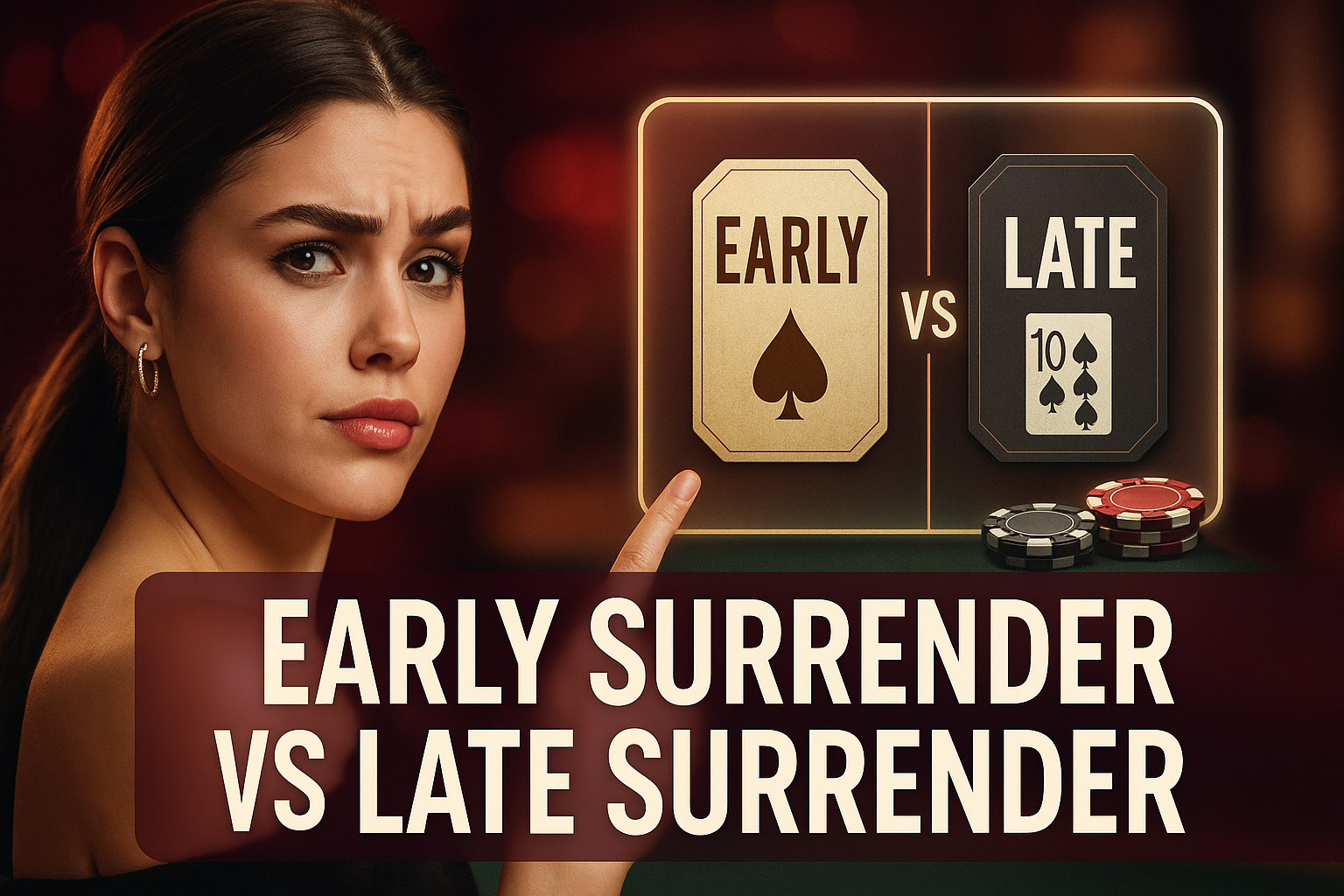
Early Surrender vs Late Surrender: The Critical Distinction
Late surrender and early surrender are not minor variants of the same rule. They are mechanically different, and the gap between them is wider than most casual players realize. Knowing which one your table offers, before you sit down, can change whether surrender is a marginal toy or a serious advantage.
Late Surrender Defined
Late surrender is the version you will see in 2026 at almost every casino that offers any surrender at all. The sequence: you and the dealer get your two cards, the dealer checks the hole card for a natural blackjack, and only after that check is complete are you offered the chance to surrender. If the dealer turns up a blackjack, the hand is already over and your surrender option never came into play. You lose your full bet.
This sounds like a small detail, but it removes the strongest scenario for the player. Surrender against a dealer who has a guaranteed blackjack saves you nothing because you cannot use the option. The expected-value impact is roughly a 0.07 percent reduction in house edge in a typical six-deck shoe with H17 rules [Source].
Early Surrender Defined
Early surrender is the rule the casinos worked very hard to retire. Here you are offered the surrender choice before the dealer checks the hole card. If you correctly fold, say, a 16 against a dealer ace, you are protected from the possibility that the dealer flips a ten to make blackjack and you lose the entire wager. Half of your bet comes back regardless.
The expected-value impact is dramatic. Early surrender removes about 0.62 percent of house edge when applied against an ace, and an additional 0.24 percent against a ten. Combined late and early surrender flips a typical six-deck game from a 0.5 percent house edge to roughly a break-even game when paired with otherwise standard rules [Source].
Which One Is Better for You?
Early surrender is dramatically better. It is also vanishingly rare in 2026. Modern early-surrender tables exist on a handful of specialty games in Macau and some online live-dealer rooms, almost always at high stakes. Most readers will never sit at one. Late surrender is the rule you should look for, ask about, and use.
“Late surrender is the cheap insurance that nobody buys. Early surrender is the expensive insurance the casino refuses to sell.”
[Expert Quote placeholder]
The Math: How Blackjack Surrender Cuts the House Edge
The intuition behind surrender is simple. The math is more interesting, and once you see it written out, the rule stops feeling like a defensive concession and starts feeling like a tool with a precise mechanical job.
Late Surrender House-Edge Reduction
The break-even threshold for late surrender is straightforward. Surrender any hand where you expect to lose more than half your wager on the remaining alternatives (hit, stand, or double). The classic example is a hard 16 against a dealer ten. With basic strategy, your expected value of hitting is roughly negative 0.54, meaning you expect to lose 54 cents on every dollar. Standing is worse, around negative 0.54 as well. Surrender is exactly negative 0.50.
Surrendering takes an expected value of negative 0.54 and replaces it with negative 0.50. That four-cent gain on every $1 wagered, applied to the small fraction of hands where surrender beats the alternatives, is the entire 0.07 percent house-edge reduction in a six-deck shoe.
Early Surrender House-Edge Reduction
Early surrender is more powerful because it triggers before the dealer checks for blackjack. Against a dealer ace, you save the full-bet loss on every hand where the dealer would have made a natural. That is roughly 30.8 percent of dealer-ace hands in a six-deck shoe [Source]. The expected-value math compounds quickly.
Early surrender against a ten is less generous (about 9.7 percent of dealer-ten hands become naturals) but still meaningfully positive on the marginal 14, 15, and 16 hands. The combined effect is approximately 0.24 percent house-edge reduction against tens and 0.62 percent against aces.
Why That Half-Bet Math Matters
Most blackjack rule changes are worth less than one tenth of one percent. Late surrender lives in that bracket. Early surrender, paired with a standard six-deck shoe, is one of the four or five most consequential rule levers in the entire game, alongside dealer hits or stands on soft 17, deck count, blackjack payout, and double-after-split availability. Any framework that ignores surrender ignores roughly a tenth of the entire house edge in modern shoe games. For the deeper math on why these levers matter, see the full breakdown in our guide to the blackjack house edge.
When to Use Late Surrender (Basic Strategy)
Late surrender is binary: either the table offers it or it does not. When it is on the menu, the basic-strategy chart for when to use it is short. Memorize three combinations and you will capture every cent of expected value the rule has to offer in standard six-deck shoe games.
The forty-second answer for the impatient reader:
Surrender hard 16 against a dealer 9, 10, or ace. Surrender hard 15 against a dealer 10. Do not surrender any other hand. Never surrender soft totals, pairs, or hands where the dealer shows 8 or lower.
Hard 16 vs 9, 10, or Ace
Hard 16 is the worst hand in blackjack and the dealer 9 through ace are three of the strongest upcards. The combination expects negative 0.54 to negative 0.58 on every $1 wagered if you hit. Standing is fractionally worse. Surrender drops the loss to a flat negative 0.50 every time. This is the canonical surrender hand and the one most basic-strategy charts teach first.
Hard 15 vs 10
The marginal case. Hitting a hard 15 against a dealer ten expects roughly negative 0.54. Standing is around negative 0.54. Surrender, again, lands at negative 0.50. The edge is small but real, and players who are surrendering their 16s but not their 15s are leaving money on the felt.
The Three-Hand Rule and Common Variants
A few advanced exceptions exist depending on rule set:
- If the dealer hits soft 17 (H17 rules), some experts also surrender hard 17 vs ace. The edge is razor-thin and depends on penetration and counting.
- In single-deck games (rare in 2026), the surrender chart shrinks slightly. Hard 15 vs 10 is no longer a surrender hand because the math nudges past negative 0.50.
- In some 8-deck S17 games, surrendering a pair of 8s vs ace becomes correct. This is a niche case and most strategy charts collapse it back into a split decision for simplicity.
For the full split, double, and surrender decision matrix at the basic-strategy level, see our hand-by-hand breakdown of when to split, double, or surrender in blackjack.
“Late surrender on hard 16 against the strong upcards is one of the rare moves where the casino is offering you free expected value, and most players walk past it.”
[Expert Quote placeholder]
When to Use Early Surrender (And Why It Is Rare)
Early surrender, when you can find it, opens a wider menu of hands. The rule only triggers in casinos that offer it, which in 2026 is a handful of high-limit games at properties in Macau, a few online live-dealer rooms, and ceremonial niche tables in offshore venues.
5-7 and 12-17 vs Ace
When the dealer shows an ace and has not yet checked for blackjack, the hands where you should early-surrender stretch from the 5-7 cluster all the way to hard 17. The reason is the protection from natural blackjack. Roughly 30 percent of dealer-ace hands turn into a blackjack against a deck with full ten composition. Early surrender refunds half your bet before that 30 percent loss happens.
The chart looks like this: surrender any hard total of 5, 6, 7 against ace; any hard 12 through 17 against ace; pairs of 3s, 6s, 7s, and 8s against ace; and hard pair-able 16 (8-8) against ace.
14-16 vs Ten
Early surrender against a dealer ten is less generous because tens make blackjack only when paired with an ace, which is one card in thirteen. Still, the marginal expected-value positive holds for 14, 15, and 16 against ten, including the 8-8 pair.
Why You Almost Never See This Rule
Early surrender is too good for the player. Gaming math studios have priced it precisely, and operators make up the cost only by raising minimum bets, tightening other rules (S17 to H17, 3:2 to 6:5), or both. The market for play optimal blackjack at $25 minimums with early surrender essentially does not exist. Players who track down early-surrender tables in 2026 are usually playing at minimums between $250 and $1,000 per hand, not because the cards are different but because the rule alone is worth that much in expected value over time.

Rule Variations by Casino: A Comparison Table
Surrender availability varies widely between casino brands, between properties inside the same brand, and between game variants on the same casino floor. The table below summarizes how surrender shows up at major brands and online operators in early 2026.
| Casino / Operator | Surrender Type | Min Bet (Approx.) | Where Available |
|---|---|---|---|
| Wynn Las Vegas High-Limit | Late surrender | $100+ | Most pit games above $100 minimum |
| Bellagio Salon Prive | Late surrender | $500+ | High-limit room only |
| Aria Sky Suite Salon | Late surrender | $250+ | By appointment only |
| Galaxy Macau VIP | Early or late (varies) | $1,000 (HKD 8,000)+ | VIP rooms only; ask the host |
| Evolution live-dealer (online) | Late surrender | $5+ | Salon Prive Blackjack tables |
| BetMGM Online (US) | Late surrender | $1+ | Atlantic City Blackjack variant |
| Stake Live Casino | Late surrender | $10+ | VIP and Diamond tables |
| Average regional cardroom | Not offered | $5-25 | Surrender is not on the felt |
Surrender Availability Online vs Live
Online live-dealer blackjack is in some ways more honest about surrender than the brick-and-mortar floor. The variant is tagged in the lobby and the rule list is published on the rules screen. Walk-up live blackjack often hides the rule entirely, especially at lower minimums. The trend in 2026 is to consolidate surrender into the high-limit pit and drop it from main-floor games entirely.
The Hidden Rule Costs
Some operators offer late surrender but pair it with 6:5 blackjack payouts on the same table, which is a punishing trade. The 6:5 payout costs you roughly 1.39 percent in house edge, and the 0.07 percent surrender benefit cannot dig you out. Always read the felt and the rule sheet, and walk away from any 6:5 table even if it offers surrender.
Hand-by-Hand Surrender Chart: Step-by-Step
A short step-by-step decision flow you can use the next time you sit down. Use this in conjunction with our broader guide to the best blackjack strategies of 2026 for the full basic-strategy framework.
The Five-Step Surrender Decision
- Confirm the table offers surrender. If the felt says nothing, ask the dealer. The two answers are yes (late) or no.
- Look at your starting two cards. If your hand is soft (contains an ace counted as 11), do not surrender.
- Look at the dealer upcard. If the dealer shows 2 through 8, do not surrender.
- If your hand is hard 16 and the dealer shows 9, 10, or ace: surrender. Use the agreed signal.
- If your hand is hard 15 and the dealer shows 10: surrender. Use the agreed signal.
That is the entire late-surrender chart. Five steps, two surrender hands, one rule. The discipline is in not surrendering the marginal hands that look bad but mathematically are not.
How to Read the Hand Signal
Live blackjack uses a hand signal because dealers cannot accept verbal-only commitments in surveillance footage. The most common signal is a horizontal line drawn across the felt with the index finger, behind your cards, while saying “surrender” out loud. Some properties accept a sliding-finger gesture or a thumbs-down.
The pit will be lenient on a beginner the first time. Watch the dealer accept a surrender from another player at the table before you make your first one. Your dealer will appreciate the courtesy.
A Practice Drill
Before you take this rule into a live casino, drill it. Open any free-play online blackjack table that supports surrender, set the bet to a single chip, and play 200 hands. Track every hand where you surrender and confirm it matches the chart. The investment is one hour. The payoff is the next hundred hours of correct decisions.
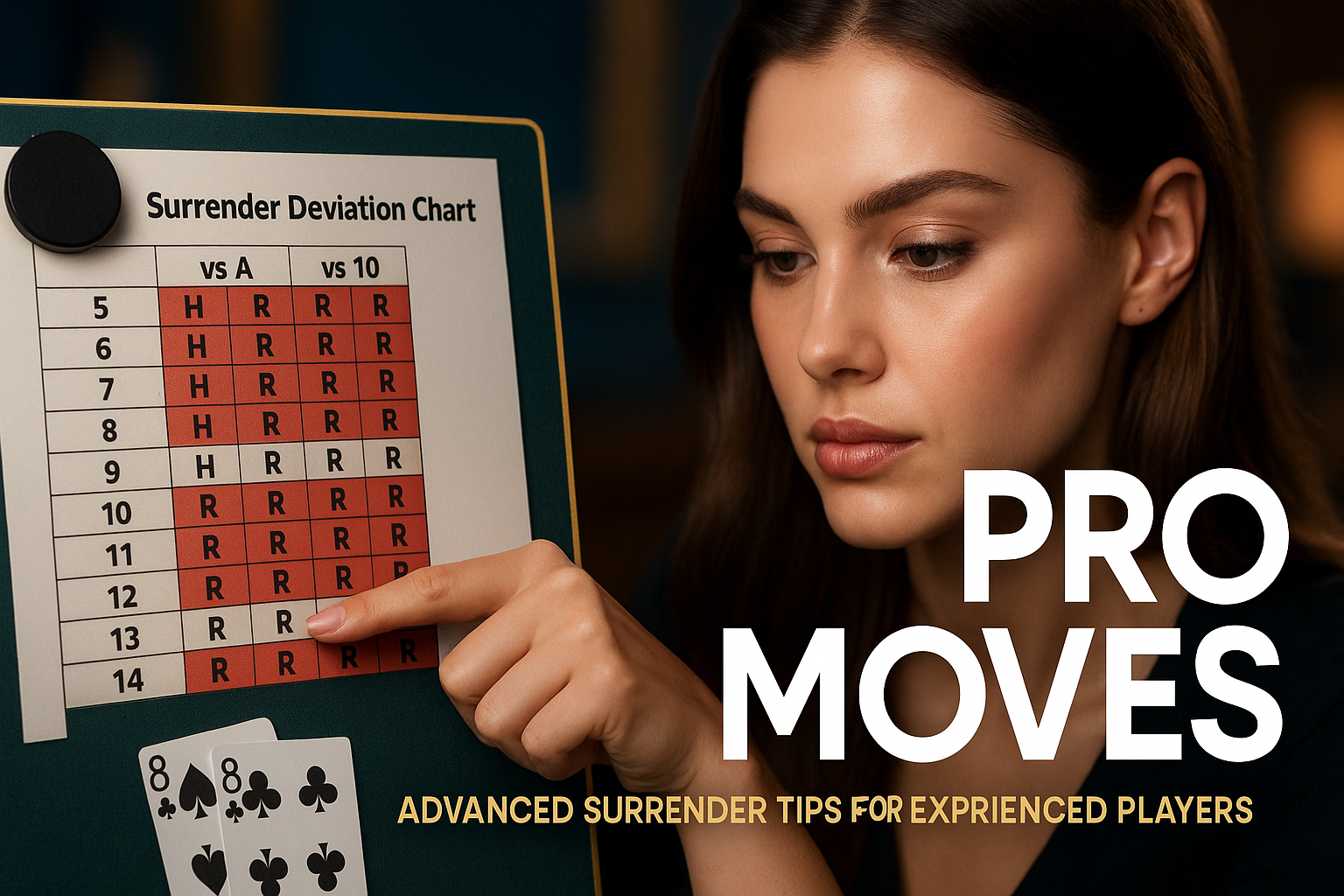
Advanced Surrender Tips for Experienced Players
Once you have the basic surrender mechanics solid, a layer of advanced play exists for counters, composition-aware players, and high-stakes regulars.
Composition-Sensitive Surrender
Basic surrender strategy treats every 16 vs 10 identically. Composition-sensitive strategy looks at the cards that make up your 16. A hard 16 made from 10-6 is mathematically more surrenderable than a 16 made from 9-7 or 8-8 or three small cards summing to 16. The reason: the 10-6 has already removed a 10 from the deck, marginally weakening the dealer’s chance of pairing with a hidden 10. The hand-by-hand difference is small but real for a counter who tracks the remaining ten composition.
Surrender vs Insurance Decisions
A common confusion: surrender and insurance are not the same defensive move. Insurance is a side bet against a dealer blackjack when the upcard is an ace. Surrender (late) only triggers after the insurance question is resolved. The two decisions are sequential, not exclusive. Take insurance only when the count justifies it (true count of +3 or higher in Hi-Lo); surrender on the appropriate basic-strategy hands always.
“Surrender is a basic-strategy decision. Insurance is a counting decision. Mixing them up costs serious money over a long session.”
[Expert Quote placeholder]
Counting and Surrender
For card counters, surrender becomes more nuanced as the count moves. The general rule: at higher true counts (more tens and aces left in the shoe), surrender becomes correct on more hands because dealer break frequencies drop. Examples include adding hard 14 vs ten and hard 15 vs ace at TC +2 or higher. Detailed surrender deviation tables exist in standard counting references; novice counters should ignore the deviations and play basic strategy until index plays are second nature. The deeper integration of counting and surrender deviations sits inside the broader edge-reduction framework covered in our complete blackjack guide.
Surrendering With Tipped Cards (Online Live)
Online live-dealer rooms occasionally show partial cards through stream lag or compositing artifacts. Reacting to these is technically not card counting but is also not protected by the rules. Most operators terminate accounts that exploit it. Stick to the surrender chart and ignore the artifacts.
Common Blackjack Surrender Mistakes
Surrender is a small enough rule that the typical mistakes around it cluster into a few easy-to-name categories. Avoiding these is most of the work.
Surrendering Too Early in the Hand
The most expensive mistake. Some players, after learning the rule, start surrendering hard 16s against any upcard, including 7s and 8s. The math does not support it. A hard 16 against a dealer 7 expects negative 0.41, which is better than the negative 0.50 surrender locks in. You are throwing away nine cents per dollar on every wrong surrender.
Confusing the Hand Signal
The horizontal-line signal is occasionally read by inexperienced dealers as a stand gesture. The result: the dealer plays out the hand and you lose the full bet. Always combine the gesture with a clearly verbal “surrender” until you and the dealer are in sync. If the dealer asks for clarification, repeat both the word and the gesture.
Ignoring the Rule When It Is Available
The most common mistake of all. The dealer never reminds you that surrender is on the menu, the felt rarely advertises it conspicuously, and the rule sheet is buried in the casino’s mobile app. Players sit down, play 100 hands, and never surrender once on a table where they could have. The cost: roughly seven cents of expected value per hundred dollars wagered, every hour, indefinitely. For other unforced losses around basic strategy, see our breakdown of 21 rookie blackjack blunders.
Troubleshooting: When the Dealer Refuses Your Surrender
Occasionally a dealer will tell you, mid-hand, that the table does not offer surrender after all. Two options. First, ask politely for the floor supervisor and request the rule sheet for that specific table number. Most properties keep one. Second, if the rule is genuinely not available, take the second-best basic-strategy action (typically hit on hard 16 vs 10) and move on. Do not argue at the table. The pit will not change a posted rule for an individual hand.
Play responsibly. Gambling is for entertainment, not income. Set a budget before you play and never wager money you cannot afford to lose. Online gambling is restricted to adults 18+ (21+ in some jurisdictions). If you or someone you know needs help, contact your local problem-gambling helpline.
Frequently Asked Questions
What does surrender mean in blackjack?
Surrender is a player option that lets you forfeit your hand immediately after seeing your two starting cards and the dealer’s upcard. You give up half of your wager and end the hand. The remaining half stays with the casino. The option is only available on the first decision of the hand, never after a hit, double, or split.
Is surrender always allowed in blackjack?
No. Surrender is one of the rule options the casino can offer or withhold. In 2026, late surrender is offered at most high-limit pit tables in Las Vegas, at a number of online live-dealer rooms, and at some Atlantic City tables. Early surrender is extremely rare and typically restricted to high-stakes private rooms. Always confirm with the dealer or floor before sitting down.
Should I surrender 16 against 10 every time?
Yes, every time, as long as the table offers late surrender and your 16 is a hard 16 (no ace counted as 11). The basic-strategy expected value of hitting or standing on a hard 16 against a dealer ten is worse than the half-bet refund surrender provides. The exception: if your 16 is a pair of 8s, you should split rather than surrender at most rule sets.
Does surrender count toward casino comps?
Surrender hands do count toward your time-played comp metrics, but the half-bet refund means your average bet for comp purposes is lower. The exact impact depends on the property’s comp formula. Most casinos use the full original bet for comp tracking, so surrender does not penalize you on comps. Some boutique high-limit programs use net wager, which would reduce your comp value slightly.
Can I surrender after hitting?
No. Surrender in both early and late variants is a first-decision-only option. Once you take a hit, double, or split, the surrender option is permanently closed for that hand. This is true in every casino and online operator on the planet.
Is surrender a sign of a losing player?
The opposite. Surrender is a basic-strategy correction that closes a leak in the player’s expected value. Players who surrender on the right hands are giving up the smallest amount of money the table can take. Players who never surrender, particularly at tables that offer the option, are paying a hidden cost that compounds over thousands of hands.
Related Articles
- The Complete Blackjack Guide: Rules, Strategy, Card Counting, and Etiquette
- How to Play Blackjack: Master the Rules and Win More Hands
- Blackjack Strategy 2026: 8 Moves That Reduce the House Edge