

Introduction: Making Informed Betting Decisions in Baccarat
The moment you sit at a baccarat table, you face a crucial decision: which baccarat betting options deserve your chips? This choice fundamentally determines your expected outcomes, session duration, and psychological experience.
Many players assume baccarat betting options are mathematically equivalent—merely different labels for similar outcomes. This misconception leads to catastrophic strategic errors, particularly around Tie bets. Others recognize Banker’s advantage but misunderstand the 5% commission’s actual impact on long-term results.
The reality differs dramatically from both assumptions. Baccarat betting options carry distinct odds, payouts, house edges, and psychological profiles. Understanding these distinctions separates informed players from those gambling blindly against mathematical certainty.
This comprehensive guide deconstructs all three baccarat betting options: the Banker bet’s mathematical superiority, the Player bet’s intermediate positioning, and the Tie bet’s seductive payout masking devastating house edge. You’ll discover why the 5% Banker commission represents genuine value, which scenarios favor each bet, and most importantly, how to align betting decisions with realistic expectations.
By mastering these fundamentals, you’ll make strategic betting decisions, optimizing long-term outcomes while maintaining entertainment value.
The Three Primary Baccarat Betting Options: Overview
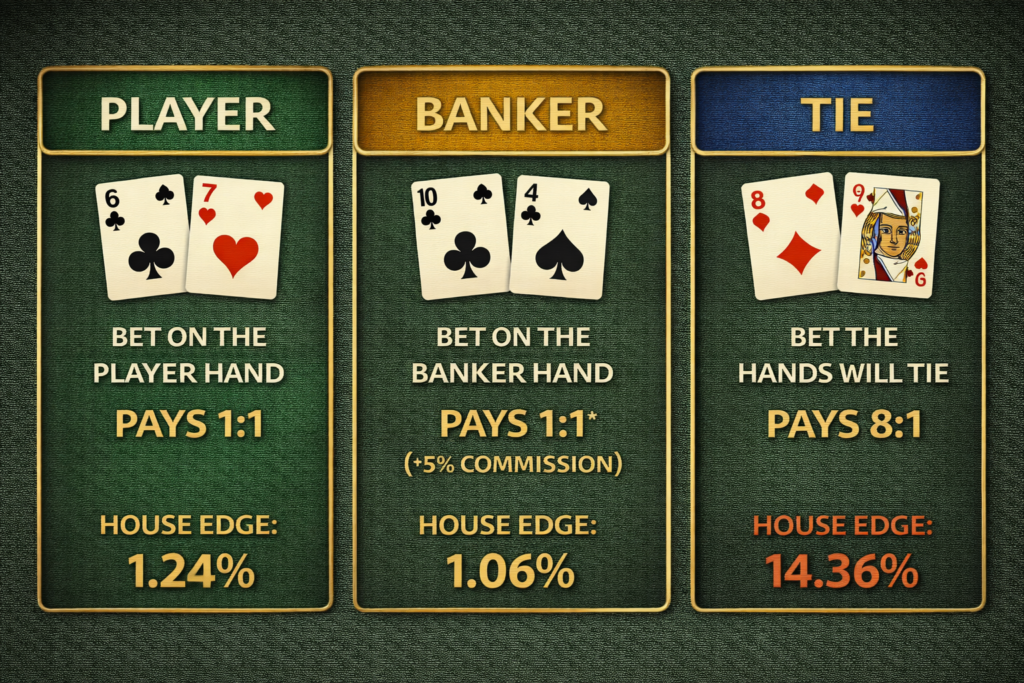
Before exploring individual bets, understanding the complete landscape establishes context.
Bet Structure and Basic Mechanics
Player Bet: You wager the Player hand will achieve a higher total (closer to 9) than the Banker hand. Wins pay 1:1 with no commission.
Banker Bet: You wager the Banker hand will achieve a higher total. Wins pay 1:1 minus 5% commission.
Tie Bet: You wager both hands achieve identical totals. Wins pay 8:1 (sometimes 9:1) with no commission.
Critical Distinction: These betting names don’t indicate which hand you’re playing. You might bet on Banker while another player bets on Player—all betting against the house, not each other.
Fundamental Probability Breakdown
Across standard 8-deck baccarat games, precise probabilities emerge:
- Banker wins: 45.86%
- Player wins: 44.62%
- Tie: 9.52%
The remaining percentage (negligible rounding) represents statistical fluctuation. Notice the Banker’s 1.24% advantage (45.86% – 44.62% = 1.24%) over Player hands—the mathematical foundation for understanding commission structure.
Quick Takeaway: Banker’s mathematical advantage explains why casinos deduct 5% commission on Banker wins. This commission balances the inherent advantage, creating fair competition between betting options.
The Banker Bet: Understanding Mathematical Advantage and Commission Impact
The Banker bet represents baccarat’s most mathematically sound wagering option—despite the 5% commission deterring casual players.
Banker’s Winning Probability and Why It Exists
The Banker hand wins 45.86% of hands versus the Player’s 44.62%. This 1.24% differential stems from drawing rules favoring the position playing last.
Drawing Rule Advantage: The Banker hand draws third (after observing Player’s action), enabling strategically informed decisions. While drawing rules are automatic rather than strategic, this positional advantage produces statistically superior outcomes.
Historical Data Confirmation: Decades of casino records confirm this 45.86% win rate with remarkable consistency across venues worldwide.
House Edge Calculation: The Commission’s True Impact
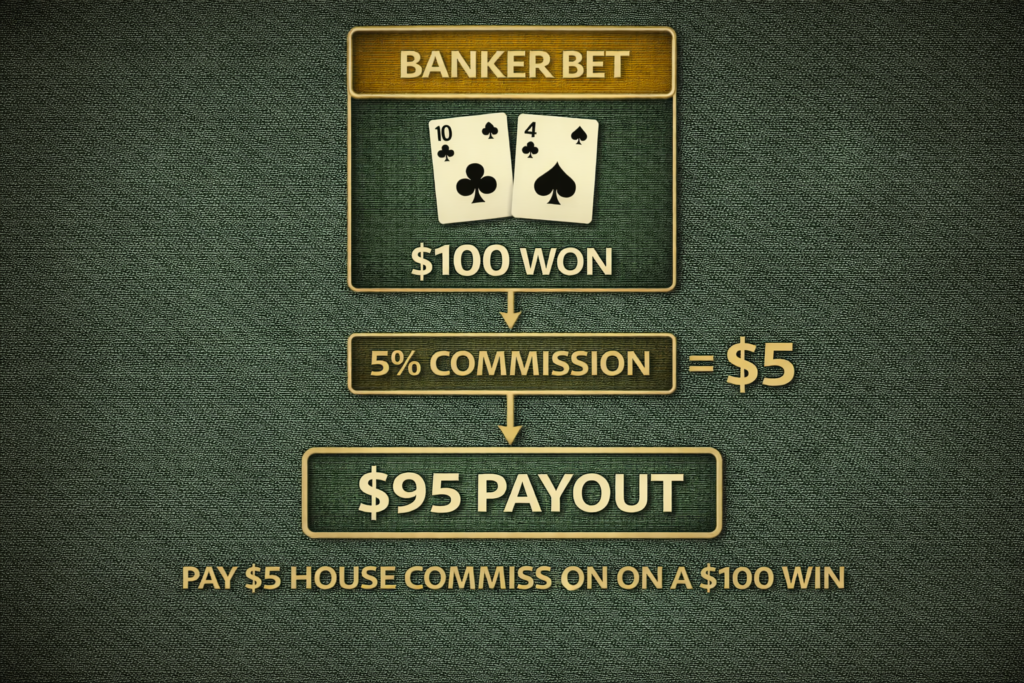
The 5% commission transforms apparent disadvantage into mathematical equality:
Scenario: You wager $100 on Banker and win:
- Gross payout: $100 (1:1 ratio)
- Commission deduction: $5 (5% of $100)
- Net profit: $95
- Total return: $195 ($100 original stake + $95 profit)
House Edge Calculation:
- Banker wins: 45.86% of the time
- Player wins: 44.62% of the time
- Ties: 9.52% (bets returned, zero net effect)
After accounting for commission on Banker wins and ties’ neutral impact, the Banker bet house edge: 1.06%
This 1.06% house edge represents your expected loss per dollar wagered over infinite hands. A $1,000 session wagering exclusively on Banker should average $10.60 loss—significantly better than alternative bets.
Why the Commission Is Actually Advantageous
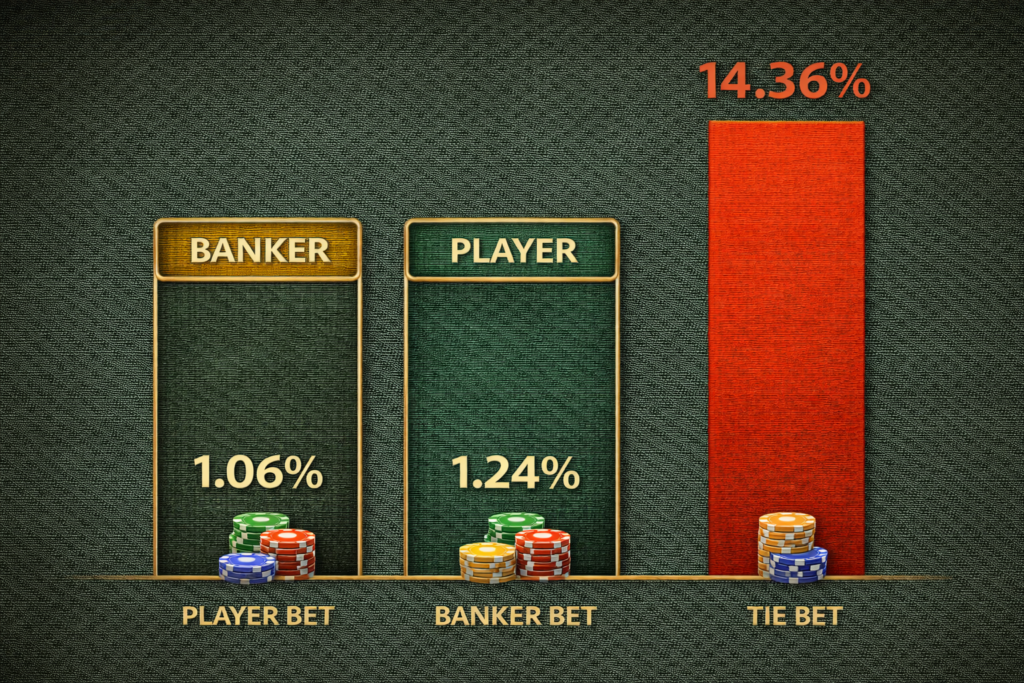
Professional players recognize the commission’s paradox: lower house edge despite taking a commission.
Comparison: Player bet offers 1.24% house edge—higher than Banker’s 1.06% despite receiving full 1:1 payouts. The Player bet’s mathematical disadvantage outweighs its commission-free status.
Conclusion: For long-term play, Banker betting mathematically outperforms Player betting. The 0.18% edge difference (1.24% – 1.06% = 0.18%) may seem trivial per hand, but compounds across extended sessions.
Expert Insight: Approximately 51% of experienced baccarat players exclusively bet Banker for this mathematical reason. They view the 5% commission as the cost of superior odds—a reasonable trade-off.
The Player Bet: Accessibility vs. Optimal Odds
The Player bet occupies the middle ground: accessible, psychologically appealing, yet mathematically inferior to Banker betting.
Player’s Odds and House Edge
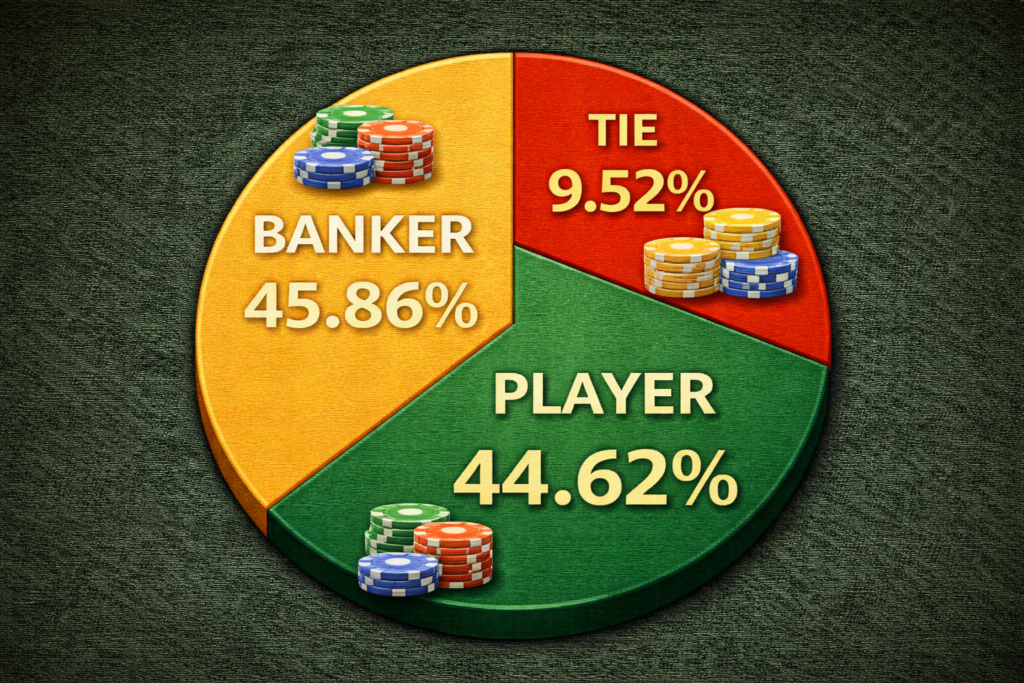
Player wins: 44.62% of hands
House edge: 1.24%
Payout: 1:1 (full even money with no deductions)
The Player bet’s appeal stems from simplicity: even-money payouts without commission calculations. Many beginners prefer this psychological clarity, avoiding Banker’s commission considerations.
When Player Betting Makes Sense
While statistically inferior, Player betting suits specific scenarios:
Scenario 1: Session Entertainment Duration
If your goal prioritizes extended play over mathematical optimization, Player betting’s marginally higher house edge (0.18% difference from Banker) matters less than consistent entertainment. Over 2-3 hours casual play, this difference produces minimal impact.
Scenario 2: Psychological Preference
Some players prefer even-money simplicity over calculating Banker payouts. The psychological comfort may enhance enjoyment enough to offset mathematical disadvantage.
Scenario 3: Bankroll-Limited Sessions
With limited session bankrolls (e.g., $50), the 0.18% house edge difference averages to $0.09 across that session—negligible compared to variance effects.
The Gambler’s Fallacy Risk
Player betting invites dangerous thinking: “Banker has won twice, so Player is ‘due.'” This Gambler’s Fallacy leads players to chase Player bets after Banker winning streaks, escalating losses through emotional decision-making.
Prevention: Regardless of recent outcomes, maintain consistent bet selection based on mathematical advantage, never recent hand history.
The Tie Bet: The Seductive Trap
The Tie bet represents baccarat’s most insidious wagering option—mathematically catastrophic despite offering the game’s highest payouts.
Tie Bet Mechanics and Payouts
Tie bet wager: Both hands achieve identical totals
Winning probability: 9.52%
Payout: 8:1 (some casinos offer 9:1)
House edge: 14.36% (with 8:1 payout) or 4.84% (with 9:1 payout)
Why Tie Bets Are Mathematically Terrible
The stark contrast between payout and probability reveals the trap:
Fair payout for 9.52% probability: 9.52:1 (paying $9.52 for every $1 wagered)
Actual payout: 8:1
This discrepancy creates the 14.36% house edge—among casino gaming’s worst bets.
Real-World Impact: Wagering $100 on Tie bets:
- Expected loss: $14.36 per $100 wagered
- Versus Banker betting: $1.06 per $100 wagered
- Difference: $13.30 per $100—1,254% more expensive
Why Tie Bets Appear Attractive
Understanding the psychological mechanics explains persistent Tie betting despite terrible odds:
Psychological Factor #1: Payout Magnitude
The 8:1 payout ($800 profit on $100 wager) triggers excitement disproportionate to actual probability. Humans psychologically overweight spectacular outcomes relative to their likelihood.
Psychological Factor #2: Rarity Appeal
Low-frequency events (9.52% occurrence) create anticipation. Players emotionally weight “overdue” Ties, ignoring that frequency never changes probability.
Psychological Factor #3: Casino Marketing
Casinos highlight Tie payouts in promotional materials while downplaying odds. A $100 Tie win story generates more excitement than consistent Banker grinding—but occurs 10x less frequently.
Pro Tip: Permanently eliminate Tie betting from your strategy. The 14.36% house edge creates losses faster than any other wager available. That capital allocates far more efficiently to Banker or Player bets.
Comparing Baccarat Betting Options: Head-to-Head Analysis
| Metric | Banker Bet | Player Bet | Tie Bet |
| Winning Probability | 45.86% | 44.62% | 9.52% |
| Payout Ratio | 0.95:1 | 1:1 | 8:1 |
| House Edge | 1.06% | 1.24% | 14.36% |
| Expected Loss per $100 | $1.06 | $1.24 | $14.36 |
| Psychological Appeal | Moderate (commission math) | High (simplicity) | Very High (payout) |
| Strategic Recommendation | Optimal | Acceptable | Avoid |
The Mathematics Made Simple
If you wager $1,000 across each betting option long-term:
- Banker bet: Expect to lose approximately $10.60
- Player bet: Expect to lose approximately $12.40
- Tie bet: Expect to lose approximately $143.60
The Tie bet costs 13.5x more than Banker betting to achieve identical mathematical randomness. This represents pure waste—capital better allocated elsewhere.
Strategic Bet Selection: Matching Wagers to Player Profiles
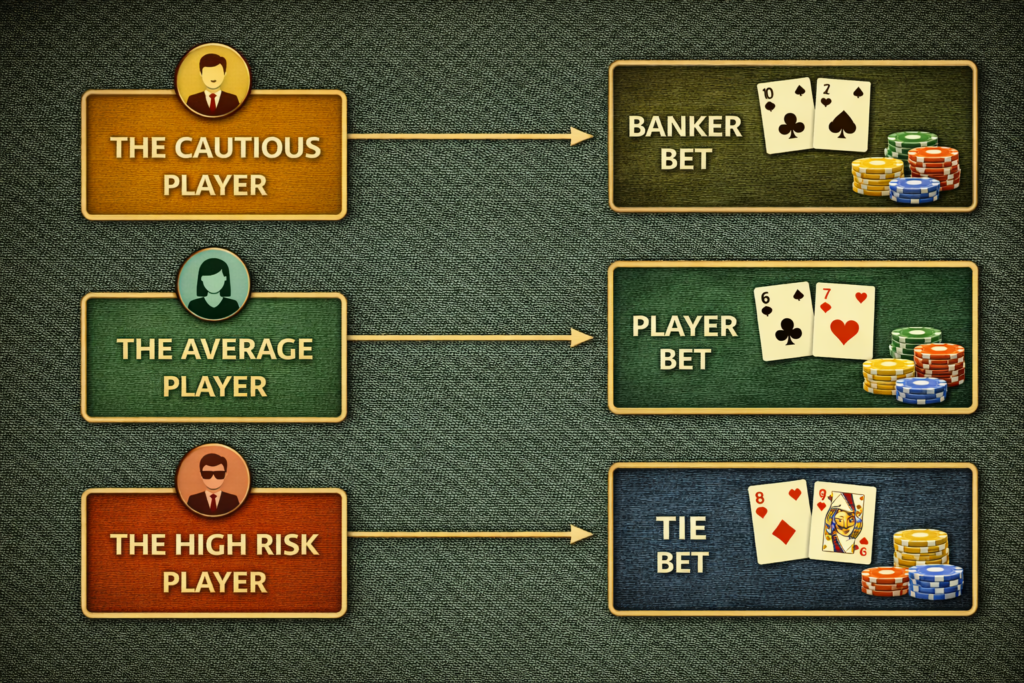
Different player types benefit from distinct betting strategies.
Conservative Player Profile
Characteristics: Limited bankroll, risk aversion, entertainment priority
Optimal bet selection: Banker bets exclusively
Rationale: Lowest house edge (1.06%) preserves capital longest. Extended play duration rewards conservative wagers.
Moderate Player Profile
Characteristics: Balanced approach, moderate bankroll, entertainment/profit balance
Optimal bet selection: 70% Banker, 30% Player
Rationale: Primarily leverages Banker’s mathematical advantage while maintaining Player betting variety. Psychological rotation prevents monotony.
Aggressive Player Profile
Characteristics: Large bankroll, high volatility tolerance, maximum profit focus
Optimal bet selection: Banker bets exclusively plus occasional inside bets (pair bets, Lucky 6)
Rationale: Maximizes mathematical advantage while side bets (if played) are clearly understood as entertainment supplements.
Never-Recommended Profile
Characteristic: Any strategy incorporating regular Tie betting
Why: The 14.36% house edge makes this mathematically indefensible under any circumstance.
Common Mistakes in Bet Selection
Mistake #1: Alternating Bets Based on Recent Results
Pattern: Betting Player after Banker winning streak (believing Player is “due”)
Reality: Each hand is independent; recent history is irrelevant
Solution: Commit to consistent bet selection regardless of outcome patterns
Mistake #2: “Chasing Ties” After Missing Several
Pattern: Increasing Tie bet size after multiple non-tie hands
Reality: Ties occur 9.52% of time independent of recent patterns
Solution: Eliminate Tie betting entirely; this pattern waste cannot exist
Mistake #3: Underestimating Commission Impact
Pattern: Believing Banker’s 5% commission somehow disadvantages the bet
Reality: Commission creates lower overall house edge (1.06% vs 1.24%)
Solution: Calculate net profits after commission; recognize commission as fair value
Mistake #4: Viewing Baccarat Betting as Predictable
Pattern: Believing sequences like “B-P-B-P” (Banker-Player-Banker-Player) predict future outcomes
Reality: Baccarat outcomes are genuinely random; patterns don’t influence probability
Solution: Accept mathematical randomness and focus on bankroll preservation
Advanced Considerations: Refining Bet Selection
Side Bets and Alternative Wagering Options
Beyond standard Player/Banker/Tie, casinos offer:
Pair Bets: First two cards match in rank (payout varies 11:1-12:1)
Lucky 6: Banker hand totals exactly 6 (payout 13:1-21:1)
Perfect Pair: Both hands produce matching pairs (payout 25:1)
These side bets carry house edges exceeding 10%, making them entertainment supplements rather than strategic wagers. Use side bets only if explicitly understanding and accepting their mathematical disadvantage.
Commission-Free Baccarat Variants
Some casinos offer “commission-free” versions where Banker 6 totals pay 1:2 instead of 1:1 minus 5% commission.
Mathematical Reality: Commission-free variants maintain house edges identical to standard games through adjusted payouts. They’re marketing innovations, not mathematical improvements.
Shoe Composition and Card Tracking
Experienced players sometimes track remaining card composition (advanced technique) identifying when Player vs Banker probabilities shift beyond 50-50 balance.
Beginner recommendation: Ignore shoe composition. The mathematical advantage is minimal and requires extensive practice to exploit effectively.
Bankroll Management: Making Bets Sustainable
Optimal baccarat betting options mean nothing without corresponding bankroll discipline.
Recommended Betting Structure
Total Bankroll: $1,000 (money you can afford to lose)
Session Bankroll: $100 (10% of total)
Unit Size: $10 (10% of session bankroll)
Betting Limit: Wager between 1-6 units per hand (so $10-60)
This structure enables approximately 10 independent sessions before total bankroll depletion, providing multiple recovery opportunities despite mathematical house edge.
Stop-Loss Implementation
Exit when losing 50% of session bankroll ($50 of initial $100). This prevents emotional escalation and bankroll devastation.
Profit Target Strategy
Exit when winning 100% of session bankroll (doubling $100 to $200). This locks in profits and prevents emotional decisions attempting to maximize short-term gains.
Conclusion: Making Informed Betting Decisions
Baccarat betting options differ dramatically in mathematical reality despite appearing identical on the surface.
The Banker bet offers 1.06% house edge—best available option. Accept the 5% commission as fair value for mathematical advantage.
The Player bet offers acceptable 1.24% house edge. Choose it if psychological preference justifies marginally higher cost.
The Tie bet offers catastrophic 14.36% house edge. Permanently eliminate it from consideration.
By aligning betting decisions with mathematical reality, you transform from uninformed gambler to strategic player. You won’t beat baccarat’s inherent house edge—no one does long-term. But you’ll optimize entertainment value within mathematical reality while preserving capital for extended play.
Choose Banker betting for superior mathematics. Accept the commission as price of advantage. Avoid Tie bets entirely. Within these parameters, enjoy baccarat as entertaining gaming rather than financial recklessness.