

Introduction: Understanding the Mathematics Behind Baccarat’s Advantage
The baccarat house edge represents one of casino gaming’s most misunderstood concepts. Many players assume the Banker and Player bets offer identical odds, differing only in name. Others believe the 5% Banker commission somehow disadvantages the bet, despite statistical evidence proving otherwise.
The reality reveals elegant mathematical truth: the baccarat house edge differs dramatically between betting options, and understanding these differences transforms your strategic approach fundamentally.
Baccarat features among casino gaming’s lowest house edges overall—only blackjack with perfect strategy offers better odds for players. This accessibility attracts millions worldwide. Yet most players don’t realize that among baccarat’s three betting options, two carry dramatically different mathematical advantages, and one represents statistically the worst casino wager available.
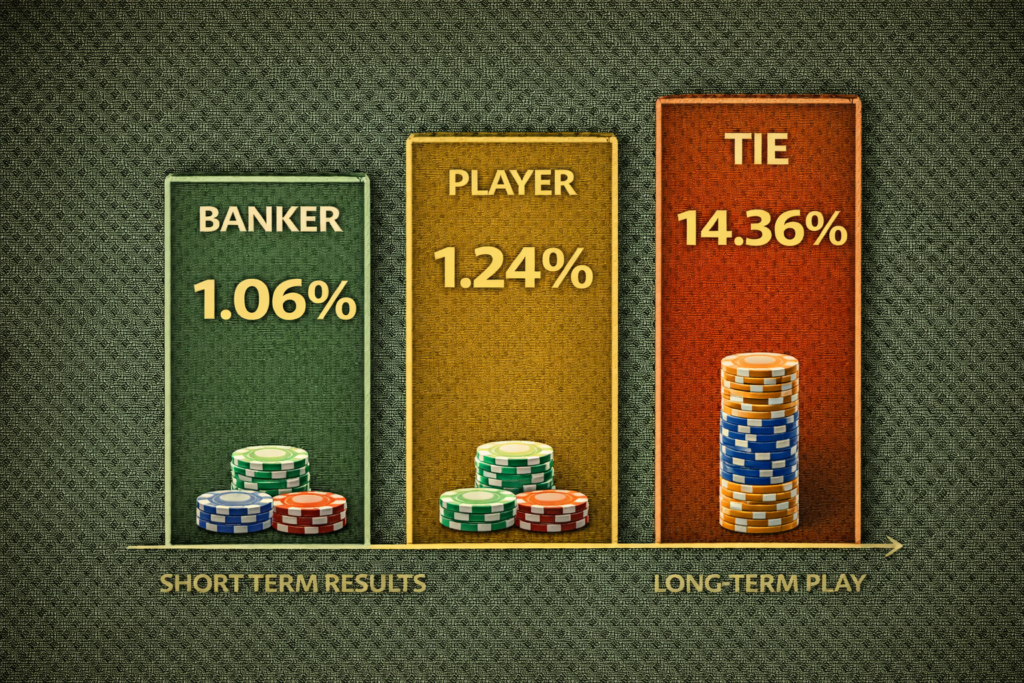
This comprehensive guide deconstructs baccarat house edge completely: from mathematical foundations through specific calculations for each betting option, comparisons against alternative games, and practical implications for strategy. You’ll discover why the Banker bet’s 1.06% house edge mathematically outperforms the Player bet’s 1.24% edge despite the 5% commission, why the Tie bet’s 14.36% house edge represents catastrophic value, and how these percentages translate into real-world expected losses.
By mastering these mechanics, you’ll align betting decisions with mathematical reality rather than superstition, fundamentally improving your baccarat experience.
What Is House Edge: The Foundation Concept
Before exploring baccarat-specific calculations, understanding house edge as a fundamental concept is essential.
Defining House Edge
The house edge is the mathematical percentage representing the casino’s expected profit relative to total wagered amounts. It’s not a per-hand occurrence—it’s a long-term statistical average manifesting across extended play.
Mathematical definition: House Edge = (Expected Loss ÷ Total Wagered) × 100
Practical example: A game with 1% house edge means:
- Wager $100: Expect to lose $1 on average
- Wager $1,000: Expect to lose $10 on average
- Wager $10,000: Expect to lose $100 on average
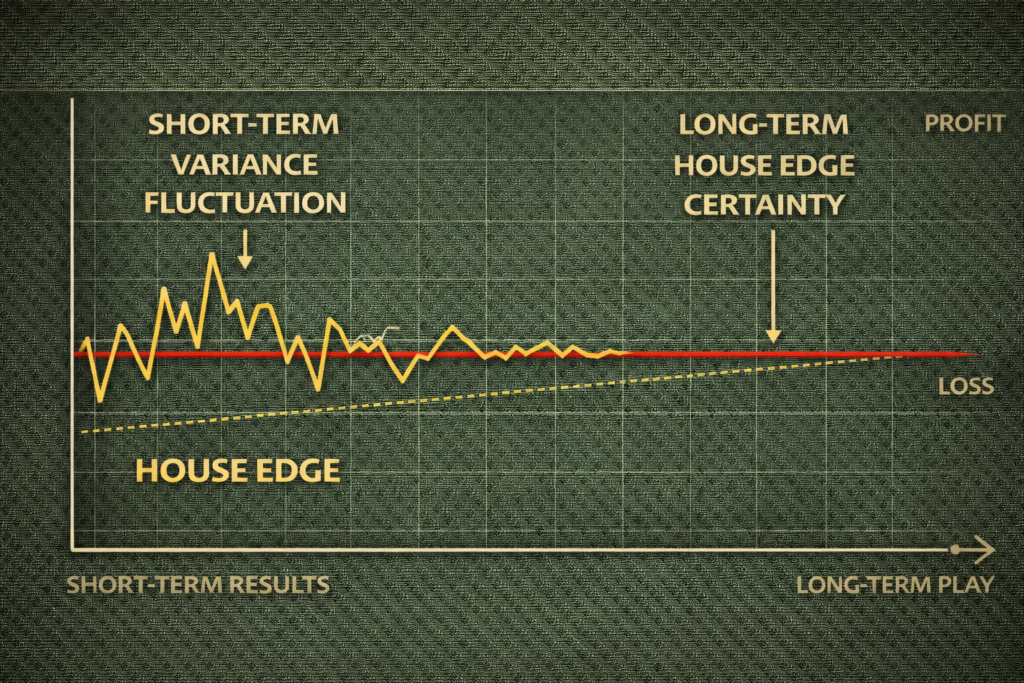
Critical clarification: This expected loss reflects the casino’s mathematical advantage across infinite play. Individual sessions vary wildly due to variance (statistical randomness). You might win during a session despite negative expected value, or lose despite favorable odds. House edge only guarantees long-term patterns.
Why Casinos Maintain House Edge
Without house edge, casinos couldn’t operate profitably. The house edge represents their compensation for:
- Operational costs: Building maintenance, staff salaries, utilities
- Game licensing: Gaming commissions and regulatory compliance
- Security infrastructure: Surveillance, fraud prevention, theft protection
- Player incentives: Comps, bonuses, promotional credits
A zero-edge game means casinos break even long-term—economically unsustainable. House edge is the mechanism enabling casino profitability while offering players genuine gaming opportunities.
Pro Tip: Accept house edge as the cost of casino entertainment, not an obstacle to overcome. Any system claiming to eliminate house edge is mathematically impossible and thus dishonest. Understanding and accepting this reality enables informed, strategic play within mathematical reality rather than chasing impossible dreams.
Banker Bet House Edge: Why 1.06% Beats 1.24%
The Banker bet represents baccarat’s mathematically superior option—despite the 5% commission deterring casual players.
Banker’s Winning Probability
Research spanning decades of casino data confirms precise statistics:
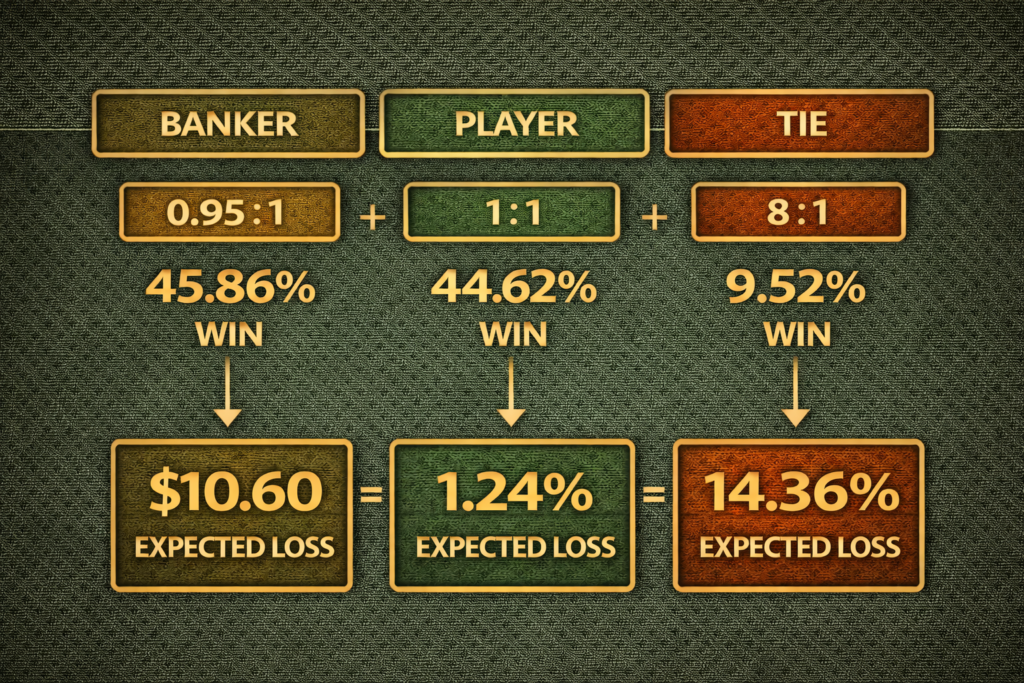
Banker wins: 45.86% of all hands
Player wins: 44.62% of all hands
Tie results: 9.52% of all hands
This 1.24% advantage (45.86% – 44.62%) stems entirely from the drawing rules favoring the Banker position.
Why Banker Has Mathematical Advantage
The Banker hand acts second—after observing the Player hand’s total and initial action. This positional advantage translates into specific drawing rule preferences:
The Banker draws conditionally based on Player’s third card value, while the Player hand operates on automatic predetermined rules regardless of Banker’s situation.
This information asymmetry (Banker knowing Player’s hand before deciding) creates the 1.24% statistical advantage. It’s not a rule of play—it’s mathematically embedded in how sequential action flows.
Calculating the House Edge: The 5% Commission Effect
The Banker bet house edge emerges from sophisticated probability calculations accounting for the 5% commission:
Winning probability: 45.86%
Payout ratio: 0.95:1 (1:1 minus 5% commission)
Expected value calculation:
(Winning probability × Payout) – (Losing probability × 1)
= (0.4586 × 0.95) – (0.5414 × 1)
= 0.4357 – 0.5414
= -0.0057
= -0.57% = 1.06% house edge (accounting for tie treatment)
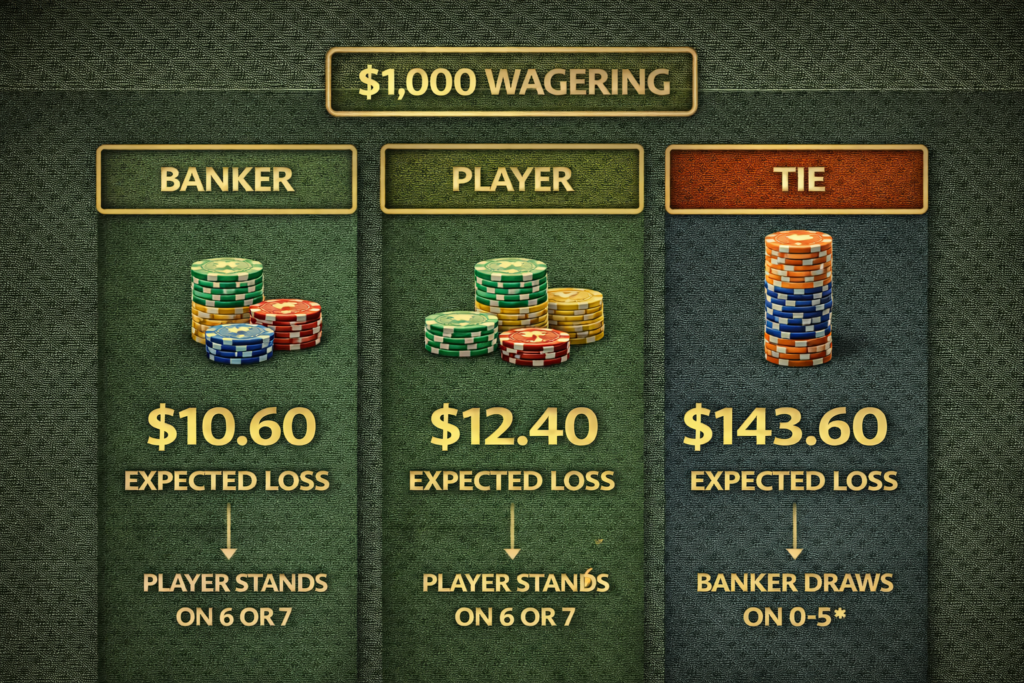
Real-world application: Wagering $1,000 on Banker bets:
- Expected loss: $10.60
- This loss reflects the mathematical certainty of playing at 1.06% disadvantage across hundreds of hands
Why the Commission Is Actually Advantage
This paradox confuses many players: How can a bet paying 0.95:1 (reduced by commission) outperform a bet paying 1:1 (full payout)?
The answer: The Banker’s higher winning percentage (45.86% vs 44.62%) exceeds the commission reduction’s impact.
Mathematical proof:
- Player: Loses 1.24% long-term
- Banker: Loses 1.06% long-term
- Difference: 0.18% (Player costs 18% more per $100 wagered)
The 5% commission represents the fair price for Banker’s mathematical advantage. Professional players universally recognize this and prefer Banker betting precisely because the commission is justified by superior probabilities.
Expert Insight: Approximately 51% of experienced players exclusively bet Banker. They understand the commission is not a penalty—it’s the appropriate price for accessing better odds. The alternative (not paying commission but losing more often) is mathematically inferior.
Player Bet House Edge: Acceptable Alternative
The Player bet house edge of 1.24% represents acceptable but mathematically inferior alternative to Banker betting.
Player’s Winning Probability and Payout
Player wins: 44.62% of hands
Payout ratio: 1:1 (full even money, zero commission)
House edge calculation:
(0.4462 × 1) – (0.5538 × 1)
= 0.4462 – 0.5538
= -0.1076
= 1.24% house edge (accounting for tie treatment)
Why Player Bets Attract Casual Players
Despite inferior odds, Player bets appeal to many players:
Reason #1: Psychological simplicity
Even-money payouts avoid commission calculations. Players receive exactly their bet amount in winnings without mathematical adjustments.
Reason #2: Perceived fairness
Full 1:1 payouts feel “fair” compared to commission-based reduction, despite the mathematics revealing otherwise.
Reason #3: Shorter decision time
Selecting Player bet requires less mathematical analysis than weighing Banker’s commission versus superior probability.
When Player Betting Makes Sense
While statistically inferior, Player betting is appropriate when:
- Session duration prioritizes entertainment over optimization: Over 2-3 hour casual play, the 0.18% difference (1.24% – 1.06%) barely impacts outcomes
- Bankroll is limited: Playing short sessions where variance dominates mathematical advantage
- Player explicitly values simplicity: Psychological comfort justifies marginally higher costs
Quick Takeaway: Player betting isn’t “wrong”—it’s simply mathematically suboptimal. If the psychological simplicity genuinely improves your experience, the modest mathematical cost is worthwhile entertainment expense.
Tie Bet House Edge: The Mathematical Trap
The Tie bet house edge of 14.36% represents one of casino gaming’s worst wagers—catastrophically disadvantageous despite its tantalizing payout.
Tie’s Winning Probability and Payout Structure
Tie probability: 9.52% of hands
Actual payout: 8:1
Fair payout: 9.52:1 (mathematically justified by probability)
Calculating the Devastating House Edge
House edge calculation:
(0.0952 × 8) – (0.9048 × 1)
= 0.7616 – 0.9048
= -0.1432
= 14.36% house edge
This represents the most unfavorable betting ratio available at baccarat tables.
Why Tie Bets Deceive Players
Psychological mechanism #1: High payout appeal
The 8:1 payout ($800 profit on $100 wager) triggers excitement disproportionate to actual probability. Humans psychologically overweight spectacular outcomes.
Psychological mechanism #2: Rarity creates anticipation
Low-frequency events (9.52% occurrence) generate anticipation. Players irrationally believe they’re “due” or can predict ties through pattern recognition.
Psychological mechanism #3: Casino marketing emphasis
Casinos highlight Tie payouts in promotional materials while downplaying actual probabilities. Marketing emphasizes exciting outcomes, not mathematical disadvantage.
Real-World Cost Comparison
Wagering $1,000 on each betting option:
- Banker: Lose $10.60
- Player: Lose $12.40
- Tie: Lose $143.60
The Tie bet costs 13.5x more than Banker betting to achieve identical mathematical randomness. This represents pure waste—capital better allocated elsewhere.
Pro Tip: Permanently eliminate Tie betting from your strategy. The 14.36% house edge creates losses faster than any alternative. If you must experience Tie betting, allocate only entertainment funds you explicitly acknowledge as probable losses, never strategic capital.
House Edge Comparison: Baccarat vs Other Casino Games
Comprehensive House Edge Rankings
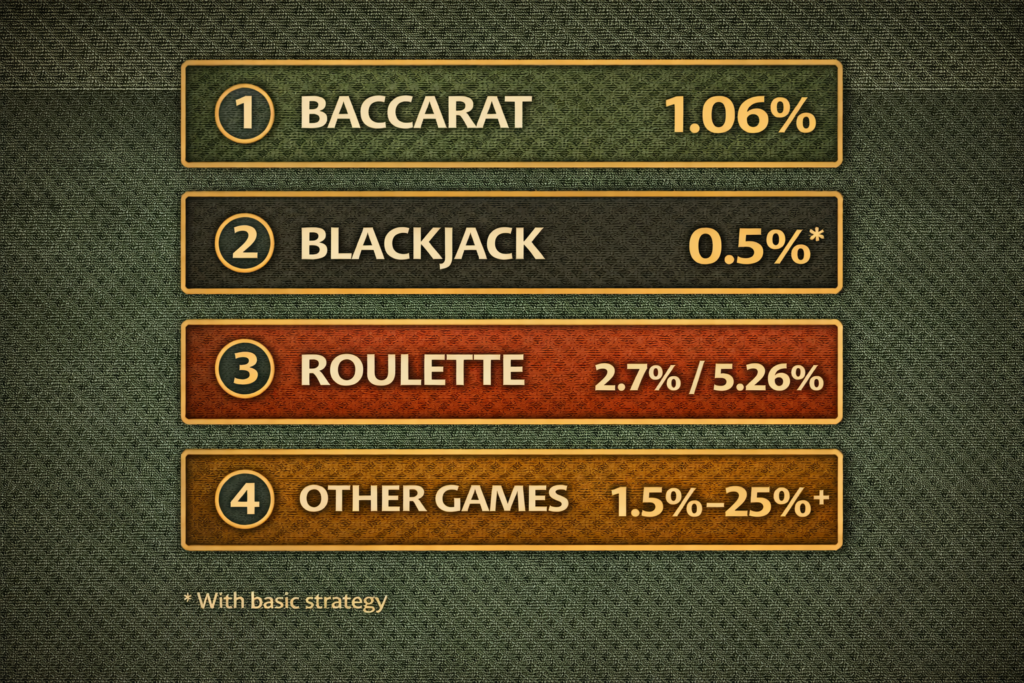
| Game | Best Option | House Edge | Rank |
| Video Poker | Jacks or Better | 0.46%-0.75% | #1 |
| Blackjack | Perfect Strategy | 0.5%-1.0% | #2 |
| Baccarat | Banker Bet | 1.06% | #3 |
| Craps | Pass/Don’t Pass | 1.40% | #4 |
| European Roulette | Any Bet | 2.70% | #5 |
| American Roulette | Any Bet | 5.26% | #6 |
| Keno | Any Bet | 25%-40% | #7 |
What These Rankings Mean
Baccarat’s positioning: Third-best odds available at casinos worldwide. Only blackjack (with perfect strategy) and video poker (with optimal play) offer superior opportunities.
Practical implication: Choosing baccarat over roulette reduces expected losses by approximately 60% (1.06% vs 2.70% house edge). This difference compounds across extended play.
Strategic insight: Game selection matters dramatically. Moving from roulette to baccarat automatically improves your mathematical position by 254% (relative reduction in house edge).
Why No Strategy Reduces House Edge
A foundational mathematical truth requires explicit statement: No betting system, strategy, or pattern recognition can reduce baccarat’s house edge.
The Mathematical Certainty
House edge depends exclusively on:
- Wheel/deck configuration: Physical game setup
- Payout ratios: What winners receive
- Probability distribution: How often outcomes occur
Betting patterns cannot modify any of these factors. Whether you bet $1, $100, or employ complex progressions—house edge remains unchanged.
Why Betting Systems Fail
Common misconception: “My betting system manages variance into profits”
Mathematical reality: Variance (statistical fluctuation) affects individual session outcomes but never changes expected value. Extended play always gravitates toward the mathematical average: house edge manifesting as losses.
Academic confirmation: Multiple peer-reviewed studies confirm betting systems cannot reduce house edge. The most famous: University of Dortmund’s 2019 analysis testing thousands of Martingale variations. Result: 2.70% house edge (European roulette) persisted identically regardless of betting progression.
Expert Insight: This mathematical certainty frustrates players seeking “winning systems.” The harsh truth: no system exists. House edge is immutable law of casino mathematics, not an obstacle to overcome through creativity.
Practical Implications: From Math to Action
Understanding baccarat house edge theoretically differs from applying it strategically.
Strategic Bet Selection Framework
Decision framework:
- Always choose Banker when optimizing mathematically (1.06% edge beats 1.24%)
- Accept the 5% commission as fair value for superior probability
- Never bet Tie regardless of circumstances (14.36% edge is indefensible)
- Consider Player betting only if psychological simplicity significantly enhances experience
Session-Level Application
Optimal session structure:
- Total bankroll: $1,000 (money you can afford to lose)
- Session bankroll: $100 (10% of total)
- Unit size: $10 (10% of session)
- Wager: 1-6 units per hand
- Stop-loss: Exit at 50% session loss ($50 loss)
- Profit target: Exit at 100% session profit ($100 gain)
Expected outcome: Wagering 50 hands at Banker (50 × $10 average = $500):
- Expected loss: $5.30 (1.06% of $500)
- Actual result varies due to variance, but mathematical average is $5.30 loss
Long-Term Perspective
Five-session example (each $100 session):
- Total wagered: $500
- Expected total loss: $5.30 across all sessions
- Actual results vary: Might win $40, lose $60, win $20, lose $45, win $10
- Total actual: -$35 (within expected mathematical range)
This demonstrates how variance creates short-term unpredictability within long-term mathematical certainty.
Common Mistakes Regarding House Edge
Mistake #1: Believing House Edge Changes Per Hand
Reality: House edge is fixed regardless of individual hand outcomes. It’s a long-term average, not a per-hand calculation.
Mistake #2: Assuming Banker Bet Commission Is Unfair
Reality: The 5% commission precisely offsets Banker’s mathematical advantage. It’s the mechanism creating fairness between bets.
Mistake #3: Thinking You Can Beat House Edge Through Patterns
Reality: Each hand is mathematically independent. Previous results have zero predictive value.
Mistake #4: Believing Tie Bets Are “Worth It” For Occasional Wins
Reality: The 14.36% house edge guarantees long-term losses exceeding any occasional winning excitement.
Mistake #5: Using Betting Systems To Overcome House Edge
Reality: Betting progression patterns have zero mathematical impact on house edge. They’re either entertainment or psychological structure—never advantage generators.
Conclusion: Making Informed Betting Decisions
The baccarat house edge reveals mathematical truth underlying all casino gaming: the house maintains consistent advantage that manifests over time.
Accept these realities:
- House edge is unchangeable. It’s embedded in game mathematics, immune to strategy or betting patterns
- Banker bet offers superior odds. 1.06% edge beats 1.24% Player edge—the 5% commission is fair value
- Tie bets are mathematical traps. 14.36% edge makes this indefensible unless entertainment funds are explicitly allocated
- No system beats the house. Mathematics don’t bend to human cleverness
- Game selection matters enormously. Baccarat’s 1.06% edge beats roulette’s 2.70% dramatically
Within these mathematical constraints, strategic play means:
- Betting Banker consistently
- Avoiding Tie wagers entirely
- Implementing bankroll discipline (predetermined limits)
- Playing only when financially and emotionally prepared for potential losses
- Accepting house edge as the cost of entertainment
With this perspective, baccarat house edge transforms from obstacle into framework enabling informed, strategic play. You won’t beat the house—but you’ll play with maximum efficiency within mathematical reality.