

Introduction: Demystifying the Complex Craps Table Layout
The craps table layout intimidates many beginners with its apparent complexity and numerous betting areas. Yet this seemingly chaotic design follows logical organization once you understand its structure. The craps table layout is specifically designed to accommodate 20 simultaneous players while maintaining organizational clarity for dealers managing multiple concurrent wagers.
In reality, the table layout divides into three distinct sections, each serving specific betting purposes. Understanding these sections transforms overwhelming visual chaos into comprehensible organization. Most successful craps players focus on just a handful of core betting areas while ignoring numerous complicated alternatives.
Research shows approximately 68% of beginning craps players feel confused about table positioning and bet placement, leading to costly errors and dealer frustration. Meanwhile, experienced players navigate the craps table layout intuitively, knowing exactly where to place every bet and understanding table geography without hesitation.
This comprehensive guide deconstructs the craps table layout section by section: explaining physical dimensions, identifying every betting area, clarifying self-service versus dealer-assisted zones, detailing how dealers track multiple players’ bets, and providing clear navigation guidance. You’ll master the entire layout geography, enabling confident bet placement and professional table interaction.
Quick Takeaway: The craps table layout divides into two mirror-image wings plus a central proposition area. Learn the wing structure first, then master the central section as advanced play develops.
Overall Table Dimensions and Structure
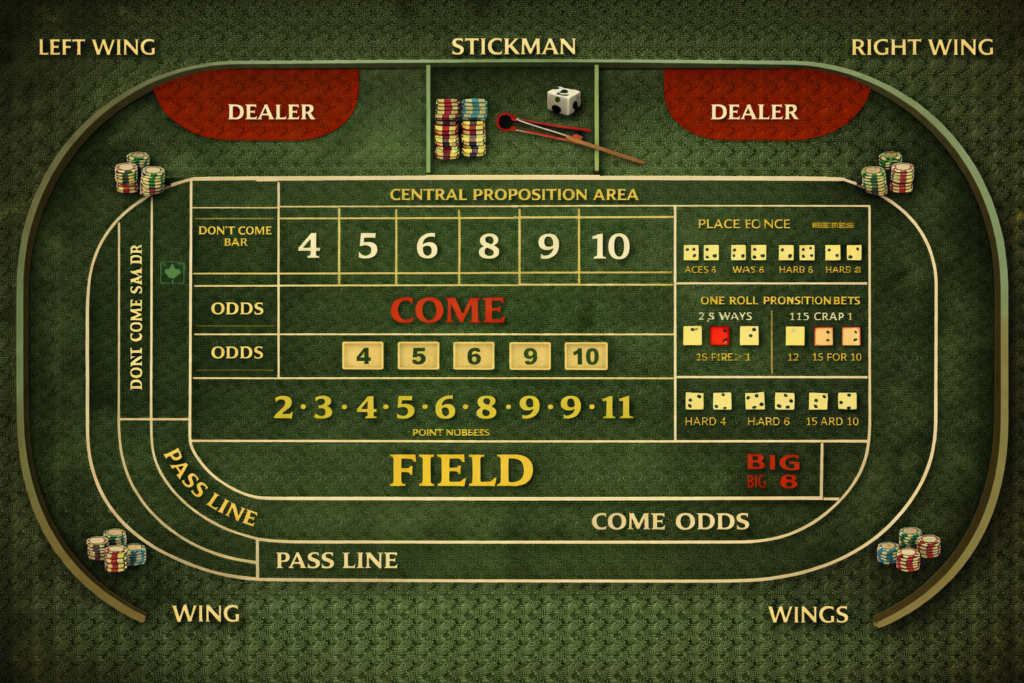
Physical Specifications
A standard craps table layout measures approximately 12 feet long by 4 feet wide, accommodating up to 20 simultaneous players around its perimeter. This specific sizing enables all players to reach betting areas comfortably while maintaining dealer supervision.
Table structure components:
- Two identical wings: Mirror-image halves accommodating main betting areas
- Central proposition section: Specialized high-payout bets served by the stickman
- Three dealer zones: Boxman (center), Stickman (center), and two Dealers (one per wing)
Symmetrical Wing Design
The symmetry is intentional and crucial. Every position around the table provides identical access to all primary betting options. This prevents competitive advantage based on table positioning—a fundamental fairness principle ensuring all players enjoy equal opportunities.
Practical implication: You can sit anywhere around the table comfortably. No position is superior to another for accessing basic betting areas.
The Wings: Primary Betting Areas
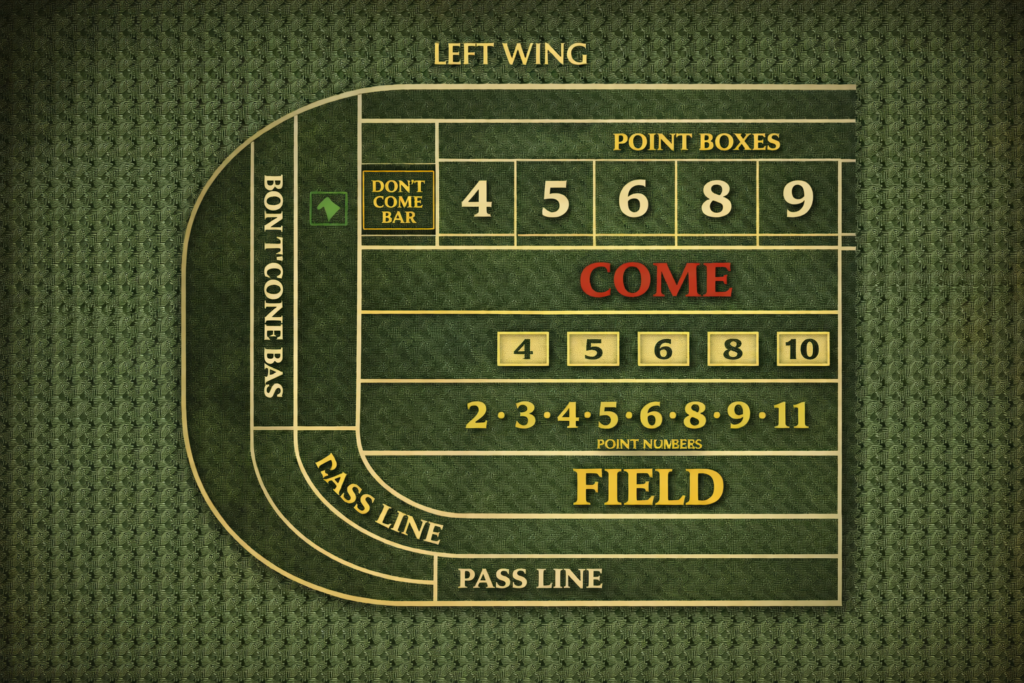
Understanding Wing Organization
Each wing of the craps table layout contains all fundamental betting areas used during active gameplay. These sections include Pass Line, Don’t Pass, Come, Don’t Come, Point boxes, Field, and supporting areas.
The wings’ organization follows logical flow matching actual game progression: Pass Line area for come-out rolls, Point boxes for established points, Come sections for secondary positioning, and supporting bets throughout.
Pass Line and Don’t Pass Areas
Pass Line betting section: A stripe running around the table’s outer edge marks the Pass Line. This is where you place pre-come-out-roll wagers betting with the shooter.
Don’t Pass area: Adjacent to Pass Line, marked “Don’t Pass Bar 12” to indicate the 12 push rule.
Location advantage: These areas are positioned on the table’s perimeter, enabling all players to access them easily from their standing positions. No special dealer assistance is required—you place chips yourself directly into these sections.
Point Box Sections
Six point boxes (marked 4, 5, 6, 8, 9, 10) occupy prominent positions in each wing. These boxes receive Come bets when points establish and serve as reference markers for point progression.
Organization principle: Point boxes are arranged sequentially, enabling dealers to quickly identify which number is “live” during point play.
Dealer management: Dealers organize chips within each point box according to player position. A player standing at the table’s upper-left places their bet in the upper-left of each box, enabling easy tracking of multiple concurrent wagers.
Field Betting Area
The Field section displays numbers 2, 3, 4, 9, 10, 11, and 12—covering seven winning numbers on one-roll bets. This area occupies prominent table real estate despite carrying high (5.56%) house edge.
Positioning: Field sections appear in both wings identically, enabling any player to access Field betting without dealer assistance.
The Come and Don’t Come Areas
Come Bet Mechanics and Placement
The Come area functions identically to Pass Line but activates after point establishment. Come bets are self-service—you place chips directly into the marked Come section.
When a Come point establishes, dealers automatically move your chips to the corresponding point box, maintaining your position relative to the table. This transition happens mechanically, requiring no player action.
Real-world example:
- Point already established: 8
- You place Come bet by dropping chips into Come section
- Next roll: 5
- Dealer automatically moves your chips to the “5” point box
- Your Come bet now has 5 as its personal point
Don’t Come Placement
Don’t Come sections sit adjacent to Come areas, marked “Don’t Come Bar 12.” Placement mechanics mirror Come betting—self-service placement initially, then automatic dealer transfer when points establish.
The Central Proposition Section: Advanced Betting
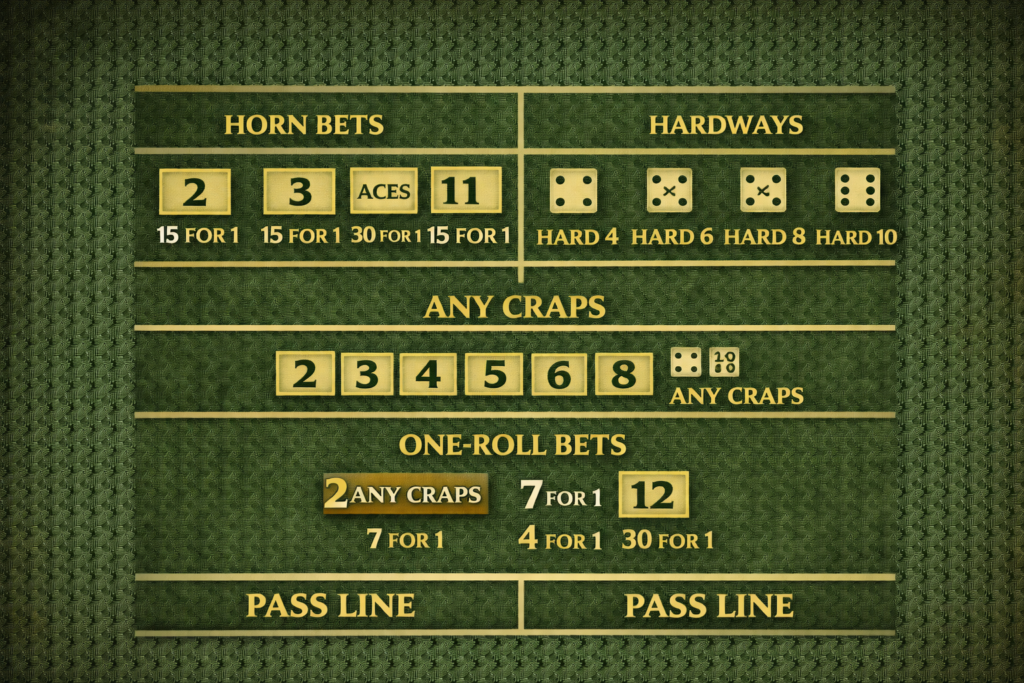
Purpose and Organization
The central proposition area occupies the table’s middle, visible to both wings while managed exclusively by the stickman. This section houses high-payout, high-house-edge proposition bets used less frequently by strategic players.
Proposition categories:
- One-roll bets: Snake Eyes (2), Boxcars (12), specific number combinations
- Hard ways: Wagering specific even numbers appear as doubles (3-3, 4-4, 5-5)
- Horn bets: Multiple single-roll combinations
- Any Seven: Wagering 7 appears on next roll
- Craps & Eleven (C&E): Combination bets covering craps and eleven
Understanding Proposition Payouts
Proposition bets display payout ratios prominently. Critical distinction: 6-to-1 means profit of $6 (plus return of original $1 wager for $7 total return), while 6-for-1 means $6 total (casino keeps original wager).
Professional insight: Proposition bets consistently offer 4-7% higher house edge than optimal alternatives. Avoid them entirely unless treating them purely as entertainment with explicit entertainment-only budget allocation.
Accessing Proposition Bets
Unlike wing bets, proposition bets require dealer assistance. You don’t place chips directly—you indicate your desired proposition and bet amount to the stickman, who places chips on your behalf.
This dealer-assisted model creates inherent friction, naturally discouraging casual proposition betting and reserving these bets for deliberate, strategic players.
Self-Service vs. Dealer-Assisted Betting Areas
Self-Service Betting Zones
Self-service areas where you place chips directly without dealer assistance:
- Pass Line and odds bets
- Don’t Pass and odds bets
- Come betting areas
- Field betting section
- Big 6/8 (if available)
Advantage: Speed and control—your chips go exactly where intended without intermediary handling.
Dealer-Assisted Zones
Areas requiring dealer/stickman placement:
- Proposition bets (all types)
- Come bets transitioning to point boxes (dealer moves them)
- Don’t Come bets transitioning to point boxes (dealer moves them)
- Place bets (some casinos allow self-service; many require dealer placement)
Purpose: Dealer involvement for specialized bets maintains organization when multiple players maintain concurrent wagers on identical numbers.
Tracking Multiple Players’ Bets: The Position System
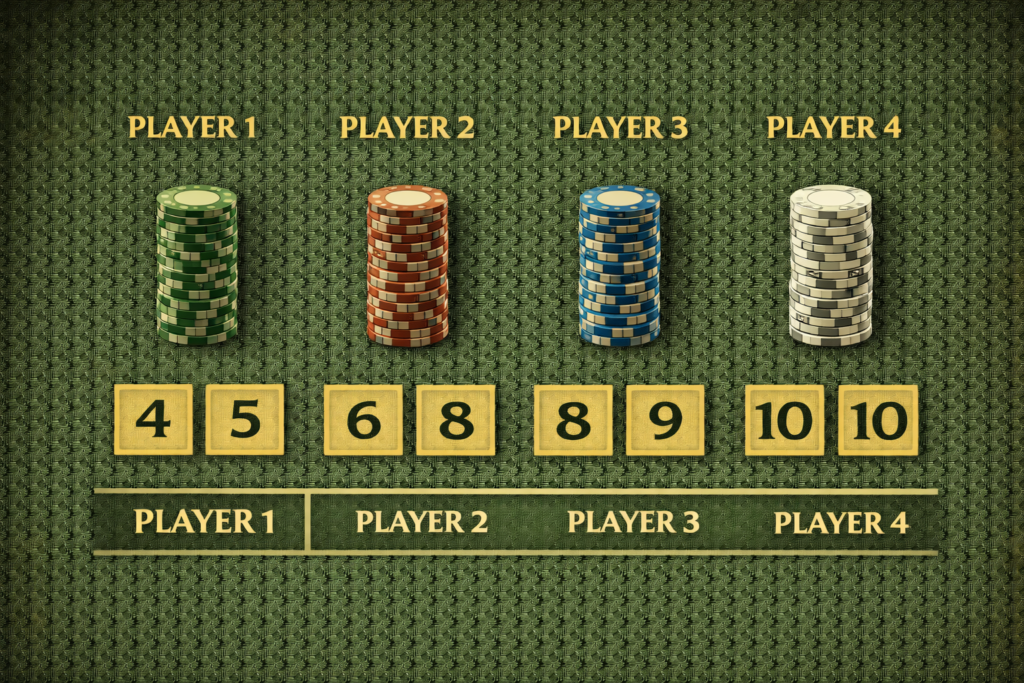
How Dealers Maintain Organization
With multiple players betting on identical numbers simultaneously, tracking bets requires meticulous organization. The solution: positioning bets according to each player’s table location.
Positioning principle: Each player’s position around the table corresponds to their bet location within each numbered section.
Real-world example:
Three players at the table with bets on the 8:
- Player at upper-left corner: Bet appears in upper-left of the 8 box
- Player at bottom-center: Bet appears in center-bottom of the 8 box
- Player at right side: Bet appears in right section of the 8 box
This positioning system enables dealers to instantly identify which bet belongs to which player despite all chips appearing identical.
Best Practices for Bet Placement
Consistency matters: Always place your self-service bets in the same relative position. If you stand at the table’s left corner, place bets in locations closest to your position.
Dealer communication: Confirm every bet placement with your dealer. “Thirty on the pass line” or similar verbal confirmation prevents misunderstandings.
Physical positioning: Stand consistently near your preferred betting area. This makes your betting location intuitive for dealers and speeds up game flow.
The Craps Table Crew: Positions and Responsibilities
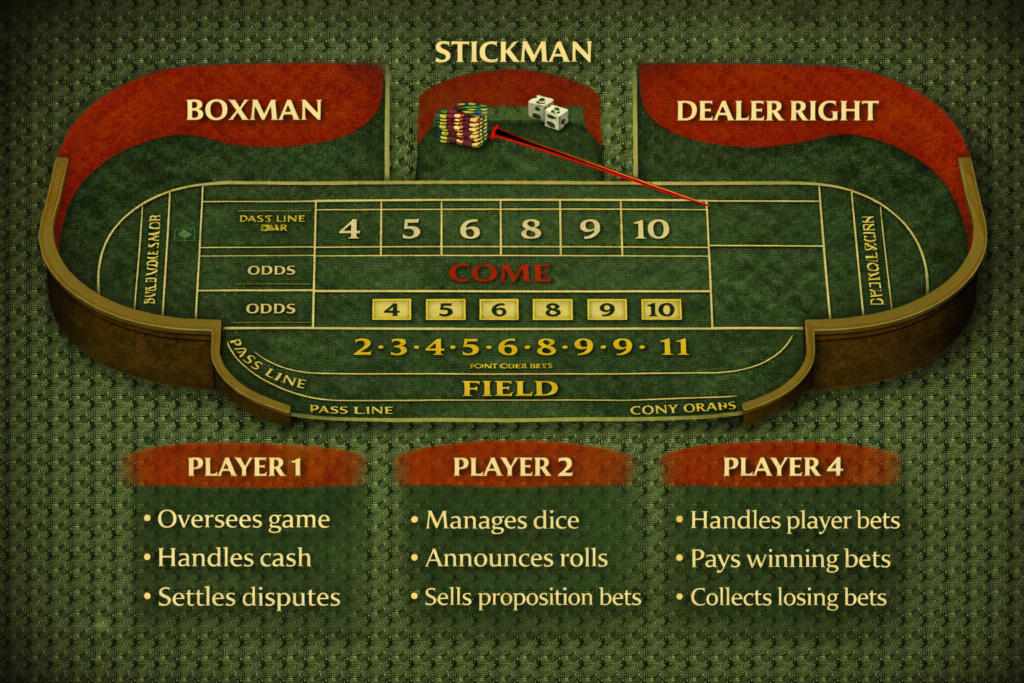
The Boxman
The Boxman sits opposite the Stickman, supervising the entire operation. Responsibilities include:
- Monitoring game integrity
- Managing the table’s chip bank
- Handling player club cards and disputes
- Making final judgment on betting ambiguities
Location: Centered opposite Stickman, with clear visibility of all areas.
The Stickman
The Stickman controls the central proposition area with a 30-inch rattan L-shaped stick, enabling manipulation of dice and chips across table distances.
Responsibilities:
- Managing proposition bets
- Controlling and announcing dice outcomes
- Directing dealer payouts
- Controlling game pace
Unique position: Only member equipped to manage the central section efficiently.
The Dealers (Two Per Table)
Two Dealers—one per wing—manage all wing-specific functions:
- Placing Come/Don’t Come chips into point boxes
- Calculating and paying winning bets
- Collecting losing bets
- Answering player questions about their specific wing
Why two dealers: Wings accommodate multiple simultaneous bets requiring independent management. Two dealers prevent bottlenecks during high-action sequences.
Navigation Guide: Finding Your Bet Areas
Beginner-Friendly Betting Route
New player approach: Stick to three areas initially:
- Pass Line: Outer stripe around table—simplest self-service bet
- Odds area: Directly behind Pass Line after point establishment
- Come section: After mastering Pass/Odds, add Come betting when comfortable
This three-area focus enables learning table geography without overwhelming complexity.
Progressive Learning Path
Session 1-5: Master Pass Line, understand Point boxes, practice consistent chip placement
Session 6-10: Add Odds betting, understand payout ratios, practice odds calculations
Session 11-20: Introduce Come bets, understand transition mechanics, practice multiple simultaneous point management
Advanced: Explore Field bets (understanding poor odds), attempt proposition bets with explicit entertainment-only allocation, master complex multi-bet combinations
Common Layout Navigation Mistakes
Mistake #1: Confusion About Dealer-Assisted vs. Self-Service
Error: Attempting to place proposition bets yourself instead of through stickman
Prevention: Remember: if you’re placing chips directly, it’s self-service; if signaling the dealer, it’s dealer-assisted. Proposition bets are always dealer-assisted.
Mistake #2: Inconsistent Chip Placement
Error: Placing bets in varying locations around the table, confusing dealers about chip ownership
Prevention: Maintain consistent position relative to table. Always place self-service bets from your standing position toward your nearest table edge.
Mistake #3: Not Confirming Bet Amounts
Error: Assuming dealers understood your bet quantity without verbal confirmation
Prevention: Always state bet amount and type clearly: “Twenty dollars on the pass line” ensures no misunderstanding.
Mistake #4: Ignoring Table Crew Positions
Error: Attempting to negotiate with wrong crew member about disputes
Prevention: Know crew roles: Dealers manage wing bets, Stickman manages propositions, Boxman handles disputes and final decisions.
Tips for Confident Table Navigation
Pro Tip #1: Scout Before Playing
Arrive during off-peak hours and observe table operation. Watch how dealers organize bets, how chips flow, how different players interact with the layout. This passive observation clarifies structure before you wager.
Pro Tip #2: Ask Questions During Slow Periods
Dealers appreciate questions during slow table times. Ask them to explain areas, demonstrate transitions, clarify payout locations. Most dealers gladly explain layouts to interested players.
Pro Tip #3: Use Mental Landmarks
Mentally divide the table into sections: “upper-left wing,” “central proposition,” “right wing.” Navigate using these landmarks rather than trying to memorize every box.
Conclusion: Mastering Craps Table Layout
The craps table layout appears complex initially but follows logical organization. Understanding its three-section structure, self-service versus dealer-assisted areas, and position-based chip tracking transforms chaos into comprehensible geography.
Master these fundamentals:
- Two wings: Identical sections containing Pass, Don’t Pass, Come, Don’t Come, and Point boxes
- Central section: Proposition bets managed by stickman
- Position system: Your table location determines chip placement within each section
- Crew roles: Know who handles what—dealers for wings, stickman for center, boxman for disputes
With this layout understanding, you’ll navigate craps tables confidently, place bets accurately, and interact professionally with table crews. The craps table layout transforms from intimidating mystery to intuitive geography.