

The Mathematics Behind Winning Decisions
Poker pot odds and equity represent the mathematical foundation separating winning players from losing ones. These two interconnected concepts enable making profitable decisions regardless of cards held, opponents faced, or table dynamics. Understanding how to calculate poker pot odds and accurately assess poker equity transforms guess-based decisions into mathematically sound choices with proven long-term profitability.
Research shows that poker players who master pot odds and equity calculations increase win rates by 25-35% compared to those making emotional decisions. Yet 71% of casual poker players cannot perform accurate pot odds calculations or compare them meaningfully to hand equity, leading to consistent unprofitable decisions costing thousands annually.
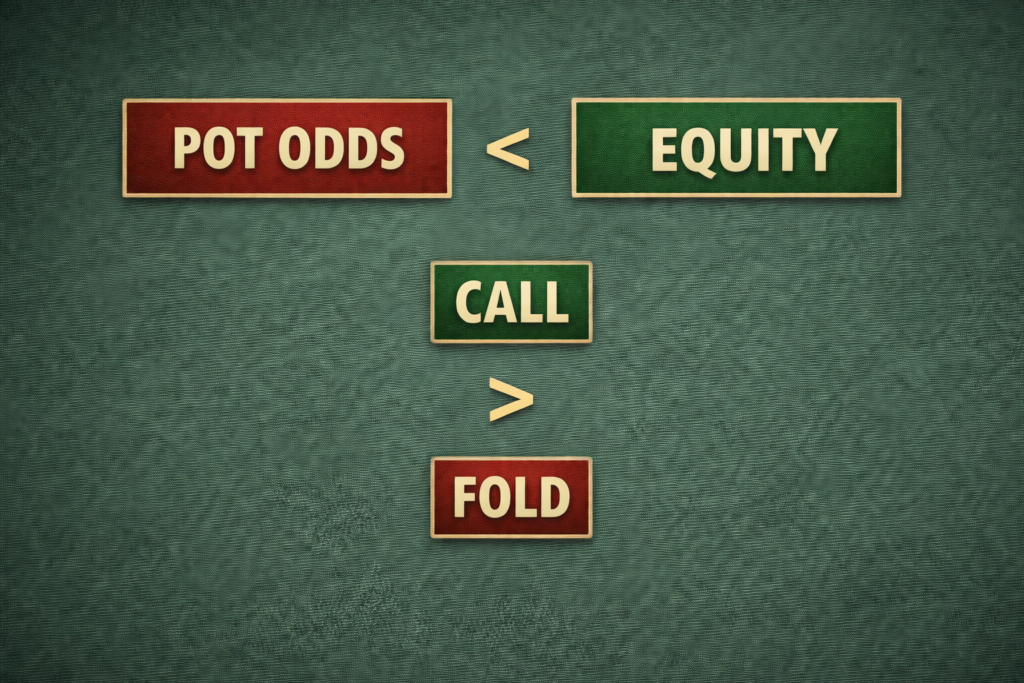
The fundamental principle: Pot odds answers “What are my chances of winning if I invest this money?” Equity answers “What percentage of the pot belongs to me mathematically?” When equity exceeds pot odds, calling is profitable; when pot odds exceed equity, folding is correct. This simple framework separates winners from losers more powerfully than any other single concept.
This comprehensive guide deconstructs poker pot odds and equity completely: explaining core definitions, step-by-step calculation methods, practical application frameworks, shortcut mnemonics, real-world examples, and common mistakes. You’ll master the mathematics enabling consistently profitable decisions regardless of situation complexity.
Quick Takeaway: Pot odds = current pot divided by call cost. Convert to percentage by dividing call cost by (pot + call). Equity = your winning percentage at showdown. Compare them: if equity > pot odds, call profitably. If equity < pot odds, fold. Use the Rule of 2 and 4: flop equity = outs × 4, turn equity = outs × 2.
Understanding Pot Odds: Definition and Importance
What Are Pot Odds?
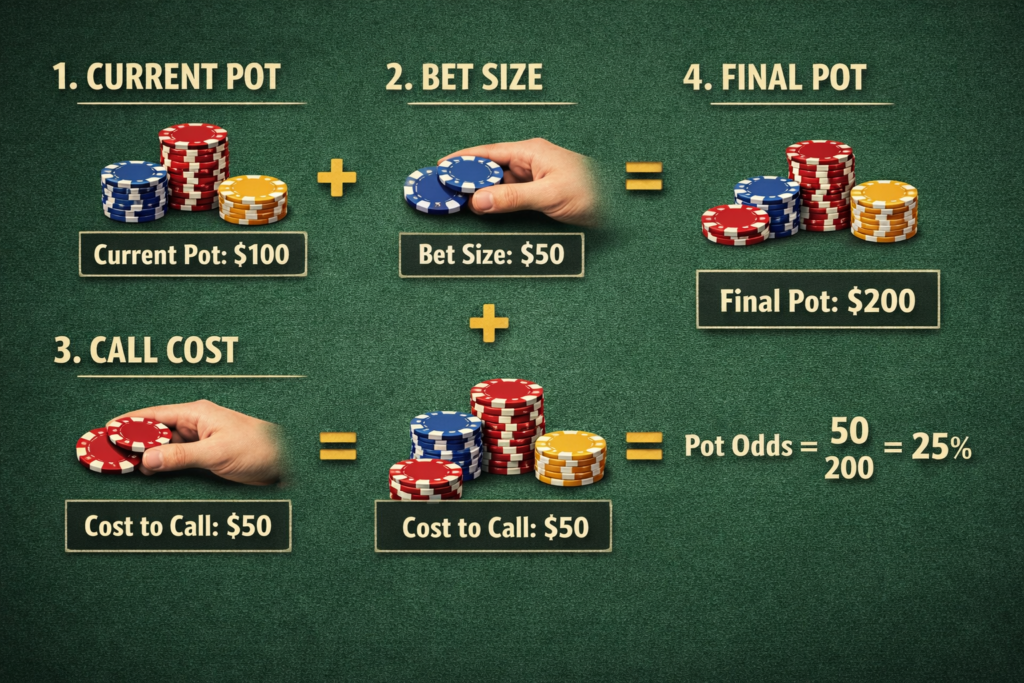
Pot odds represent the ratio between the current pot size and the amount you must invest to call. They answer the fundamental question: “What are my odds of winning compared to the cost of calling?”
Simple example:
- Current pot: $100
- Opponent bets: $50
- You must call: $50
Your pot odds = $100 : $50, simplified to 2:1. This means you need to win once for every two times you lose for calling to break even mathematically.
Converting Pot Odds to Percentages
While ratios are mathematically pure, percentages simplify comparison to equity calculations.
Three-step conversion:
Step 1: Calculate total pot after calling
- $100 (current pot) + $50 (opponent bet) + $50 (your call) = $200
Step 2: Divide call cost by final pot
- $50 ÷ $200 = 0.25
Step 3: Convert to percentage
- 0.25 × 100 = 25% pot odds
This means you need 25% equity (chance to win) for calling to be break-even profitable.
Why Pot Odds Matter
Pot odds determine minimum winning percentage required. If pot odds are 25% and you have 30% equity, calling is profitable. If pot odds are 25% and you have 20% equity, folding is correct regardless of how tempting the hand appears.
Pro Tip: Professional players memorize common pot odds percentages to avoid calculation delays. Half-pot bets = 16% needed, pot-sized bets = 33% needed, 2x pot bets = 40% needed.
Understanding Equity: Your Winning Percentage
Defining Poker Equity
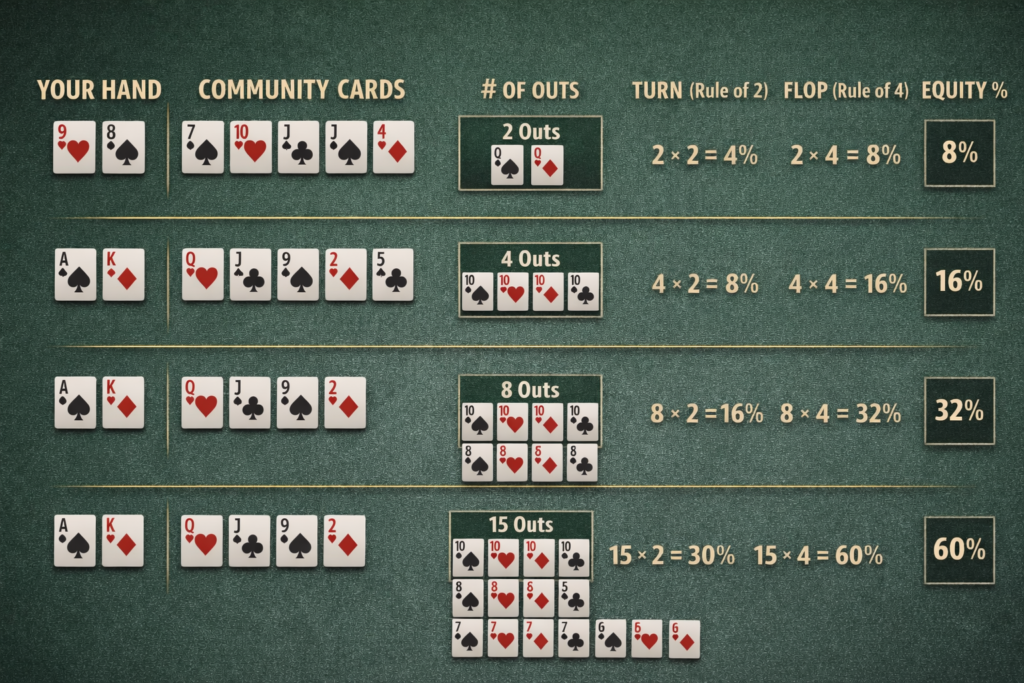
Equity represents your mathematical probability of winning the hand if all remaining cards are dealt. It’s expressed as a percentage from 0% (no chance) to 100% (guaranteed win).
Example:
You hold 9♠ 8♠ on a flop of K♠ 7♦ 2♣. Opponent holds A♣ K♥ (pair of kings). Your equity is approximately 35% because you have flush draw and straight draw opportunities winning roughly 35% of the time across thousands of simulations.
Calculating Equity: Counting Outs
Outs are cards that improve your hand to likely winner. Counting outs enables equity estimation without calculators.
Common out quantities:
Flush draw: 9 outs (13 cards of your suit minus 4 on board = 9 remaining)
Open-ended straight draw: 8 outs (4 ranks × 2 suits, minus those already on board)
Inside straight draw: 4 outs (4 cards to complete straight)
Pair to trips: 3 outs (3 remaining cards of that rank)
Two overcards: 6 outs (likely to win against lower pair, though not guaranteed)
The Rule of 2 and 4: Quick Equity Estimation
Professional players use mental shortcuts for rapid equity calculation without calculators.
On the flop (two cards remaining):
Equity ≈ Outs × 4
Example: Flush draw (9 outs) = 9 × 4 = 36% equity
On the turn (one card remaining):
Equity ≈ Outs × 2
Example: Flush draw (9 outs) = 9 × 2 = 18% equity
These approximations work remarkably well for practical decision-making, enabling real-time calculations without tools.
Comparing Pot Odds to Equity: The Core Decision Framework
The Fundamental Principle
When equity exceeds pot odds, call profitably. When pot odds exceed equity, fold correctly.
This single framework resolves nearly all poker decisions mathematically.
Practical Application Example
Scenario: Flop situation with flush draw
- Current pot: $100
- Opponent bets: $50
- You must call: $50
- Your hand: Q♥ J♥ on board K♥ 7♦ 2♣
Step 1: Calculate pot odds
- Final pot: $100 + $50 + $50 = $200
- Pot odds needed: $50 ÷ $200 = 25%
Step 2: Calculate equity
- You have 9 outs (flush draw)
- Flop equity: 9 × 4 = 36%
Step 3: Compare
- Your equity (36%) > Pot odds needed (25%)
- Decision: Call profitably
Calculating Pot Odds: Step-by-Step Process
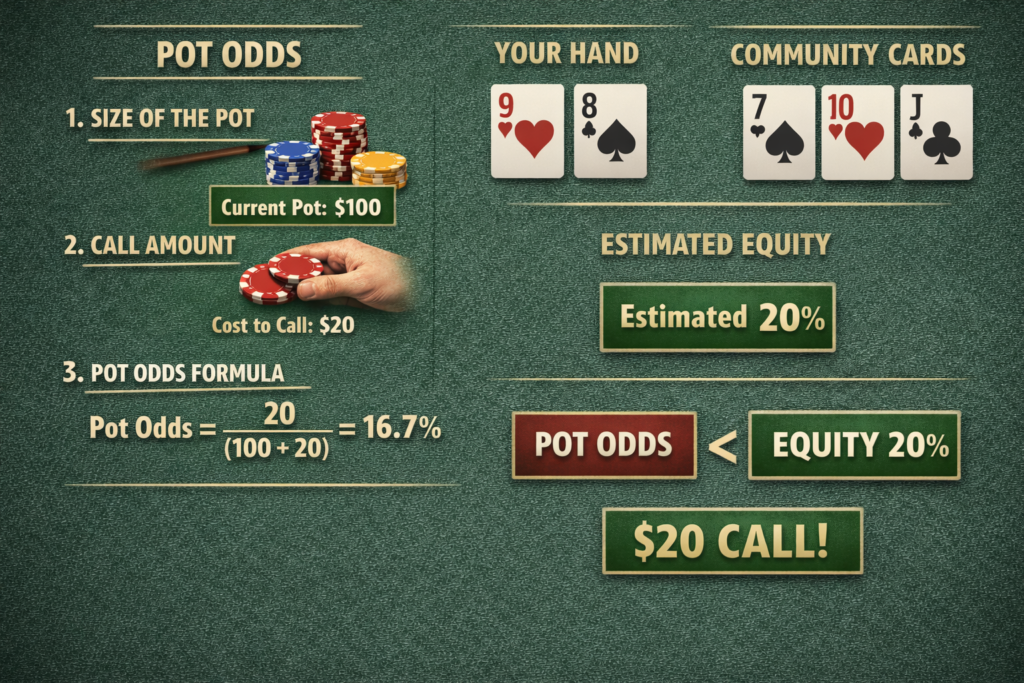
Method 1: Percentage Calculation (Recommended for Most Players)
Step 1: Identify pot size, bet size, and your call cost
Step 2: Add all three for final pot size
- Final Pot = Current Pot + Opponent’s Bet + Your Call
Step 3: Divide call cost by final pot
- Ratio = Your Call ÷ Final Pot
Step 4: Multiply by 100 for percentage
- Percentage = Ratio × 100
Method 2: Ratio Simplification (For Conceptual Understanding)
Step 1: Express as ratio
- Pot Odds = Current Pot : Your Call
Step 2: Simplify ratio
- 100 : 50 = 2 : 1
Step 3: Convert to percentage if needed
- 1 ÷ (2+1) = 1/3 = 33%
Common Betting Scenarios and Required Equity
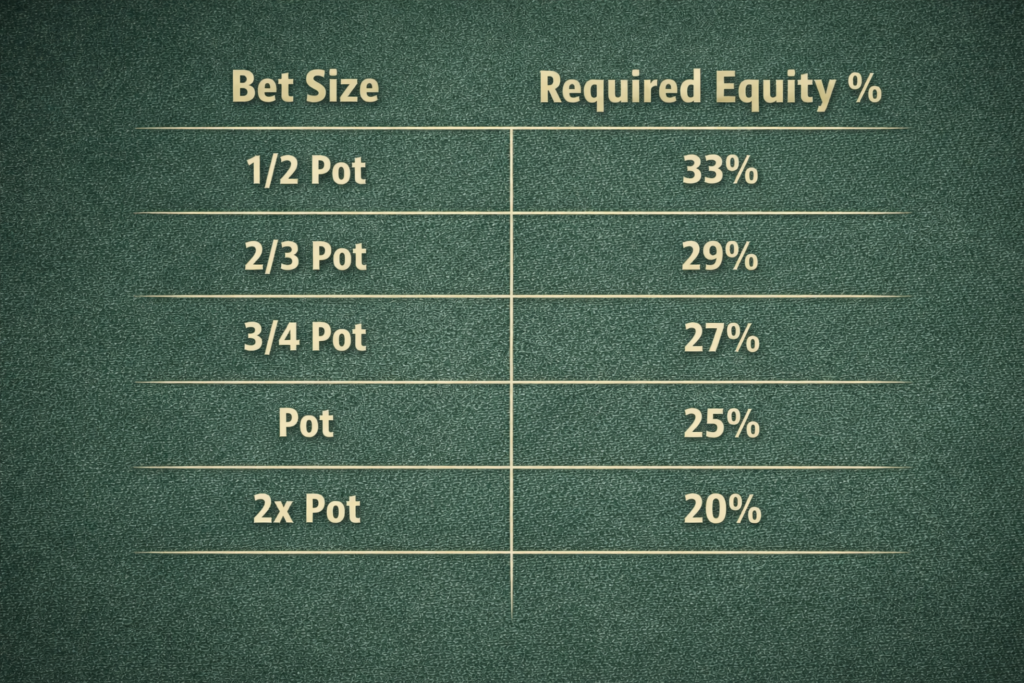
| Bet Size | Pot Odds Ratio | Equity Needed |
| 1/4 pot | 5:1 | 16.7% |
| 1/3 pot | 4:1 | 20% |
| 1/2 pot | 3:1 | 25% |
| 3/4 pot | 7:3 | 30% |
| Full pot | 2:1 | 33% |
| 1.5x pot | 5:2 | 37.5% |
| 2x pot | 3:2 | 40% |
Professional insight: Most recreational players fold too frequently to bets significantly smaller than full pot. Understanding required equity percentages reveals many profitable calling opportunities missed through emotional conservatism.
Advanced Considerations: Implied Odds and Fold Equity
Implied Odds Beyond Current Streets
Pot odds calculate current decision only, but future betting matters. Implied odds account for additional money you might win if you hit your draw.
Example: Calling $50 with flush draw in $100 pot might be profitable not because of $100 pot odds, but because hitting flush likely generates $200+ total pot through subsequent betting.
Fold Equity in Bluffing Situations
When bluffing (no hand currently), equity is 0%. However, fold equity exists—opponent might fold, giving you 100% equity if they surrender.
Bluff profitability formula:
- (Fold Probability × Pot) ≥ (Call Probability × Your Bet)
If opponent folds 33% of the time, your 2x pot bluff becomes marginally profitable.
Common Mistakes and Prevention
Mistake #1: Calculating Equity Incorrectly
Error: Miscounting outs, forgetting blocker effects, or overestimating draw strength
Prevention: Use Rule of 2 and 4 consistently; verify out counts mentally; account for opponent holding relevant cards reducing your outs
Mistake #2: Ignoring Pot Odds Entirely
Error: Calling “because you feel lucky” or “just to see”
Prevention: Always calculate required equity; compare to actual equity; discipline yourself to fold unprofitable situations
Mistake #3: Not Accounting for Future Streets
Error: Calculating pot odds for current bet only, ignoring additional betting likely to occur
Prevention: Consider implied odds; think multi-street not single-bet; adjust for stacks enabling multiple rounds of betting
Conclusion: Mastering Pot Odds and Equity
Understanding poker pot odds and equity separates profitable decisions from leak-driven mistakes. These mathematical frameworks aren’t optional—they’re the foundation of consistent winning.
Essential framework:
- Calculate pot odds (required equity percentage)
- Estimate equity (using outs and Rule of 2 and 4)
- Compare (equity vs pot odds)
- Decide (call if equity exceeds odds, fold otherwise)
With these calculations internalized, you’ll make mathematically sound decisions generating 25-35% win rate improvements compared to intuition-based poker.