

Introduction: Understanding Baccarat’s Two Most Distinct Variants
When exploring baccarat game variants, most players encounter two fundamentally different experiences: Punto Banco and Chemin de Fer. Yet confusion persists about their distinctions, with many assuming these names simply represent regional terminology for identical games.
The reality differs dramatically. Punto Banco and Chemin de Fer represent distinct philosophical approaches to baccarat—one prioritizes simplicity and standardization, the other emphasizes player skill and social interaction. Understanding these differences transforms your casino experience from passive observation to informed participation.
The baccarat variants landscape includes dozens of modern innovations, but Punto Banco and Chemin de Fer remain the foundational games underlying everything else. Punto Banco dominates North American and online casinos through its accessibility and automation. Chemin de Fer survives in European establishments through its strategic depth and rotating banker mechanics.
This comprehensive guide deconstructs both variants completely: from gameplay mechanics and rule differences through strategic implications, player involvement, and practical availability. You’ll discover why Punto Banco attracts beginners despite offering zero decision-making, why Chemin de Fer rewards experienced players through genuine strategic choices, and which variant suits your playing style.
By mastering these distinctions, you’ll select appropriate tables confidently while understanding exactly what each variant demands strategically and socially.
Punto Banco: The Standardized Modern Version
Punto Banco represents baccarat’s most accessible iteration—streamlined, automated, and globally standardized. Also called “North American Baccarat,” it dominates modern casinos through simplicity.
Core Mechanics and Gameplay Structure
Punto Banco translates literally to “Player Banker” in Spanish/Italian, reflecting the game’s two competing hands. Despite these names, all players bet against the house—not against each other.
Key characteristics:
- Casino always acts as Banker (house-banked game)
- 6-8 standard card decks shuffled together
- All drawing rules are completely automatic
- Players make zero strategic decisions beyond initial bet selection
- Dealer handles all card dealing and management
Betting structure: Before cards are dealt, players select one of three betting options:
- Player bet: Wagers the Player hand totals closer to 9
- Banker bet: Wagers the Banker hand totals closer to 9
- Tie bet: Wagers both hands achieve identical totals
Once bets are placed, gameplay proceeds mechanically according to fixed rules—no player input affects outcomes.
Drawing Rules in Punto Banco: Complete Automation
The defining characteristic separating Punto Banco from Chemin de Fer is complete rule automation.
Player hand drawing rules:
- 0-5: Must draw third card
- 6-7: Must stand
- 8-9: Natural, game ends immediately
Banker hand drawing rules (simplified):
- 0-2: Always draws third card
- 3-6: Draws conditionally based on Player’s third card value
- 7: Must stand
- 8-9: Natural, game ends immediately
These rules apply automatically—players have zero discretion. The dealer implements them mechanically, ensuring consistent gameplay across all casinos worldwide.
Pro Tip: Punto Banco’s automated rules eliminate the anxiety of strategic decision-making, making it ideal for beginners uncomfortable with gameplay pressure. However, this automation also means player skill has zero impact on outcomes—it’s pure chance.
Chemin de Fer: The Strategic Classic
Chemin de Fer (literally “railway” in French) represents baccarat’s original format, emphasizing player skill, social interaction, and rotating responsibilities.
Historical Context and Cultural Significance
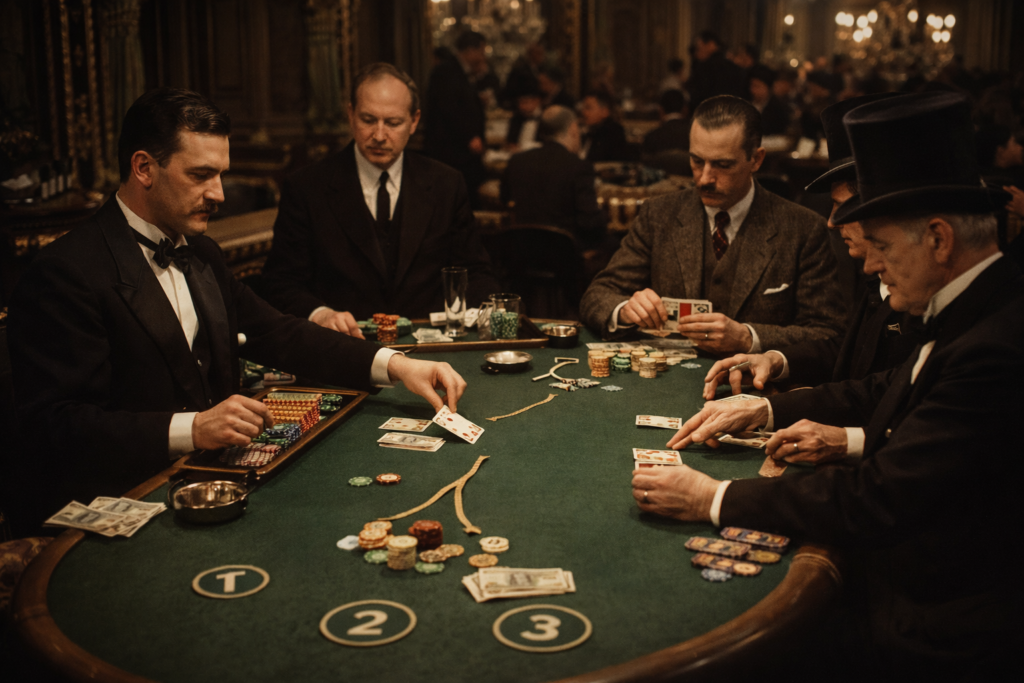
Chemin de Fer originated in 19th-century France, establishing baccarat’s reputation as a sophisticated gentleman’s game. The name “railway” allegedly references the game’s fast-paced nature or the shoe passing counterclockwise around the table like train cars.
Cultural legacy: James Bond popularized Chemin de Fer in early 007 films (notably “Dr. No” and “Casino Royale”), cementing its association with European elegance and high-stakes gambling.
Core Mechanics: Rotating Banker and Player Decisions
Chemin de Fer fundamentally differs from Punto Banco through two revolutionary mechanics:
- Rotating Banker Position
Unlike Punto Banco where the casino always banks, Chemin de Fer rotates the Banker role among players:
- One player assumes the Banker position per hand
- That player finances the Bank with personal funds
- Other players bet against the Banker (not the house)
- When the Banker loses, position passes counterclockwise to the next player
- Players can decline the Banker role, passing it to the next participant
Strategic implication: Acting as Banker creates personal risk and reward—you’re gambling your own money against other players, not simply betting against the house.
- Player Drawing Decisions
Both the Player and Banker make actual strategic decisions about drawing third cards:
Player decision-making:
- With hand totals 0-4: May choose to draw or stand
- With total 5: Full discretion to draw or stand (most critical decision)
- With totals 6-7: Typically stands
- With totals 8-9: Natural, no decision necessary
Banker decision-making:
- Evaluates their hand against the Player’s visible total
- Makes discretionary drawing decisions based on strategy
- Considers what Player might hold and optimal counterstrategy
Expert Insight: These decision points introduce genuine skill into Chemin de Fer. Experienced players optimize drawing decisions based on probability, opponent behavior, and game situation. This strategic depth separates Chemin de Fer from Punto Banco fundamentally.
Game Procedural Differences
Table setup: Kidney-shaped table accommodating up to 12 players
Minimum players: Requires at least 4-6 players to begin (varies by casino)
Croupier role: Casino employee facilitates gameplay, ensures rule compliance, and collects 5% commission on Banker wins—but doesn’t participate in betting or outcomes.
Betting mechanics:
- “Banco”: One player bets the entire Bank amount
- “Banco with the table”: Player bets half the Bank, others can cover remainder
- Standard bets: Multiple players bet portions totaling the Bank amount
Card handling: In traditional Chemin de Fer, the acting Banker physically deals cards, adding tactile involvement absent from Punto Banco.
Head-to-Head Comparison: Punto Banco vs Chemin de Fer
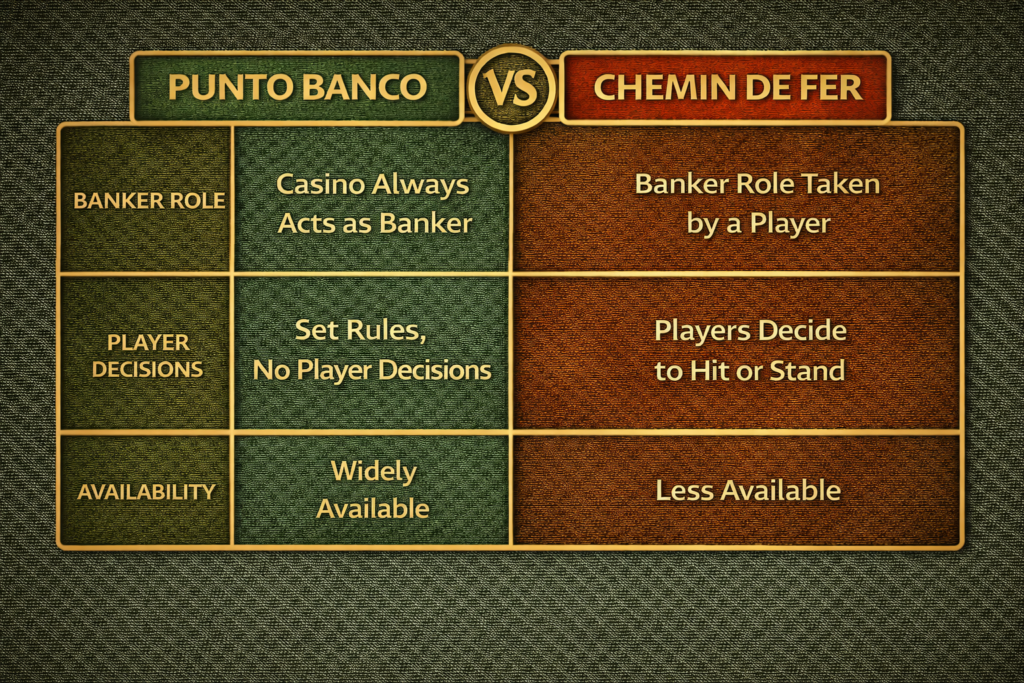
| Aspect | Punto Banco | Chemin de Fer |
| Banker Role | Always the casino/house | Rotates among players |
| Player Decisions | None (fully automated) | Strategic drawing choices |
| Skill Factor | Zero—pure chance | Moderate—decisions matter |
| Minimum Players | 1 (you vs house) | 4-6 players required |
| Game Speed | Fast (40-60 hands/hour) | Slower (20-30 hands/hour) |
| Card Handling | Dealer manages everything | Players handle cards |
| House Edge | 1.06% (Banker), 1.24% (Player) | ~1.17% (varies with skill) |
| Casino Role | Active participant (banks all bets) | Passive facilitator (collects commission) |
| Availability | Worldwide (standard format) | Limited (European casinos mainly) |
| Best For | Beginners, fast play, simplicity | Experienced players, social interaction |
Mathematical and Strategic Implications
Punto Banco mathematical reality:
- House edge remains constant (1.06% Banker, 1.24% Player)
- Player skill cannot reduce house edge
- Optimal strategy = always bet Banker
- Variance creates short-term results, but mathematics guarantee long-term house advantage
Chemin de Fer mathematical reality:
- Skilled players can marginally reduce effective house edge
- Drawing decisions at total 5 significantly impact probabilities
- Banker position creates risk/reward dynamics absent from Punto Banco
- Social dynamics (reading opponents) introduce psychological elements
Research shows that expert Chemin de Fer players can reduce the effective house edge by approximately 0.05-0.10% through optimal drawing decisions—minimal but measurable advantage over autopilot play.
Quick Takeaway: Punto Banco offers consistency and simplicity. Chemin de Fer offers engagement and skill expression. Neither beats the house long-term, but Chemin de Fer provides greater entertainment value for strategic players.
Availability and Accessibility: Where to Find Each Variant
Punto Banco Global Dominance
Punto Banco has become synonymous with “baccarat” in most modern contexts:
North America: Virtually every casino offers Punto Banco exclusively. Las Vegas, Atlantic City, and regional casinos standardize on this variant.
Online casinos: 99% of online baccarat games use Punto Banco rules, often simply labeled “Baccarat.”
Asia: Macau, Singapore, and Asian gambling centers primarily offer Punto Banco to accommodate high-volume play.
Accessibility: Available 24/7 at most casinos, with table minimums ranging from $5 (mini-baccarat) to $100+ (high-limit rooms).
Chemin de Fer Limited Availability
Chemin de Fer survives primarily in European establishments and high-end casinos:
Europe: French casinos (Monte Carlo, Deauville) and some UK establishments maintain traditional Chemin de Fer tables.
High-limit rooms: Premium casino sections occasionally offer Chemin de Fer for high-rollers seeking authentic experience.
Private gaming clubs: Exclusive membership clubs in major cities maintain Chemin de Fer traditions.
Practical limitation: Requires minimum player count (4-6), making it unavailable during low-traffic periods. Tables often operate by reservation or scheduled sessions.
Online availability: Extremely rare—virtually no online casinos offer authentic Chemin de Fer due to rotating banker mechanics incompatible with RNG-based gaming.
Betting Options and Payout Structures
Punto Banco Betting and Payouts
Standard bets:
- Player: Pays 1:1 (even money, no commission)
- Banker: Pays 0.95:1 (1:1 minus 5% commission)
- Tie: Pays 8:1 or 9:1 (varies by casino)
Side bets (common variants):
- Player/Banker Pair: First two cards match rank (pays 11:1-12:1)
- Perfect Pair: Both hands produce matching pairs (pays 25:1)
- Lucky 6: Banker wins with exactly 6 points (pays 13:1-21:1)
House edge on standard bets:
- Banker: 1.06%
- Player: 1.24%
- Tie: 14.36% (with 8:1 payout)
Chemin de Fer Betting and Payouts
Primary betting:
- Against the Banker: Player bets against the current Banker’s funds
- As the Banker: Player accepts bets from other participants
Payout structure:
- Standard wins pay 1:1
- Casino collects 5% commission on Banker wins (cagnotte)
- Tie results in push (bets returned)
Betting limits: Determined by the acting Banker’s stake—when a player assumes the Banker position, they set the maximum bet amount others can wager against them.
Strategic Considerations for Each Variant
Punto Banco Strategy: Simplified Decision-Making
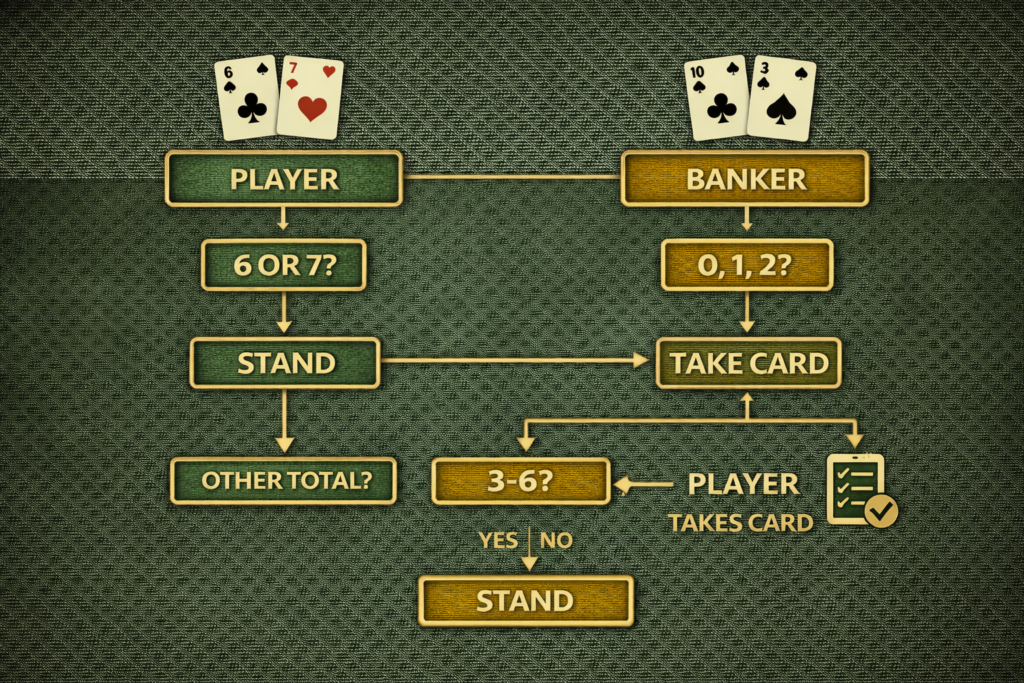
Since drawing rules are automatic, Punto Banco strategy focuses exclusively on bet selection:
Optimal strategy:
- Bet Banker consistently (lowest 1.06% house edge)
- Never bet Tie (devastating 14.36% house edge)
- Implement bankroll management (predetermined limits)
- Use betting progressions cautiously (1-3-2-6 system)
Common mistakes to avoid:
- Chasing Tie bets based on “overdue” superstition
- Believing previous results predict future outcomes (Gambler’s Fallacy)
- Increasing bet sizes to recover losses (emotional escalation)
- Playing without stop-loss/profit targets
Chemin de Fer Strategy: Genuine Decision-Making
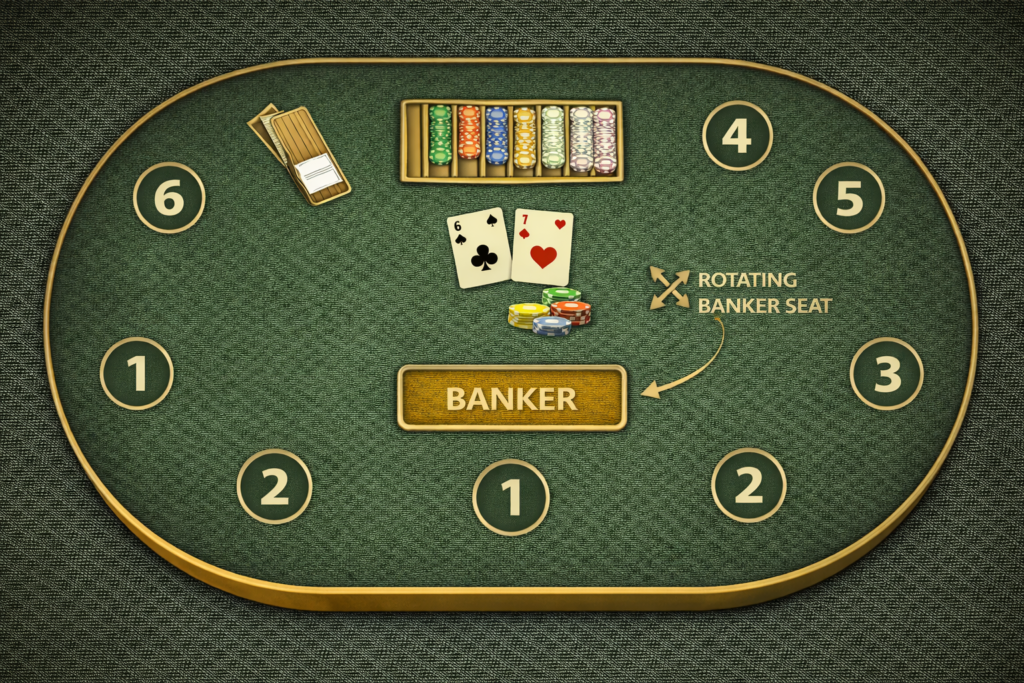
Chemin de Fer demands actual strategic thinking beyond bet selection:
Player hand strategy (total 5 decision):
- With 5 points: Statistical analysis suggests drawing approximately 40% of the time
- Context matters: Consider Banker’s betting patterns and table dynamics
- Conservative approach: Stand on 5 when Banker shows strength
- Aggressive approach: Draw on 5 when seeking maximum variance
Banker hand strategy:
- Evaluate Player visible behavior: Does Player draw conservatively or aggressively?
- Adjust drawing decisions: Counter Player tendencies with opposite strategy
- Bankroll consideration: As Banker, protect your stake through conservative play
Positional strategy:
- Accepting Banker role: Requires sufficient bankroll (3-5x table minimum recommended)
- Declining Banker role: Appropriate when bankroll is insufficient or variance is unfavorable
- Betting against Banker: Evaluate Banker’s skill and bankroll strength before committing
Pro Tip: In my experience observing Chemin de Fer tables, the most successful players treat the Banker position as a calculated investment, not an ego-driven opportunity. Decline the role when conditions don’t favor you financially or strategically.
Social Dynamics and Player Interaction
Punto Banco: Minimal Interaction

Punto Banco creates minimal social engagement:
- Players sit passively while the dealer manages everything
- No collaboration or competition between players (all bet against house)
- Fast pace discourages conversation
- Suitable for solitary players preferring minimal interaction
Table atmosphere: Professional and efficient, prioritizing speed over socialization.
Chemin de Fer: Highly Interactive
Chemin de Fer thrives on social dynamics:
- Players rotate through Banker position, creating shared experience
- Direct competition (Player vs Banker creates tension)
- Strategic discussions and observations between hands
- “Banco” calls create dramatic moments
- Slower pace enables conversation and camaraderie
Table atmosphere: Sophisticated and social, reminiscent of private club gaming rather than commercial casino operation.
Cultural component: Chemin de Fer maintains traditional European casino elegance, attracting players seeking authentic gambling heritage over modern efficiency.
Learning Curve and Skill Development
Punto Banco: Immediate Accessibility
Learning time: 5-10 minutes to understand basic mechanics
Skill ceiling: Extremely low—mastery involves only betting selection and bankroll management
Beginner-friendliness: Ideal for first-time casino visitors
Long-term engagement: Limited strategic depth may bore experienced players
Chemin de Fer: Extended Mastery
Learning time: 30-60 minutes to understand rules, weeks to develop strategic competence
Skill ceiling: Moderate—drawing decisions, Banker play, and opponent reading provide genuine strategic depth
Beginner-friendliness: Intimidating for newcomers due to decision pressure and social dynamics
Long-term engagement: Strategic complexity sustains experienced player interest indefinitely
Skill development path:
- Master basic card values and scoring
- Learn optimal drawing decisions (especially at total 5)
- Understand Banker position responsibilities
- Develop opponent reading skills
- Integrate bankroll management with positional strategy
Common Misconceptions About Baccarat Variants
Misconception #1: “Punto Banco and Baccarat Are Different Games”
Reality: Punto Banco IS baccarat—specifically, it’s the standardized North American/online version. When casinos advertise “Baccarat,” they’re almost always offering Punto Banco.
Misconception #2: “Chemin de Fer Offers Better Odds”
Reality: House edge is nearly identical (1.06% Punto Banco vs ~1.17% Chemin de Fer). The difference is strategic engagement, not mathematical advantage.
Misconception #3: “You Can Beat Chemin de Fer Through Skill”
Reality: Skilled play marginally reduces effective house edge (by ~0.05-0.10%), but cannot create player advantage. Both variants maintain house edge long-term.
Misconception #4: “Chemin de Fer Is Only for High-Rollers”
Reality: While often found in high-limit areas, Chemin de Fer table minimums vary. European casinos sometimes offer moderate-stakes Chemin de Fer accessible to average players.
Misconception #5: “Punto Banco Is Easier to Win”
Reality: Both variants offer identical long-term expected losses (approximately 1.06-1.24% of total wagered). “Easier to win” is psychological perception, not mathematical reality.
Which Variant Should You Play?
Choose Punto Banco If You:
- Prefer simple, straightforward gameplay
- Want fast-paced action (40-60 hands/hour)
- Dislike strategic decision pressure
- Play primarily online
- Seek readily available games (24/7 accessibility)
- Enjoy solitary gambling without social interaction
- Are new to baccarat
Choose Chemin de Fer If You:
- Enjoy strategic decision-making
- Prefer social, interactive gambling experiences
- Appreciate traditional casino elegance
- Have patience for slower gameplay (20-30 hands/hour)
- Possess sufficient bankroll for Banker position participation
- Travel to European casinos regularly
- Seek authentic gambling heritage over modern convenience
The Hybrid Approach
Some players alternate between variants based on context:
- Online/Convenience: Punto Banco for quick sessions
- Special Occasions: Chemin de Fer for destination casino trips
- Bankroll-Dependent: Punto Banco during limited-budget periods, Chemin de Fer when bankroll supports Banker position
Conclusion: Two Philosophies, One Game Family
Punto Banco and Chemin de Fer represent divergent evolutionary paths from baccarat’s historical origins. Punto Banco sacrifices strategy for accessibility, creating a streamlined game suitable for mass-market casinos. Chemin de Fer preserves strategic depth and social interaction at the cost of complexity and availability.
Neither variant is objectively superior—they serve different player preferences:
Punto Banco excels through simplicity, speed, and global standardization. It democratized baccarat, transforming an exclusive game into accessible entertainment.
Chemin de Fer excels through engagement, tradition, and genuine skill expression. It preserves baccarat’s sophisticated heritage while rewarding strategic thinking.
Understanding these baccarat game variants enables informed selection matching your playing style, available time, and strategic preferences. Whether you choose Punto Banco’s efficient automation or Chemin de Fer’s interactive complexity, both offer mathematically fair casino gaming within their respective frameworks.
Select based on preference, not perceived advantage—both maintain similar house edges long-term. The difference lies in entertainment value and engagement style, not mathematical superiority.