

Understanding Roulette Bet Types: The Foundation of Smart Gameplay
Roulette betting strategies fundamentally divide into two distinct categories: inside bets and outside bets. This classification isn’t arbitrary—it’s based on where you place your chips on the roulette table layout and dramatically affects your winning probability, payout potential, and overall gaming experience.
Inside bets cover specific numbers or small groups of adjacent numbers located in the central grid of the table. These wagers offer higher payouts but lower winning probabilities, making them suitable for players with larger bankrolls who enjoy high-risk, high-reward scenarios. Conversely, outside bets cover broader categories of numbers positioned along the table’s outer edges, providing better odds of winning with smaller payouts.
The house edge remains constant across both bet types in European roulette at 2.7% and American roulette at 5.26%—with one notorious exception we’ll discuss later. Understanding this fundamental distinction empowers you to align your betting choices with your risk tolerance, bankroll size, and gameplay objectives.
Pro Tip: European roulette offers significantly better odds than American roulette due to the single zero versus double zero configuration. Always choose European or French roulette variants when available to maximize your winning potential.
Inside Bets Explained: High Risk, High Reward
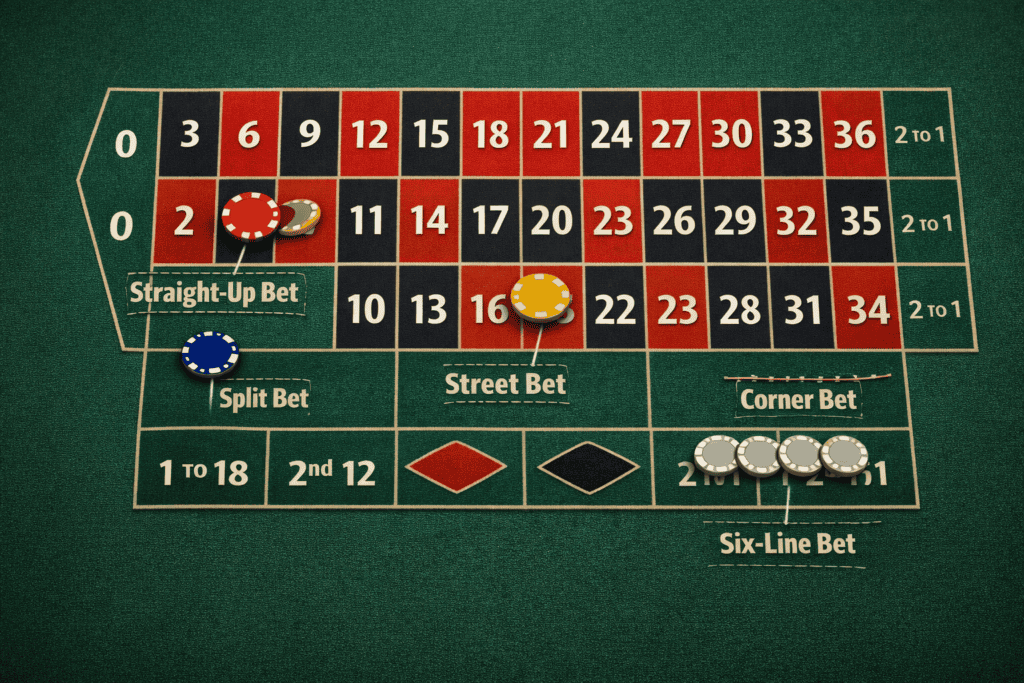
Inside bets represent the thrilling, aggressive approach to roulette. Positioned on the numbered grid at the table’s center, these wagers target specific outcomes with impressive payout ratios that can transform modest stakes into substantial wins.
Straight-Up Bet: The Ultimate Single-Number Wager
A straight-up bet is the simplest yet most challenging wager in roulette. You place your chip directly on any single number from 0 to 36 (or 00 in American roulette).
Payout: 35:1
Odds: 2.7% (European) | 2.6% (American)
Example: A $5 bet on number 17 returns $175 in winnings plus your original $5 stake if successful.
While the 1-in-37 odds seem daunting, the 35:1 payout makes this bet attractive for players seeking maximum returns. Industry experts agree that straight-up bets work best as occasional additions to a broader betting strategy rather than your primary approach.
Split Bet: Doubling Your Chances
Split bets cover two adjacent numbers on the table layout. Place your chip on the line between any two numbers—horizontally or vertically positioned.
Payout: 17:1
Odds: 5.4% (European) | 5.3% (American)
Chip Placement: On the line separating the two chosen numbers
Example: Betting $10 on the 14/17 split wins $170 if either number hits.
Split bets offer a balanced compromise between straight-up bets and broader coverage options. This bet type is particularly effective when combined with other inside bets to create comprehensive coverage patterns.
Street Bet: Covering Three Consecutive Numbers
Street bets (also called trio or row bets) cover an entire horizontal row of three consecutive numbers on the layout.
Payout: 11:1
Odds: 8.1% (European) | 7.9% (American)
Chip Placement: On the outer edge at the bottom of the row
Example: A street bet on 25-26-27 pays $55 on a $5 wager.
Street bets represent the middle ground in inside betting strategy. With roughly 1-in-12 odds, they provide reasonable winning chances while maintaining attractive payout ratios. Many experienced players use multiple street bets to create strategic coverage patterns across the table.
Corner Bet: The Four-Number Square
Corner bets (also called square bets) cover four numbers that meet at a single intersection point on the table layout.
Payout: 8:1
Odds: 10.8% (European) | 10.5% (American)
Chip Placement: At the intersection where four numbers meet
Example: A corner bet covering 10-11-13-14 wins $80 on a $10 stake.
Corner bets offer approximately 1-in-9 winning odds, making them one of the more reliable inside betting options. This bet type works particularly well in combination strategies where players cover multiple corners simultaneously.
Expert Insight: Professional players often use corner bets as their primary inside betting strategy because they offer the optimal balance between winning probability and payout potential compared to other inside bet options.
Six-Line Bet: Maximum Inside Bet Coverage
The six-line bet (also called double street) covers two adjacent rows of three numbers each, totaling six numbers.
Payout: 5:1
Odds: 16.2% (European) | 15.8% (American)
Chip Placement: On the intersection where two rows meet at the outer edge
Example: Betting $20 on numbers 1-2-3-4-5-6 returns $100 in winnings.
Six-line bets provide the highest winning probability among inside bets, with roughly 1-in-6 odds. This makes them ideal for players who want inside bet excitement with relatively safer winning chances. The 5:1 payout still offers respectable returns compared to outside bets.
Special Inside Bets: Trio, Basket, and First Four
Several specialized inside bets exist with unique characteristics:
Trio Bet (European/French Roulette): Covers three numbers, including zero (0-1-2 or 0-2-3). Pays 11:1.
Basket Bet (American Roulette): Covers 0-00-1-2-3. Pays 6:1 but carries a devastating 7.9% house edge—the worst bet in roulette. Avoid this wager at all costs.
First Four Bet (European Roulette): Covers 0-1-2-3. Pays 8:1 with standard European house edge.
Warning: The basket bet is widely known as the “sucker bet” because its house edge of 7.9% is significantly worse than all other roulette wagers. Never place this bet regardless of your strategy.
Outside Bets Explained: Safer, Consistent Options
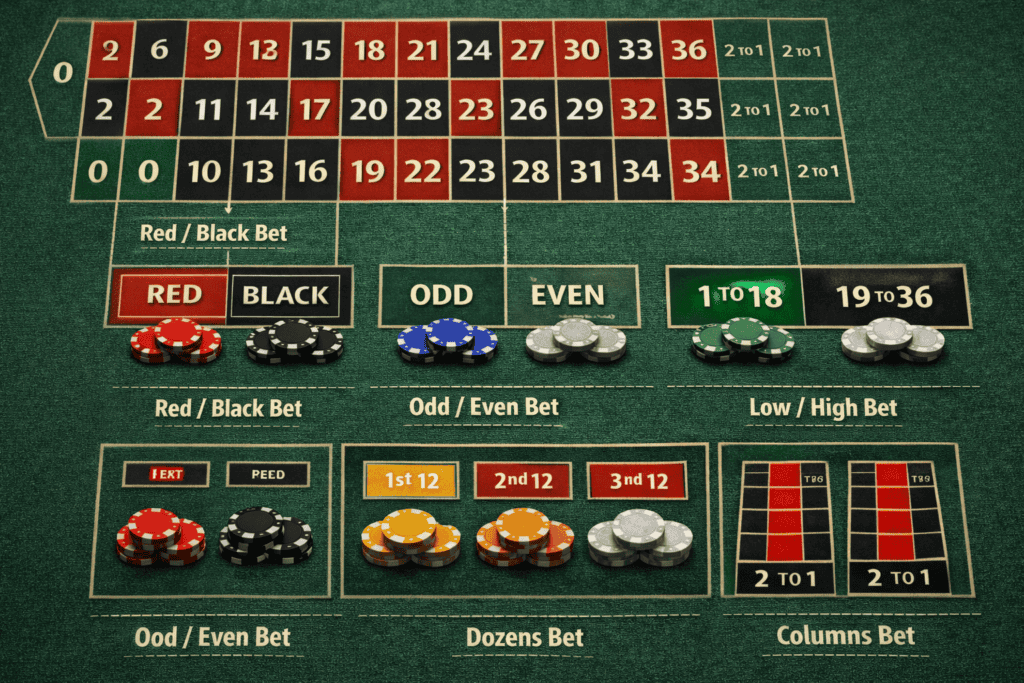
Outside bets occupy the peripheral sections of the roulette table and cover large groups of numbers based on shared characteristics. These wagers offer better winning probabilities but smaller payouts, making them ideal for conservative players, beginners, and those prioritizing extended gameplay over jackpot pursuits.
Red or Black: The Classic Even-Money Bet
Betting on red or black is the most popular roulette wager worldwide. You’re predicting whether the winning number will be red or black (excluding zero).
Payout: 1:1 (even money)
Odds: 48.6% (European) | 47.4% (American)
Coverage: 18 numbers
Example: A $50 bet on red wins $50, returning $100 total.
Red/black bets offer the closest thing to a coin flip in roulette, with winning chances just below 50% due to the green zero. This bet type forms the foundation of many betting systems, including Martingale, D’Alembert, and Paroli strategies.
Odd or Even: Simple and Effective
Odd/even bets predict whether the winning number will be odd or even, covering 18 numbers with the same odds as red/black.
Payout: 1:1 (even money)
Odds: 48.6% (European) | 47.4% (American)
Coverage: 18 numbers
Example: Betting $25 on odd numbers returns $25 in winnings if successful.
Odd/even bets are mathematically identical to red/black wagers and work interchangeably in most betting strategies. Many players combine these bet types to create layered coverage patterns.
High or Low: The 1-18/19-36 Split
High/low bets divide the roulette wheel into two halves: low numbers (1-18) and high numbers (19-36).
Payout: 1:1 (even money)
Odds: 48.6% (European) | 47.4% (American)
Coverage: 18 numbers
Example: A $100 bet on high numbers (19-36) wins $100 when the ball lands on 25.
High/low bets complete the trinity of even-money outside bets. They’re particularly useful in advanced systems that rotate between different even-money bet types to maximize table coverage.
Quick Takeaway: All three even-money bets (red/black, odd/even, high/low) offer identical odds and payouts. Choose based on personal preference or as dictated by your betting system rather than any mathematical advantage.
Dozen Bets: Covering One-Third of the Table
Dozen bets divide the 36 numbers into three groups of 12 consecutive numbers: first dozen (1-12), second dozen (13-24), and third dozen (25-36).
Payout: 2:1
Odds: 32.4% (European) | 31.6% (American)
Coverage: 12 numbers
Example: A $30 bet on the second dozen (13-24) wins $60 when the ball lands on 18.
Dozen bets offer superior 2:1 payouts while maintaining reasonable 1-in-3 winning odds. Many players bet on two dozen numbers simultaneously to cover 24 numbers (approximately 65% of the table), creating a popular strategy known as the “64% system”.
Column Bets: Vertical Coverage
Column bets cover one of three vertical columns running the length of the table layout, with each column containing 12 numbers.
Payout: 2:1
Odds: 32.4% (European) | 31.6% (American)
Coverage: 12 numbers
Chip Placement: In the box at the bottom of your chosen column
Example: Betting $15 on column 1 (containing 1-4-7-10-13-16-19-22-25-28-31-34) wins $30.
Column bets are mathematically identical to dozen bets but provide different number distributions. Savvy players use this distinction to create strategic combinations covering specific number ranges.
Inside Bets vs Outside Bets: Direct Comparison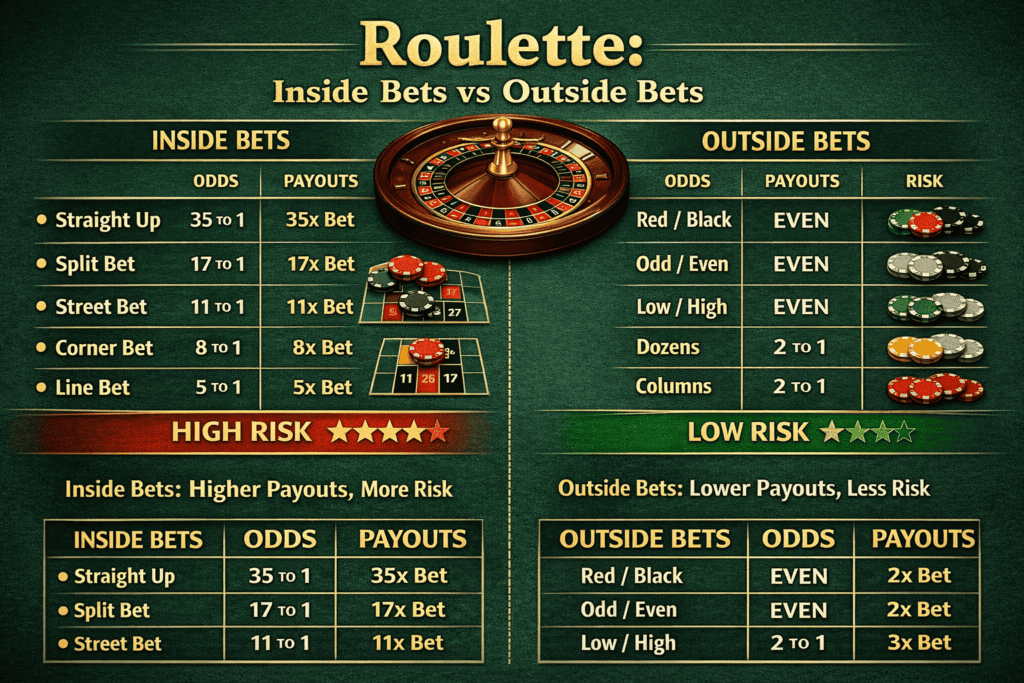
Understanding the trade-offs between inside and outside bets is crucial for developing an effective roulette strategy. Here’s a comprehensive comparison:
| Factor | Inside Bets | Outside Bets |
| Winning Probability | Low (2.7% to 16.2%) | High (32.4% to 48.6%) |
| Payout Potential | High (5:1 to 35:1) | Low (1:1 to 2:1) |
| Risk Level | High | Low to Moderate |
| Bankroll Requirements | Larger | Smaller |
| Best For | Risk-tolerant players seeking big wins | Conservative players want consistent results |
| Volatility | High variance with dramatic swings | Low variance with steady outcomes |
| Gameplay Duration | Shorter (due to faster losses) | Longer (sustained by frequent small wins) |
Expert Insight: In my experience working with roulette players across skill levels, beginners consistently perform better starting with outside bets to understand game mechanics before transitioning to inside bets. This approach extends learning time while managing bankroll effectively.
European vs American Roulette: How Bet Type Odds Differ
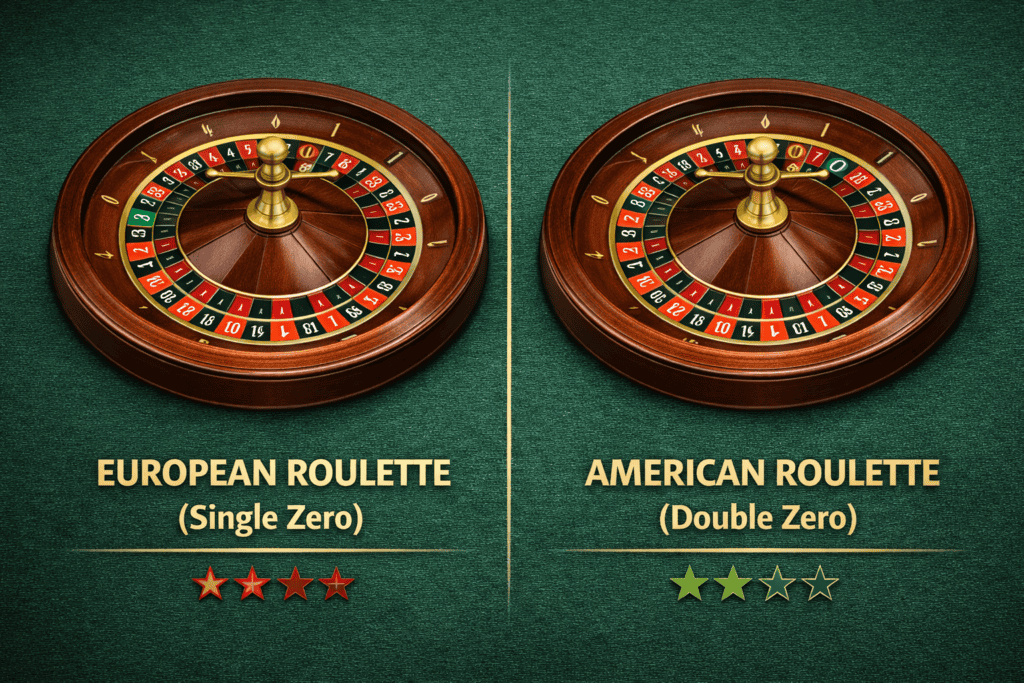
The fundamental difference between European and American roulette—the single zero versus double zero—creates significant variations in winning probabilities across all bet types.
House Edge Comparison
European Roulette: 2.7% house edge (single zero)
American Roulette: 5.26% house edge (double zero)
This means American roulette players lose money nearly twice as fast over extended gameplay. Research consistently shows that European roulette provides better value regardless of your chosen betting strategy.
Odds Difference in Practice
For a straight-up bet:
- European: 1 in 37 chance (2.70%)
- American: 1 in 38 chance (2.63%)
For even-money bets:
- European: 18 in 37 chance (48.65%)
- American: 18 in 38 chance (47.37%)
While individual differences seem small, they compound dramatically over hundreds of spins. A player making 1,000 even-money bets of $10 each can expect to lose approximately $270 in European roulette versus $526 in American roulette.
Pro Tip: Always choose European or French roulette when available. The improved odds apply equally to inside and outside bets, making this the single most impactful decision you can make to improve your roulette results.
Advanced Betting: French Roulette and Announced Bets
French roulette introduces sophisticated bet types called “announced bets” or “call bets” that cover specific wheel sectors rather than table layout sections.
Voisins du Zero (Neighbors of Zero)
Covers 17 numbers surrounding zero: 22-18-29-7-28-12-35-3-26-0-32-15-19-4-21-2-25.
Winning Odds: 45.9% (highest among announced bets)
Chips Required: 9 chips covering various splits, corners, and trio bets.
Tiers du Cylindre (Third of the Wheel)
Covers 12 numbers opposite zero: 27-13-36-11-30-8-23-10-5-24-16-33.
Winning Odds: 32.4%
Chips Required: 6 chips as split bets.
Orphelins (The Orphans)
Covers 8 numbers not included in Voisins or Tiers: 17-34-6-1-20-14-31-9.
Winning Odds: 24.3%
Chips Required: 5 chips (4 splits and 1 straight-up).
Jeu Zero (Zero Game)
Covers 7 numbers closest to zero: 12-35-3-26-0-32-15.
Winning Odds: 18.9%
Chips Required: 4 chips (3 splits and 1 straight-up).
Announced bets appeal to experienced players who prefer thinking in terms of wheel sectors rather than table layout positions. These sophisticated wagers are typically found in high-end casinos and premium online roulette variants.
Common Roulette Betting Mistakes and How to Avoid Them
Understanding what not to do is as crucial as knowing optimal strategies. Here are the most costly mistakes roulette players make:
Mistake #1: Playing American Roulette Instead of European
This single error doubles your long-term losses. The extra double-zero pocket increases the house edge from 2.7% to 5.26% while payouts remain identical.
Solution: Always choose European or French roulette variants. Every online casino offers both—there’s no reason to accept worse odds.
Mistake #2: Chasing Losses with Increased Bets
Many players increase their stakes after losses, hoping to recover quickly. This approach rapidly depletes bankrolls during inevitable losing streaks.
Solution: Implement flat betting or modest progressive systems with predefined stop-loss limits. Never increase bets emotionally.
Mistake #3: Believing in “Hot” or “Due” Numbers
The Gambler’s Fallacy convinces players that past results influence future spins. If red hits five times consecutively, many incorrectly believe black is “due”.
Reality: Every roulette spin is independent. Past results have zero predictive value for future outcomes. The probability resets completely with each spin.
Mistake #4: Making the Basket Bet (American Roulette)
The five-number basket bet (0-00-1-2-3) carries a catastrophic 7.9% house edge—significantly worse than all other roulette bets.
Solution: Never place basket bets under any circumstances. This wager literally gives the casino nearly double the normal advantage.
Mistake #5: Ignoring Bankroll Management
Players without clear budgets and betting limits inevitably lose more than intended, turning entertainment into financial stress.
Solution: Establish a gambling budget you can afford to lose. Calculate appropriate unit sizes (typically 1-2% of total bankroll) and never exceed predetermined loss limits.
Strategic Betting: When to Use Inside vs Outside Bets
An effective roulette strategy involves matching bet types to your objectives, bankroll, and risk tolerance.
Use Inside Bets When:
- You have a large bankroll that can sustain multiple consecutive losses
- You’re seeking entertainment value from high-risk, high-reward scenarios
- You’re comfortable with high volatility and dramatic bankroll swings
- Your goal is maximum payout potential rather than extended gameplay
- You’re combining multiple inside bets to create strategic coverage patterns
Recommended Approach: Allocate 20-30% of your session bankroll to inside bets, diversifying across multiple bet types rather than concentrating on single numbers.
Use Outside Bets When:
- You have a limited bankroll requiring conservative risk management
- You’re prioritizing extended gameplay over jackpot potential
- You’re a beginner learning roulette mechanics
- You’re implementing progressive betting systems (Martingale, D’Alembert, Fibonacci)
- Your goal is frequent small wins rather than rare large payouts
Recommended Approach: Start every session with outside bets to build momentum and understanding. Transition to inside bets only after establishing a profit cushion.
Hybrid Strategy: Combining Both Bet Types
Many experienced players use combination strategies that leverage both bet types simultaneously:
Example Hybrid Strategy:
- Place 2 units on dozens covering 24 numbers
- Add 1 unit on a six-line bet
- Include 1 unit on a corner bet
- Total coverage: 34 of 37 numbers with varied payout potential
This approach provides a high winning probability (over 90% coverage) while maintaining opportunities for superior payouts through inside bets.
Expert Insight: Research shows that balanced strategies combining outside bet consistency with strategic inside bet placements outperform single-approach methods in terms of both entertainment value and bankroll sustainability.
Bankroll Management for Different Bet Types
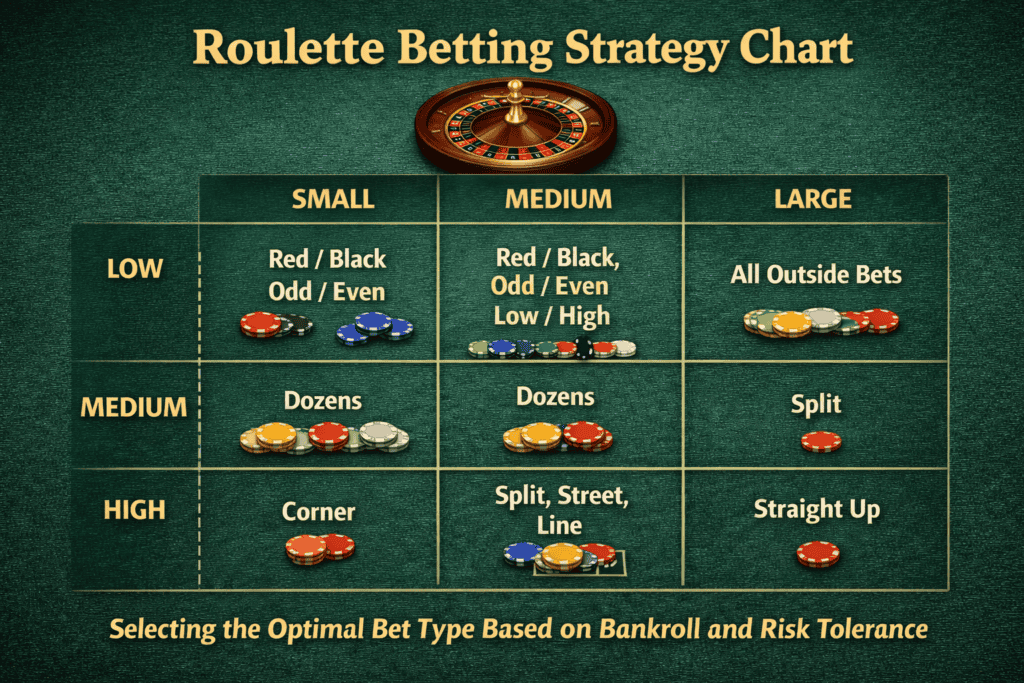
Effective bankroll management varies significantly between inside and outside betting approaches.
Bankroll Strategy for Inside Bets
Recommended Unit Size: 0.5-1% of total bankroll
Session Allocation: 20-25% of total bankroll
Stop-Loss Limit: 50% of session bankroll
Win Goal: 200-300% of session bankroll
Example: With a $1,000 total bankroll:
- Session bankroll: $200-250
- Unit size: $5-10
- Stop-loss: Quit after losing $100-125
- Win goal: Cash out after winning $400-600
Bankroll Strategy for Outside Bets
Recommended Unit Size: 2-5% of total bankroll
Session Allocation: 40-50% of total bankroll
Stop-Loss Limit: 75% of session bankroll
Win Goal: 50-100% of session bankroll
Example: With a $1,000 total bankroll:
- Session bankroll: $400-500
- Unit size: $20-50
- Stop-loss: Quit after losing $300-375
- Win goal: Cash out after winning $200-400
Pro Tip: Never combine your entire bankroll into a single session. Divide your total gambling budget into 4-5 separate sessions to ensure multiple playing opportunities even during unlucky streaks.
Optimal Bet Type Selection Based on Player Profile
Different player types benefit from different betting approaches:
Conservative Players
Profile: Limited bankroll, risk-averse, prioritizing entertainment duration
Recommended Bets: Even-money outside bets (red/black, odd/even, high/low)
Strategy: Flat betting or minimal progression systems
Expected Outcome: Extended gameplay with frequent small wins and losses
Moderate Players
Profile: Medium bankroll, balanced risk tolerance, seeking variety
Recommended Bets: Dozen/column bets with occasional inside bet additions
Strategy: Combination betting covering 60-70% of the table
Expected Outcome: Moderate volatility with decent winning frequency
Aggressive Players
Profile: Large bankroll, high risk tolerance, chasing big wins
Recommended Bets: Inside bets (straight-up, split, corner)
Strategy: Diversified inside bet combinations
Expected Outcome: High volatility with potential for substantial wins and losses
Strategic Players
Profile: Experienced, analytical, systematic approach
Recommended Bets: Hybrid combinations of inside and outside bets
Strategy: Announced bets, sector betting, and mathematical systems
Expected Outcome: Controlled volatility with optimized entertainment value
Probability and Statistics: The Mathematics Behind Bet Types
Understanding the mathematical reality of roulette helps set realistic expectations.
Single Spin Probabilities (European Roulette)
- Straight-up: 2.70% (1 in 37)
- Split: 5.41% (2 in 37)
- Street: 8.11% (3 in 37)
- Corner: 10.81% (4 in 37)
- Six-line: 16.22% (6 in 37)
- Dozen/Column: 32.43% (12 in 37)
- Even-money: 48.65% (18 in 37)
Consecutive Outcome Probabilities
The probability of the same result occurring multiple times consecutively:
- 2 times: 23.7%
- 3 times: 11.5%
- 5 times: 2.73%
- 10 times: 0.074%
This data demonstrates why betting systems based on “hot” or “cold” patterns are mathematically flawed—even unlikely sequences occur regularly in random processes.
Expected Value Calculations
Every roulette bet has a negative expected value due to the house edge:
European Roulette Expected Value: -2.7% of total amount wagered
American Roulette Expected Value: -5.26% of total amount wagered
Example: Betting $1,000 total across a session:
- European roulette expected loss: $27
- American roulette expected loss: $52.60
These figures represent long-term averages. Individual sessions will vary significantly, but the mathematical edge ensures casino profitability over millions of spins.
Advanced Tips for Maximizing Your Roulette Experience
Tip #1: Take Advantage of French Roulette Rules
French roulette offers special rules that reduce the house edge on even-money bets:
La Partage Rule: Returns half your stake when zero hits on even-money bets, reducing house edge to 1.35%.
En Prison Rule: Allows your even-money bet to remain “imprisoned” for another spin when zero hits, potentially recovering your full stake.
Tip #2: Practice with Free Online Roulette
Most online casinos offer free play modes. Use these to test betting systems, understand bet type dynamics, and build confidence before risking real money.
Tip #3: Avoid Betting Systems Promising Guaranteed Wins
No betting system overcomes the house edge. Martingale, Fibonacci, and similar systems can extend gameplay, but don’t change the mathematical reality of negative expected value.
Tip #4: Set Win Goals and Loss Limits
Before each session, establish firm thresholds for both winning and losing. Discipline in adhering to these limits separates successful recreational gamblers from problem gamblers.
Tip #5: Track Your Results
Maintain records of your sessions, including bet types used, wins/losses, and duration. This data reveals patterns in your playing style and helps optimize future strategies.
Quick Takeaway: The best roulette “strategy” isn’t a betting system—it’s choosing European roulette, managing your bankroll effectively, and maintaining realistic expectations about house edge reality.
Conclusion: Making Informed Decisions at the Roulette Table
Understanding roulette bet types—both inside and outside bets—empowers you to make strategic decisions aligned with your goals, bankroll, and risk tolerance. Inside bets offer thrilling high-risk, high-reward opportunities with payouts up to 35:1 but winning probabilities as low as 2.7%. Outside bets provide consistent, safer options with winning chances approaching 50% but more modest 1:1 or 2:1 payouts.
The optimal approach combines mathematical understanding with disciplined bankroll management. Always choose European or French roulette over American variants to cut the house edge nearly in half. Match your bet type selection to your player profile—conservative players thrive with outside bets, while aggressive players seek inside bet excitement.
Remember that no betting system eliminates the house edge. Roulette remains a game of chance where the casino maintains a mathematical advantage. Approach the game as entertainment with cost expectations rather than an income source. Set clear budgets, establish win/loss limits, and never chase losses with increased stakes.
By understanding the complete spectrum of roulette bet types explained in this guide, you’re equipped to maximize your enjoyment while minimizing costly mistakes, whether you’re placing your first chip on red or crafting sophisticated announced bet combinations. Informed decisions create the foundation for rewarding roulette experiences.