

Introduction: Understanding the Engineering Behind the Game
The roulette wheel design represents one of casino gaming’s most precisely engineered components. Yet most players encounter it without understanding the meticulous engineering, mechanical sophistication, and deliberate design choices governing its construction.
A roulette wheel isn’t randomly assembled. Every component—from the turret housing to the ball deflectors—serves specific purposes balancing fairness, durability, and player experience. The table layout design follows equally deliberate logic, with number placement carefully orchestrated to prevent bias.
Understanding roulette wheel anatomy separates casual players from informed enthusiasts who appreciate the mathematical and mechanical sophistication underlying the game. This knowledge influences bet selection, helps recognize wheel maintenance importance, and reveals why certain physical characteristics matter for game integrity.
This comprehensive guide deconstructs roulette’s entire physical architecture: from the smallest ball pocket to the largest bowl diameter. You’ll discover why number sequencing follows seemingly random patterns, how manufacturing precision prevents bias, what physical components govern ball trajectory, and how table layout design psychologically influences player betting.
By understanding the physical reality behind roulette, you’ll appreciate the engineering elegance underlying this centuries-old game while recognizing why professional casinos invest heavily in precision manufacturing and regular maintenance.
Roulette Wheel Components: The Complete Anatomy
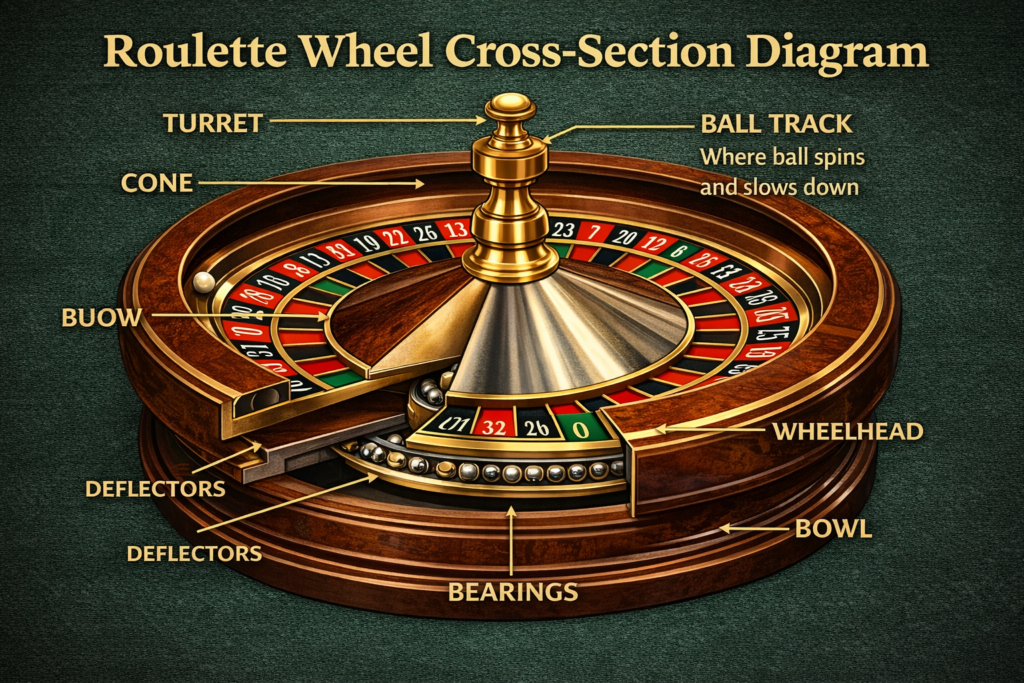
Professional roulette wheel design integrates 15+ distinct components, each serving specific mechanical functions.
Top Assembly: The Turret System
The turret represents the topmost roulette wheel component—the decorative metal housing housing players physically touch and recognize. Despite its aesthetic purpose, it integrates critical functional elements.
Turret Height Adjustment Mechanism: The turret contains a height-adjusting device that calibrates the cone’s elevation. This seemingly minor component proves critical: if the outer edge (where numbered pockets sit) is higher than the apron’s lower edge, the ball cannot drop properly into pockets, creating game-disrupting bias.
Turret Base: This component houses the turret and connects it to the cone below, creating a unified top assembly transferring spin forces throughout the wheel structure.
The Cone: Directing Ball Movement
The cone represents roulette’s most functionally important component—an inverted cone shape at the wheel’s center directing spinning balls toward number pockets.
The cone slopes upward toward the center with carefully calibrated angles. As the ball orbits the wheel losing momentum, it descends naturally toward the cone, which redirects trajectory downward into numbered pockets. This mechanical feature prevents chaotic ball behavior while maintaining apparent randomness.
Design Precision: The cone’s slope angle is calculated to specific tolerances. Too steep and balls bounce chaotically; too shallow and they develop predictable patterns. Quality wheels maintain cone angles within 0.5-degree tolerances.
The Bowl: The Wheel’s Housing Structure
The bowl forms the stationary outer structure containing and supporting all moving wheel elements. Historically constructed from mahogany wood, modern bowls use fiberglass-reinforced plastic—a material providing durability while maintaining traditional aesthetic appearance.
Bowl Diameter: Standard roulette bowls measure approximately 32 inches in diameter, creating consistent proportions across casinos worldwide. This standardization enables familiar player experience across venues.
Interior Surface: The bowl’s interior—where the ball track sits—must be impeccably smooth. Any imperfections create bias potential, so manufacturers sand and polish surfaces to near-mirror smoothness. Premium wheels use multiple sanding grits progressing to extraordinarily fine finishes.
Ball Track System: The Ball’s Path
The ball track (or track) is the curved groove running inside the bowl where the ball initially travels during each spin. This component experiences highest wear and requires frequent inspection/replacement.
Lower Ball Track: Below the main track sits a lower deflector apron containing ball deflectors—strategically positioned obstacles causing the ball to bounce unpredictably. These deflectors prevent predictable ball behavior by introducing random trajectory changes.
Critical Design Consideration: Deflectors must be consistently sized and positioned. Even 1-2mm variations create noticeable bias over thousands of spins. Quality manufacturers use CNC (Computer Numeric Control) machines for precision positioning, then conduct individual deflector testing.
The Wheelhead: Numbered Pockets and Rotation
The wheelhead is the rotating component containing 37 (European) or 38 (American) numbered pockets. This rotating disc sits in the bowl’s center, spinning independently while the ball track remains stationary.
Pocket Construction: Individual pockets are precisely machined holes receiving identical balls. Each pocket must be identically sized and shaped—any variations create bias potential. Modern wheels use CNC machines carving pockets to 0.1mm tolerances.
Spindle: The spindle is the vertical axle supporting the wheelhead’s rotation. It must be perfectly aligned and balanced; even slight misalignment creates friction increasing bias potential. Premium wheels verify spindle alignment using laser measurement equipment.
Bearings: Enabling Smooth Rotation
Upper and lower bearings support the wheelhead’s rotation—comparable to skateboard bearings enabling wheel spin. Quality bearings enable 10-20 minute spin times (professional wheelheads continue spinning long after release).
Bearing Specifications: Casino-grade bearings use specialized materials (typically ceramic and steel combinations) reducing friction while minimizing wear. Bearings are sealed against dust and contaminants, with casinos replacing them periodically based on inspection schedules.
Ball Collection and Ejection System
Modern electronic wheels include automated ball collection. After each spin, the winning pocket’s floor lowers mechanically, allowing the ball to drop into a collection channel. A ball arm then transports it to a ball magazine—an automated system preventing manual ball handling that could introduce contamination or bias.
Quick Takeaway: Understanding wheelhead components reveals why modern roulette wheels require minimal intervention—automated systems reduce human error opportunity.
Number Sequencing Logic: Why The Numbers Arrange “Randomly”
One of roulette’s most misunderstood aspects concerns why wheel numbers don’t sequence 1-2-3-4… around the wheel.
European Roulette Number Sequence
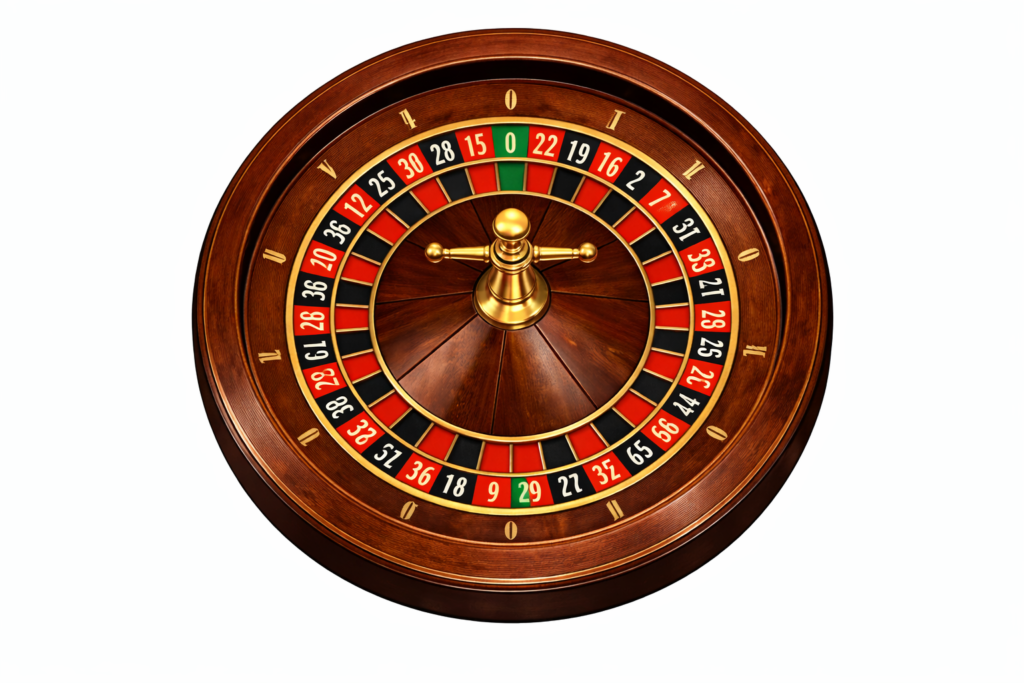
Clockwise from zero: 0-32-15-19-4-21-2-25-17-34-6-27-13-36-11-30-8-23-10-5-24-16-33-1-20-14-31-9-22-18-29-7-28-12-35-3-26
This seemingly random arrangement follows four deliberate mathematical principles:
Principle #1: Color Alternation
Every two adjacent numbers must have different colors (red/black alternation). This prevents large single-color sectors that could bias certain betting types if a wheel develops minor tilts affecting ball distribution.
Principle #2: Low/High Distribution
Low numbers (1-18) and high numbers (19-36) are distributed around the wheel to alternate as consistently as possible. This prevents sectors with consecutive low or consecutive high numbers, which could create bias if players could predict ball landing zones.
Principle #3: Odd/Even Distribution
Odd and even numbers are distributed avoiding consecutive same-parity clusters. No more than two consecutive odd or even numbers appear adjacent, preventing sectors that could be exploited if wheel biases developed.
Principle #4: Player Confusion
The seemingly random arrangement deliberately confuses players, preventing them from mentally mapping wheel sectors or identifying patterns for biased wheel exploitation. This psychological element protects against both intentional and accidental bias discovery.
American Roulette Number Sequence
American wheels use a different clockwise sequence: 0-2-14-35-23-4-16-33-21-6-18-31-19-8-12-29-25-10-27-00-1-13-36-24-3-15-34-22-5-17-32-20-7-11-30-26-9-28
Notice how Americans introduce the double-zero (00) and completely reorganize the sequence. This creates a distinct aesthetic while maintaining the same four mathematical principles, but with different sector distributions than European wheels.
Expert Insight: The number sequence logic reveals roulette’s elegant mathematical engineering—seemingly random arrangements following strict mathematical rules preventing bias exploitation.
Table Layout Design: The Betting Surface
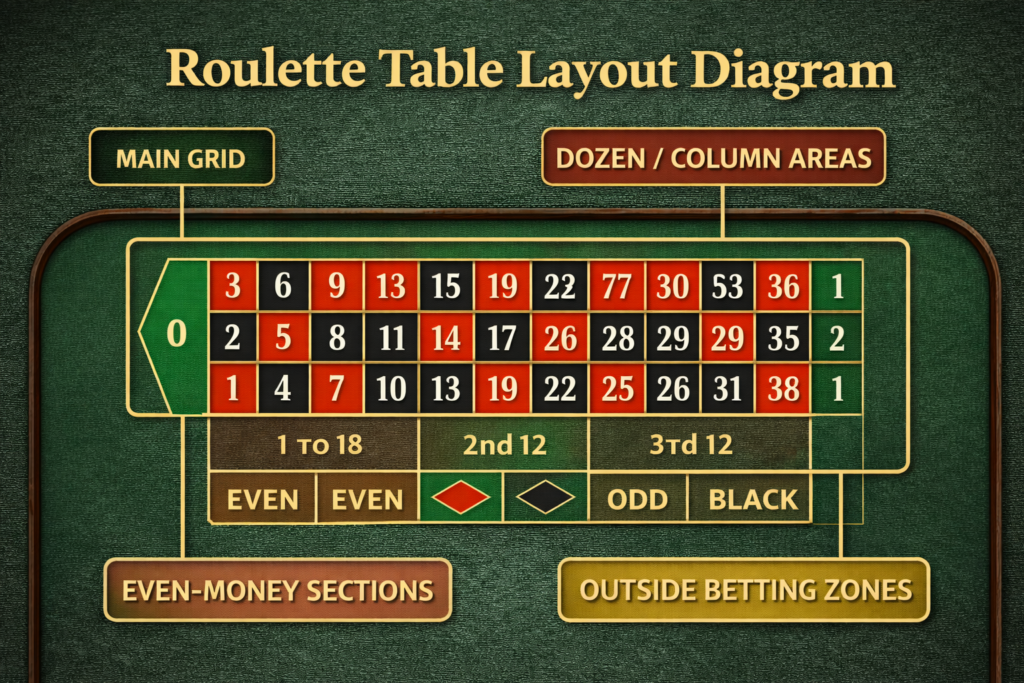
While the wheel determines outcomes, the table layout design structures player betting and influences wagering patterns.
Main Betting Grid Structure
European Table Layout: The betting surface displays 36 numbers organized in three vertical columns containing 12 numbers each (1-34 / 2-35 / 3-36 system). This arrangement differs from the wheel sequence, deliberately creating cognitive disconnect—players cannot easily predict wheel outcomes from table positions.
Grid positioning:
- Numbers 1-12 form the “First Dozen”
- Numbers 13-24 form the “Second Dozen”
- Numbers 25-36 form the “Third Dozen”
Zero Placement: The zero pocket sits at the table’s head, creating a separate betting area. Players place straight-up zero bets by positioning chips on the zero square.
Outside Betting Sections
Beyond the 36-number grid, the table layout design includes outside betting areas for even-money and coverage bets:
Even-Money Sections (1:1 payouts):
- Red/Black sections marking color bets
- Odd/Even sections for number parity bets
- Low (1-18)/High (19-36) sections for range bets
Coverage Betting Sections (2:1 payouts):
- Dozen betting areas (1-12 / 13-24 / 25-36)
- Column betting areas (each vertical column)
La Partage/En Prison Sections (French tables only):
French tables include additional betting areas for specialized rules where even-money bets can be imprisoned or halved when zero appears.
Racetrack Betting (Announced Bets)
French tables include an outer “racetrack” layout displaying wheel numbers in their actual sequence. This enables “announced bets”—betting wheel sectors rather than table layout sections. Players place chips on racetrack numbers, betting clusters like “Voisins du Zero” (neighbors of zero) or “Orphelins” (numbers outside main sectors).
Design Purpose: The racetrack serves experienced players and provides alternative betting without table layout confusion.
Pro Tip: European vs American layouts differ physically—American tables have wheel at table’s end (single layout), while European tables have wheel centered with layouts on both sides. This physical difference influences dealer positioning and betting dynamics.
European vs American Roulette: Design Differences
Beyond the critical pocket difference (37 vs 38), design distinctions affect gameplay.
Wheel Diameter and Size
Despite identical 37-pocket or 38-pocket designs, European and American roulette wheels maintain consistent diameters (approximately 32 inches). This standardization creates familiar player experience across variants.
Table Layout Positioning
European Layout: The wheel sits at table center with betting layouts on both sides. Croupiers stand opposite, managing both layouts simultaneously.
American Layout: The wheel sits at the table’s end with single betting layout. Croupier stands at side, managing from one position.
This physical difference creates distinct game atmospheres—European feels more interactive with two-sided player engagement, while American feels more formal with dealer-focused control.
Betting Surface Materials
European tables: Often use traditional felt covering (typically green), creating classic casino aesthetic.
American tables: Use durable synthetic materials (plastic or rubber-based) allowing easier cleaning and maintenance in high-volume casinos.
Manufacturing Process: How Quality Wheels Are Built
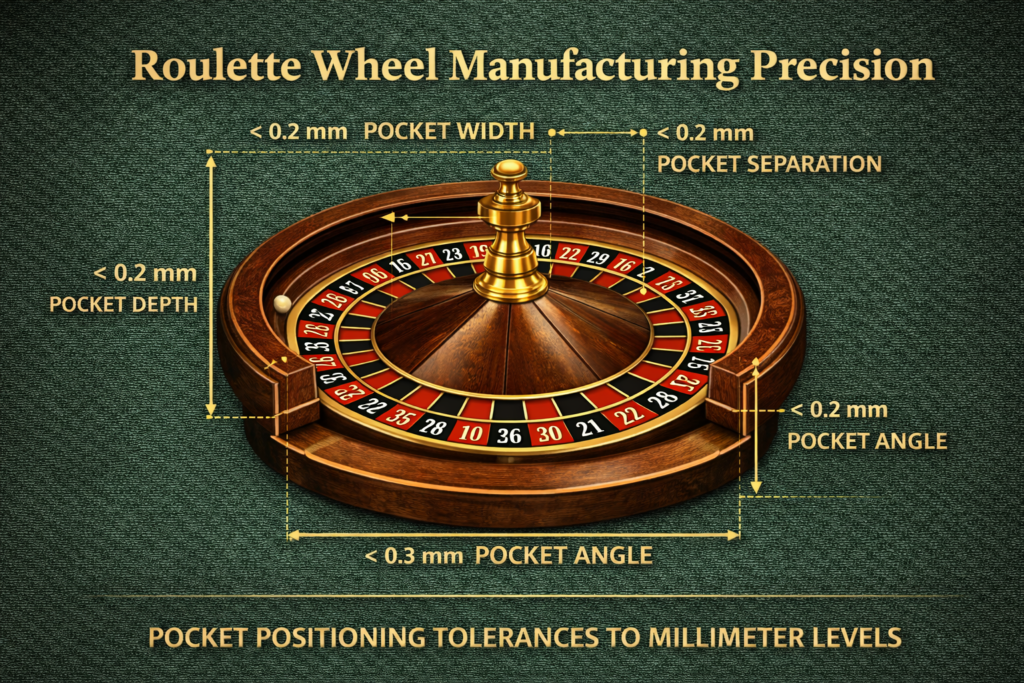
Understanding roulette wheel design requires knowing how precision manufacturing creates fairness.
Design and Engineering Phase
CAD Design: Engineers create computer-aided designs specifying every component with precision tolerances. Modern wheels are completely engineered virtually before physical construction begins.
Material Selection: Designers select materials balancing durability, aesthetic appeal, and cost. Premium wheels use hardwoods (mahogany) for bowls and high-grade materials for mechanical components.
Component Manufacturing
Pocket Carving: CNC machines carve individual pockets into the wheelhead using computer-controlled precision. Each pocket is identically sized and shaped—critical for preventing bias.
Ball Track Installation: Laser technology embeds the ball track groove, ensuring geometric consistency around the full circumference.
Deflector Positioning: Individual deflectors are precisely positioned using CNC equipment, with positioning tolerances of mere millimeters.
Assembly Process
Subassembly Construction: Components are assembled in stages—first the cone-turret assembly, then wheelhead, then ball track system, finally bowl installation.
Alignment Verification: After each stage, technicians verify alignment using laser measurement equipment. Even 0.5mm misalignment creates detectable bias.
Quality Control and Testing
Balance Testing: The completed wheel is placed on its spindle, and technicians verify it remains balanced at all rotational positions. Wheel mass must be evenly distributed—any imbalance creates bias potential.
Spin-Down Testing: The wheel is spun and allowed to naturally decelerate. Technicians record spin times, which should be consistent (typically 10-20 minutes for professional wheelheads).
Ball Drop Testing: Hundreds of test spins using multiple balls verify randomness. Statistical analysis confirms no number sectors show statistical over-representation.
Certification: Upon passing quality control, regulatory bodies certify the wheel meets industry standards and complies with gambling regulations. Only certified wheels can be used in regulated casinos.
Expert Insight: Professional wheel manufacturing takes weeks per wheel, costing $5,000-$15,000+ per unit. This expense reflects precision engineering requirements preventing bias.
Wheel Maintenance: Why Regular Inspection Matters
Even perfectly manufactured wheels require regular maintenance preventing wear-related bias.
Components Requiring Regular Replacement
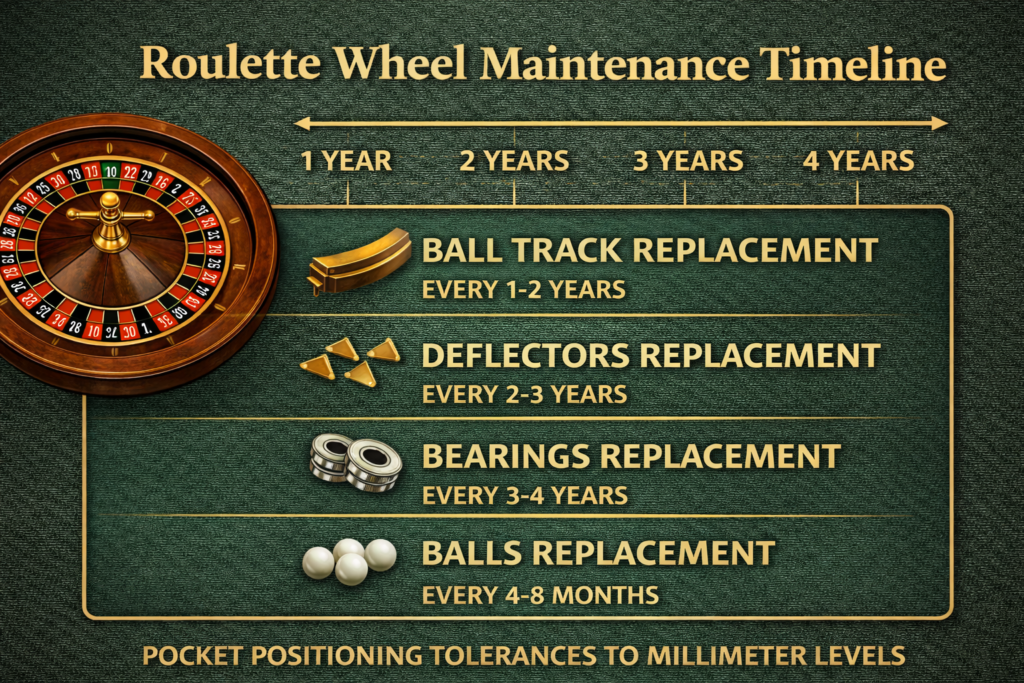
Ball Track: The most frequently replaced component due to constant ball friction. Casino specifications typically replace tracks every 12-18 months in high-volume establishments.
Ball Deflectors: These experience wear from constant ball impacts. Worn deflectors may not redirect balls consistently, introducing bias. Regular inspection identifies wear requiring replacement.
Bearings: Professional-grade bearings last 3-5 years with regular maintenance. Worn bearings increase friction, affecting spin consistency and introducing bias potential.
Balls: Despite appearing uniform, balls wear and develop slight weight variations over time. Casinos rotate through multiple balls (typically 3-5 per wheel) and replace balls showing abnormal wear.
Inspection Procedures
Visual Inspection: Technicians examine all components for visible wear, cracks, or damage.
Measurement Inspection: Using precision equipment, technicians measure critical tolerances verifying component specifications remain within acceptable ranges.
Spin Testing: Regular spin-down testing confirms the wheel maintains expected spin durations without unusual friction or binding.
Statistical Testing: Casinos periodically conduct statistical analysis of accumulated spin data, identifying any number sectors showing statistical over-representation indicating bias development.
Quick Takeaway: Wheel maintenance represents a significant casino expense—but far less expensive than allowing biased wheels to operate, which would devastate house edge long-term.
Roulette Ball Specifications: The Overlooked Component
While wheels receive attention, the roulette ball itself requires precise specifications affecting gameplay.
Material and Construction
Modern Specifications: Professional roulette balls are manufactured from phenolic resin or high-quality plastic, replacing the ivory balls used historically.
Diameter: Balls measure approximately 1.06 inches (27mm) in diameter, fitting precisely into the 1.25-inch (32mm) pocket diameter.
Weight Distribution: Balls must weigh between 16-18 grams (specifications vary by casino). Even 1-gram variations affect trajectory noticeably over multiple spins.
Surface Quality: Ball surfaces must be perfectly smooth. Any imperfections cause abnormal bouncing off deflectors or track edges, introducing bias.
Ball Rotation and Replacement
Casinos maintain multiple balls per wheel (typically 3-5), rotating them throughout gameplay. This rotation prevents single-ball wear patterns that could introduce bias.
Regular Testing: Casinos weigh balls periodically, replacing any showing weight deviation. A ball gaining or losing even 0.5 grams gets replaced immediately.
Professional Insight: Research shows ball quality significantly affects long-term randomness more than commonly realized. Quality casinos invest substantially in ball testing and replacement protocols.
Design Philosophy: Preventing Bias While Maintaining Randomness
Roulette’s brilliant design paradox: creating mathematically random outcomes while preventing exploitable biases.
Randomness Through Complexity
The multiple deflectors, cone angles, ball track curves, and number arrangements create system complexity preventing simple predictability. Even identical initial conditions produce different outcomes due to tiny perturbation variations amplified through the system.
Bias Prevention Through Distribution
Number sequencing logic, color alternation, and low/high/odd/even distribution prevent sectors that could develop statistical bias if wheels developed minor tilts or wear patterns.
Fairness Through Manufacturing Precision
Precision manufacturing within millimeter tolerances ensures no component asymmetries that could create systematic bias toward particular outcomes.
Expert Insight: Roulette represents elegant engineering balancing fairness (preventing exploitable bias) with randomness (ensuring unpredictable outcomes). This balance makes roulette mathematically honest while psychologically engaging.
Conclusion: Appreciating Roulette’s Engineering Elegance
Understanding roulette wheel design reveals a sophisticated mechanical system balancing fairness, randomness, durability, and player engagement.
The wheel anatomy—from the microscopic precision in pocket machining to the macroscopic elegance of number sequencing—demonstrates how 17th-century gambling merged with modern engineering creating a game mathematically honest yet practically entertaining.
The table layout design psychologically influences player behavior through deliberate number arrangement creating cognitive disconnect between wheel sequence and table positions, preventing bias exploitation while maintaining engagement.
Professional wheel manufacturing requires weeks of precision work and quality control, with regulatory certification ensuring fairness. Ongoing maintenance protocols preserve wheel integrity across thousands of spins and years of casino operation.
By understanding these design elements, you appreciate why modern roulette achieves genuine randomness—not through luck or superstition, but through engineering precision preventing exploitable bias while mathematically guaranteeing house edge persists.