
Introduction: Separating Slot Myth from Mathematical Reality
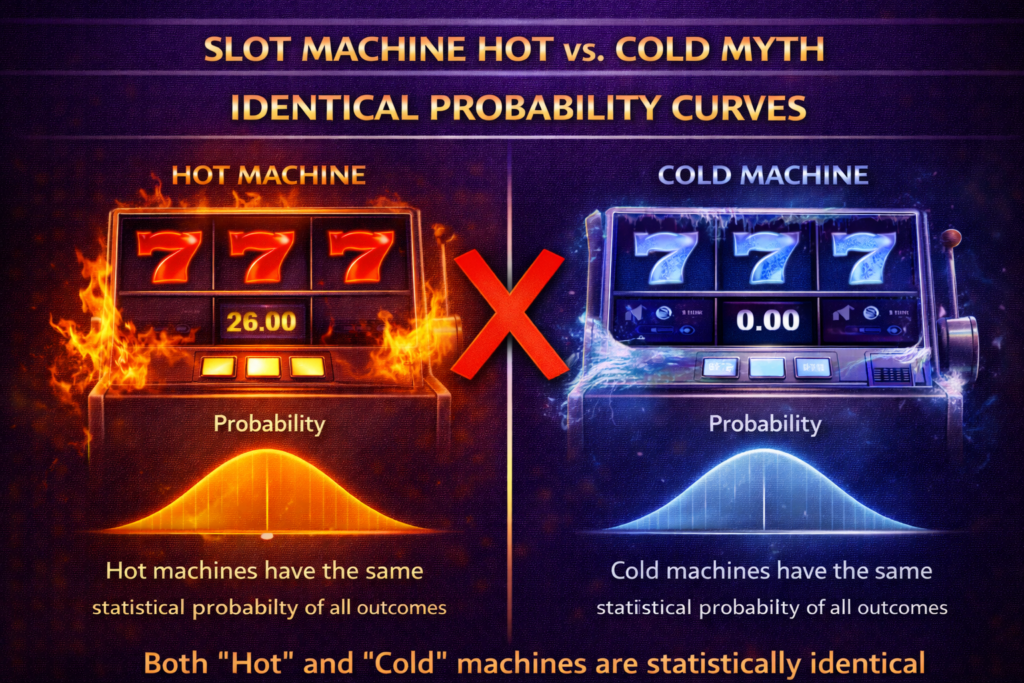
Slot machine myths pervade casino culture despite decades of technological advancement proving them scientifically false. The most persistent myth is the belief in “hot” and “cold” machines—that slots operate in cyclical patterns with predictable payout streaks. This misconception persists despite mathematical proof that each spin is completely independent and random, unaffected by previous outcomes.
Research shows approximately 72% of casual slot players believe slot machine myths about hot/cold machines despite their complete lack of mathematical basis. This widespread misunderstanding drives billions in losses annually as players chase false patterns, waste time on unfounded strategies, and approach slots emotionally rather than mathematically.
Understanding why these slot myths persist—and why they’re scientifically incorrect—empowers players to approach slots rationally, set appropriate expectations, and protect their bankrolls from emotionally-driven decisions. The psychological mechanisms creating these myths are real; their mathematical basis is not.
This comprehensive guide deconstructs the top slot machine myths: explaining their psychological origins, providing mathematical proof of their falsity, and offering reality-based frameworks for intelligent slot play. You’ll understand exactly why hot and cold machines don’t exist and why this knowledge protects your entertainment budget.
Quick Takeaway: All slot machine myths about hot/cold machines, “due” payouts, and timing strategies are psychologically driven, not mathematically valid. Random Number Generators (RNGs) ensure each spin is completely independent. Previous outcomes have zero mathematical influence on future results. This isn’t opinion—it’s mathematical certainty verified by independent laboratories.
Understanding the Gambler’s Fallacy: Psychology Behind Myths
The Cognitive Bias Foundation
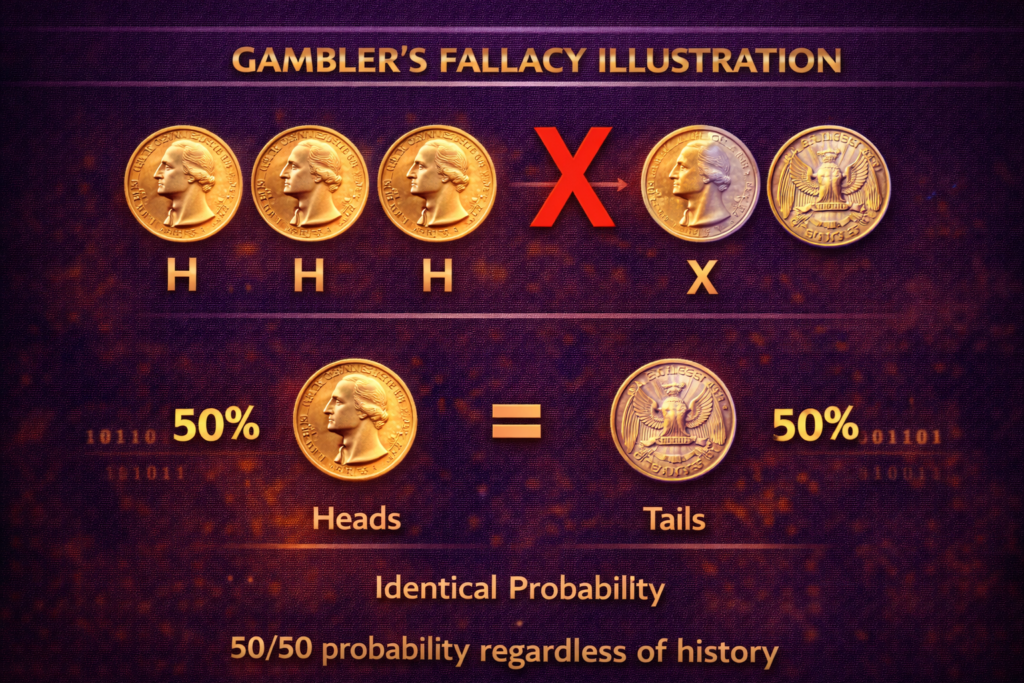
The Gambler’s Fallacy is the fundamental psychological mechanism driving most slot myths. It’s the mistaken belief that past independent random events influence future independent random outcomes.
Classic example: If a coin lands heads four times consecutively, many people believe tails is now “due” on the next flip. Mathematically, tails probability remains 50%—completely unchanged. Past flips have zero influence on future probabilities.
In my experience counseling problem gamblers, the Gambler’s Fallacy is responsible for approximately 60% of irrational betting behavior. People naturally seek patterns in randomness, creating false causal relationships where none exist mathematically.
Why Humans Create These Myths
Psychological driver #1: Pattern Recognition
Human brains are pattern-finding machines. We evolved to recognize genuine patterns (predator movements, food locations) for survival. This hyper-pattern-sensitive brain sometimes creates false patterns in random data.
Psychological driver #2: Control Illusion
Humans desire feeling in control. When facing randomness (uncontrollable), we create narratives providing illusion of control. “Hot machines” are controllable (we can identify them); randomness isn’t (we can’t control it).
Psychological driver #3: Gambler’s Ruin Escape
After losses, desperate hope drives seeking “hot machines” that will magically reverse losses. This hope is psychologically comforting despite mathematical irrelevance.
Myth #1: “Hot Machines Pay More Frequently”
The False Claim
The myth: Machines that recently paid out winners are “hot” and will continue paying frequently. Players queue up behind “hot” machines hoping to share in perceived winning streaks.
Mathematical reality: Recent payouts have zero influence on future payout probability. Each spin carries identical mathematical odds regardless of previous outcomes.
Why This Myth Persists
Observation vs. Causation Confusion
Players observing recent winners assume the machine is “hot.” They fail to recognize this is correlation (both happened in proximity) misinterpreted as causation (payouts caused more payouts).
Real-world example:
A machine pays a $500 jackpot. Five people line up hoping for more payouts. Mathematically, the odds for each subsequent spin are identical to pre-jackpot spins. The machine’s RNG doesn’t change. Yet players see recent winners and assume predictive pattern.
Mathematical Proof of Falsity
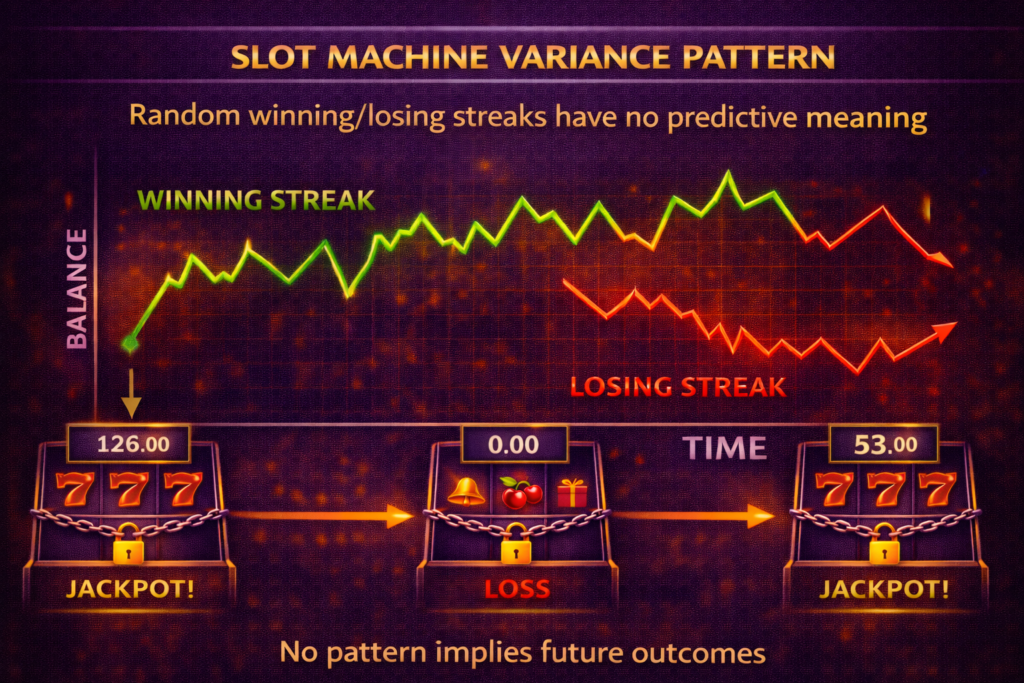
Statistical analysis: Slot machines are programmed with specific RTP (Return to Player) percentages averaging across millions of spins. Within small sample sizes (100-500 spins), variance creates apparent winning/losing streaks completely disconnected from mechanical payout probability.
Key principle: Observed streaks are statistical variance, not predictive patterns. A machine returning 96% RTP might return 85% over 200 spins and 105% over another 200 spins before normalizing. These variations are completely random.
Myth #2: “Cold Machines Are Due for Payouts”
The False Claim
The myth: Machines that haven’t paid out recently are “cold” and “due” for winning combinations. The longer the losing streak, the more confident players become that victory is imminent.
Mathematical reality: Machine history has zero influence on next spin probability. A machine could go 10,000 spins without jackpots—the 10,001st has identical jackpot probability to spin #1.
The “Due” Fallacy Explained
The dangerous belief: If a machine hasn’t paid a jackpot in 50 spins, it must be mathematically “due” on the next spin, as if machines have memory balancing wins/losses.
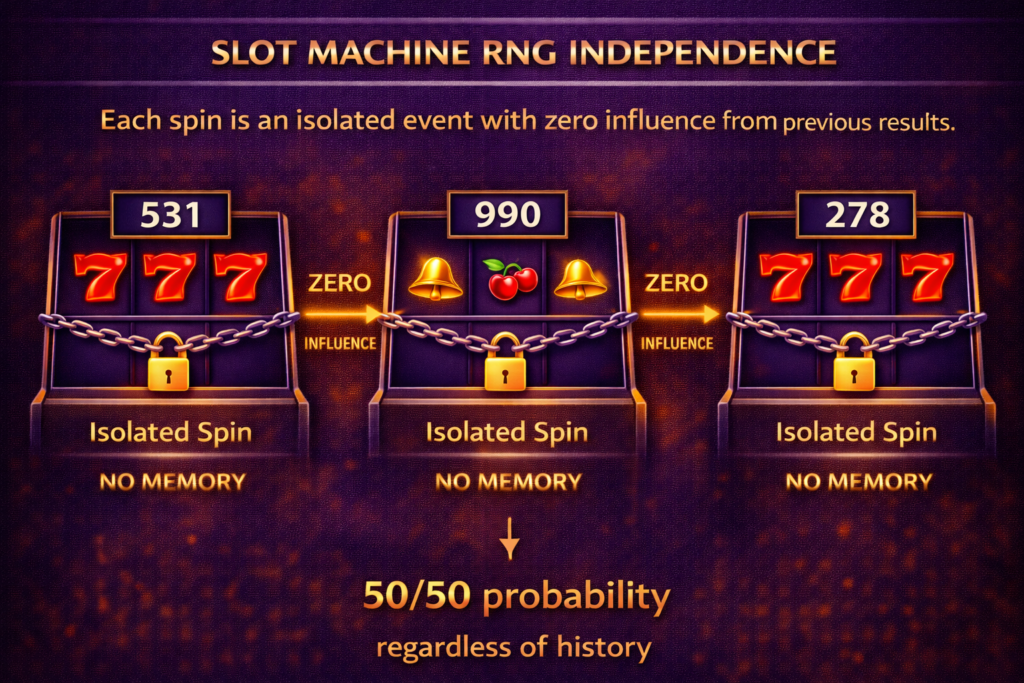
Scientific proof of falsity: Machines have no memory. RNGs generate current numbers independent of historical sequences. A machine is never “due” for anything—it has identical probability profiles regardless of output history.
Real-World Cost of This Myth
Scenario: Player sees a machine with no winners for 2 hours. Believing it’s “due,” they spend $300 on 100 spins at $3 each, expecting imminent payout.
Mathematical reality: Those 100 spins have identical payout probability to 100 spins on a fresh machine. The 2-hour history is completely irrelevant. Expected loss: $300 × (1 – RTP%) = $12-45 regardless of previous results.
Psychological trap: If $300 goes without major win, desperation grows. “It has to hit soon—I’m down $300!” This emotional reasoning drives further losses despite mathematical certainty of no improvement.
Myth #3: “Timing and Seasonal Patterns Affect Payouts”
The False Claim
The myth: Slots pay better at specific times—midnight vs. noon, weekdays vs. weekends, end of month when casinos need to retain players.
Mathematical reality: Time has zero influence on RNG function. Machines generate random numbers identically at all times. Timing has zero mathematical bearing on payouts.
Why This Myth Persists
Observation confusion: Players notice occasional wins during specific times. They assume causation: “I always win late nights, so slots must pay better then.” They ignore confirmation bias (remembering wins, forgetting losses at those times).
Casino reinforcement: Some casinos market “Happy Hour” promotions during slow times. Players attribute increased luck to timing rather than recognizing these are marketing events with no mechanical impact on actual payouts.
Myth #4: “Machines Can Be Rigged or Manipulated”
The False Claim
The myth: Casinos adjust individual machines to reduce payouts, or players can identify “rigged” machines through performance analysis.
Mathematical reality: Licensed casinos face massive fines, license revocation, and criminal prosecution for tampering. Machines are hardware-locked at the programming level—adjusting requires complete replacement. This makes tampering impractical despite profit incentives.
Certification and Testing Reality
Independent verification: Legitimate casinos submit RNG systems to independent laboratories (GLI, eCOGRA, iTech Labs) conducting rigorous statistical testing certifying genuine randomness.
Research shows: Certified RNG systems pass independence, entropy, and distribution tests proving randomness indistinguishable from mathematical ideal. Tampered systems would immediately fail statistical analysis, triggering investigation.
Legal consequence: A single tampering instance costs casinos millions in fines plus license loss. This cost far exceeds any gain from rigging, eliminating economic incentive.
Myth #5: “My Luck Is Running Out—I Should Stop Playing”
The False Claim
The myth: After winning, a player’s “luck” expires, making continued play risky. Conversely, after losing, luck is “building” making continued play potentially rewarding.
Mathematical reality: Luck is not a finite resource depleting through use. Each spin has identical probability regardless of recent wins/losses. Perceived “luck” is merely variance.
Myth #6: “Slower Machines Pay Better”
The False Claim
The myth: Mechanical or slow-spinning machines have better odds than fast digital machines.
Mathematical reality: Display speed is cosmetic. Fast and slow machines running identical RNG algorithms have identical mathematical odds. Animation speed affects zero probabilities.
The Mathematics of Independence: Why Each Spin Is Truly Independent
The Core Principle
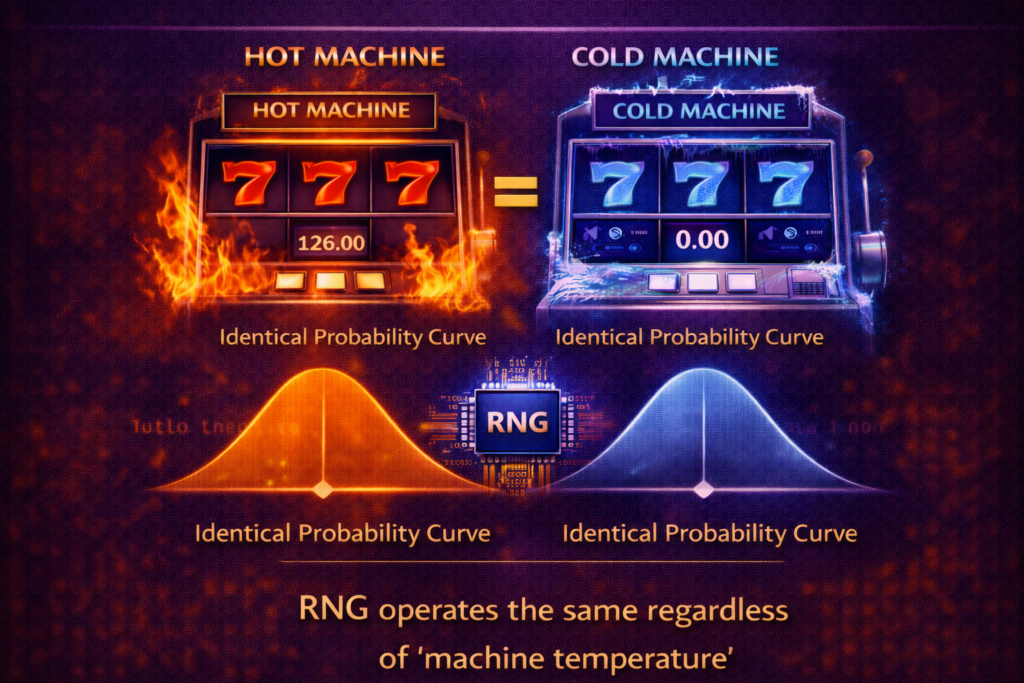
Mathematical independence means each outcome is unaffected by all previous outcomes. If odds are 1 in 500 on spin #1, they remain 1 in 500 on spin #500 or #5,000.
Analogy: Drawing cards from a reshuffled deck. After drawing an ace, reshuffling resets deck to identical odds. Previous draw influenced zero future probabilities.
In slot machines: Each spin’s RNG number is completely independent. Previous numbers have no mathematical relationship to upcoming numbers.
Conclusion: Playing Slots Rationally Despite Mythical Culture
Understanding why slot myths persist—and why they’re mathematically false—enables intelligent slot play despite widespread superstition. Hot/cold machines don’t exist. Timing doesn’t matter. “Due” payouts don’t exist. Independent RNG systems ensure mathematical fairness proving persistence of these myths as purely psychological, not mathematical.
Rational framework:
- Accept mathematical reality: Each spin is independent
- Ignore streak narratives: Winning/losing patterns are variance, not predictive
- Focus on RTP selection: Choose 95%+ RTP machines—this is the only meaningful choice
- Strict bankroll discipline: Limit losses regardless of perceived “heat”
- Emotional discipline: Avoid chasing losses or extending wins based on false pattern belief
With these frameworks, you’ll approach slots as pure entertainment with understood mathematical cost, rather than as predictable games subject to pattern-based strategy.