

The Foundation of Poker Profitability
Texas Holdem starting hands represent the absolute foundation of poker profitability. Before community cards appear, before strategy deepens, before complex decisions emerge—you face your first critical choice: which starting hands warrant playing. This decision determines everything following. Playing weak poker starting hands guarantees losses; selecting strong hands positions you for long-term profitability.
Research shows that beginning poker players lose approximately 60% more money than their skill level would predict due to poor starting hand selection. Yet mastering which hands to play in Texas Hold’em requires only understanding a few fundamental categories and making disciplined decisions. The irony: most beginners lose more by playing too many hands than by playing too few.
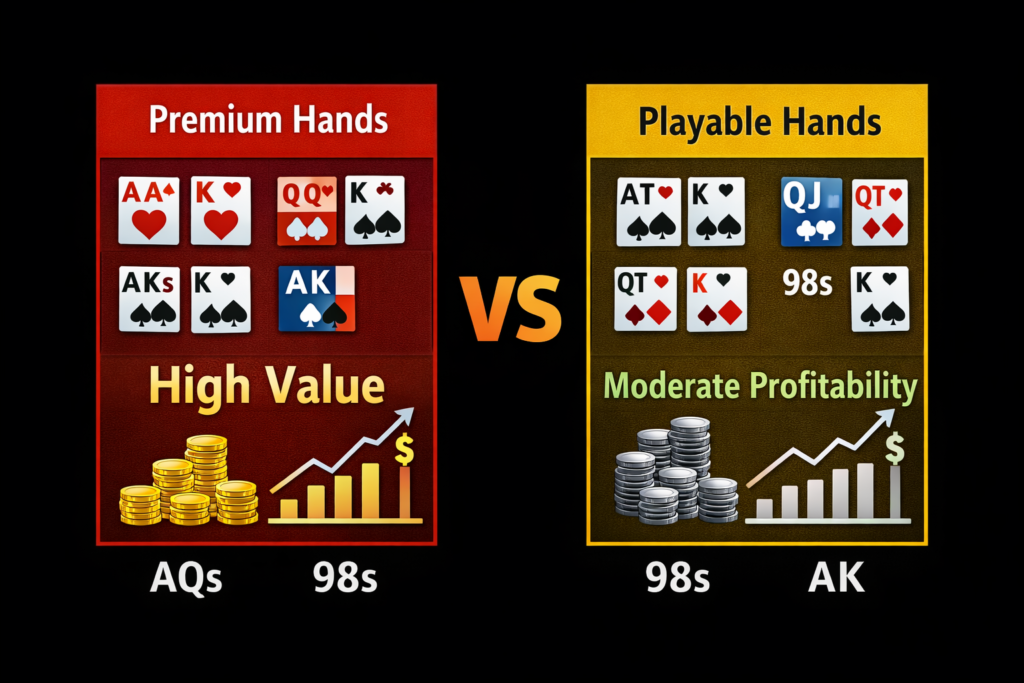
Understanding poker starting hand selection follows pure mathematical principles: stronger hands win more often against any opponents. Premium starting hands appear rarely—pocket aces approximately once every 220 hands. Yet playing only premium hands, while mathematically positive long-term, misses profitable opportunities available through disciplined expansion into secondary hand categories.
This comprehensive guide deconstructs Texas Hold’em starting hands completely: explaining hand rankings, premium categories, secondary opportunities, positional adjustments, and practical selection frameworks. You’ll understand exactly which hands to play from each position and how to adjust your starting hand selection as your poker skills advance.
Quick Takeaway: Premium starting hands (AA, KK, QQ, AK, AKs) should always be played. Strong hands (JJ, TT, AQ, AJ, KQ, KQs) warrant aggressive play from most positions. Playable hands need two of three criteria: high cards (K, Q, J, A), suitedness, or connectedness (78, 89). Avoid weak hands entirely (72o, 83o, T4o) unless in the big blind for free.
Premium Starting Hands: The Elite Tier
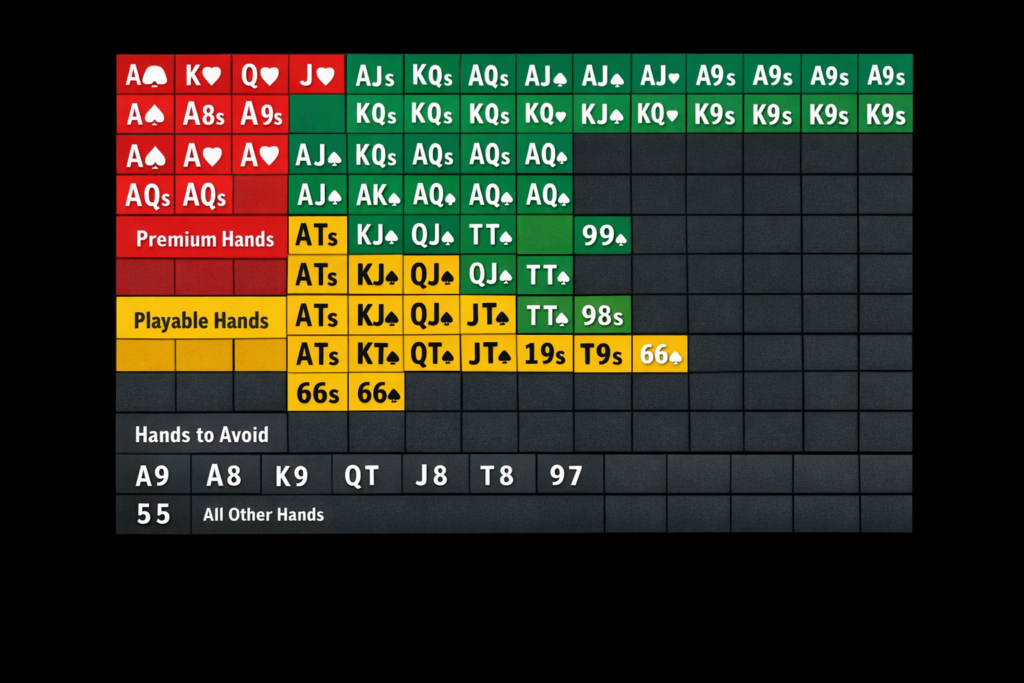
The Untouchable Five: AA, KK, QQ, AK, AKs
Premium starting hands represent the top 2% of all possible holdings—hands you should play aggressively from any position. These hands win more money than any others across long-term analysis.
Group 1: Pocket Aces (AA)
- Nickname: “Bullets”
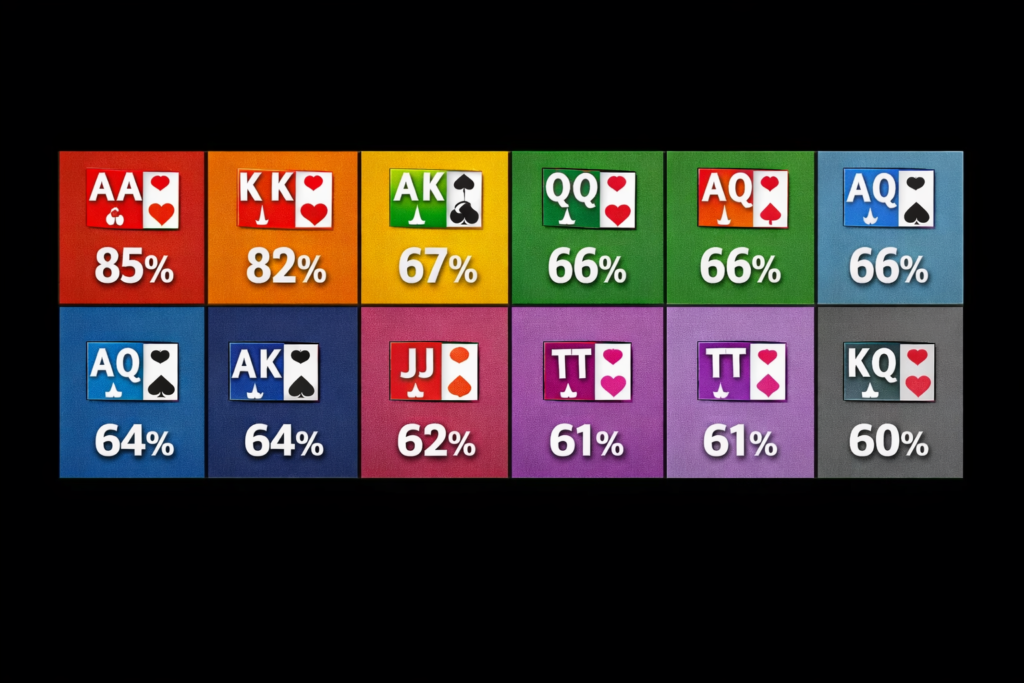
- Winning probability: Approximately 85% against random holdings
- Strategy: Always raise preflop; build pots aggressively; be comfortable getting all-in
- Warning: Aces win by large margins but occasionally get cracked; multiway pots reduce their advantage
Group 2: Pocket Kings (KK)
- Nickname: “Cowboys” or “King Kong”
- Winning probability: Approximately 82% against random holdings
- Strategy: Raise aggressively; caution if aces appear on the flop (you might be beaten)
- Key consideration: Only Aces beat Kings preflop—manageable risk profile
Group 3: Pocket Queens (QQ)
- Nickname: “Ladies” or “Dolly Parton”
- Winning probability: Approximately 80% against random holdings
- Strategy: Raise preflop but reassess if aces or kings appear on flop
- Postflop challenge: More overcards exist (A, K) compared to lower premium pairs
Group 4: Ace-King Suited (AKs)
- Nickname: “Super Slick”
- Winning probability: Approximately 67% against random holdings
- Key advantage: While not a “made hand,” AKs dominates weaker Aces (AQ, AJ, AT) and many other holdings
- Suitedness impact: The suited version significantly outperforms unsuited AK due to flush possibilities
- Strategy: Raise preflop; continue aggressively after hitting pair or making draws
Group 5: Ace-King Unsuited (AK)
- Nickname: “Big Slick”
- Winning probability: Approximately 65% against random holdings
- Distinction: Slightly weaker than AKs but still vastly superior to most holdings
- Benefit: Still dominates weak aces and many broadway combinations
Why These Hands Matter
Professional insight: Players who limit play to premium hands alone often win money because positive expected value dominates all other considerations. However, limited play frequencies create exploitable tight images.
Strong Starting Hands: The Secondary Tier
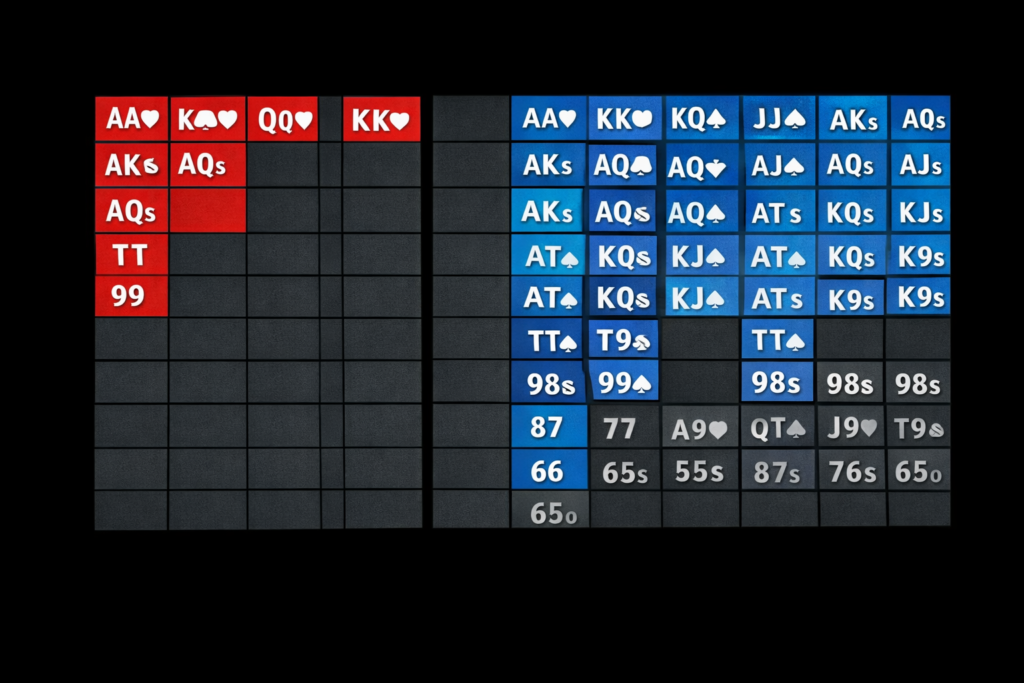
Group 2 Expansion: JJ, TT, AQ, AJ, KQ, KQs
Strong starting hands offer solid winning percentages while appearing more frequently than premium hands. These warrant aggressive play from favorable positions.
Pocket Jacks (JJ)
- Winning probability: Approximately 77% against random holdings
- Challenge: More overcards exist (A, K, Q) compared to higher pairs
- Position-dependent: Play aggressively from late position; tighten from early position
- Postflop consideration: Risk increases dramatically if overcards appear
Pocket Tens (TT)
- Winning probability: Approximately 75% against random holdings
- Value: Popular for “set mining”—hoping to hit trips on the flop
- Deep stack play: Benefits from implied odds when stacks enable calling small raises
- Short stack play: Less attractive due to reduced implied odds
Ace-Queen Suited (AQs)
- Winning probability: Approximately 66% against random holdings
- Advantages: Potential for high pairs, straight draws, and flush draws
- Key distinction: Suited version offers significant advantage over unsuited AQ
- Caution: Can be dominated by AKs or AKo from aggressive opponents
Ace-Jack Suited (AJs)
- Winning probability: Approximately 65% against random holdings
- Flush potential: Valuable because flush opportunities increase expected value
- Domination risk: Weaker than AQ or AK; can be dominated by these stronger Aces
- Position matters: More playable from late position where domination risk decreases
King-Queen Suited (KQs)
- Winning probability: Approximately 64% against random holdings
- Connected strength: Sequential nature creates straight and flush potential
- Overcard vulnerability: Both cards are relatively small; larger hands dominate frequently
- Positional advantage: Best from late position where implied odds justify calling
Playable Starting Hands: The Expansion Category
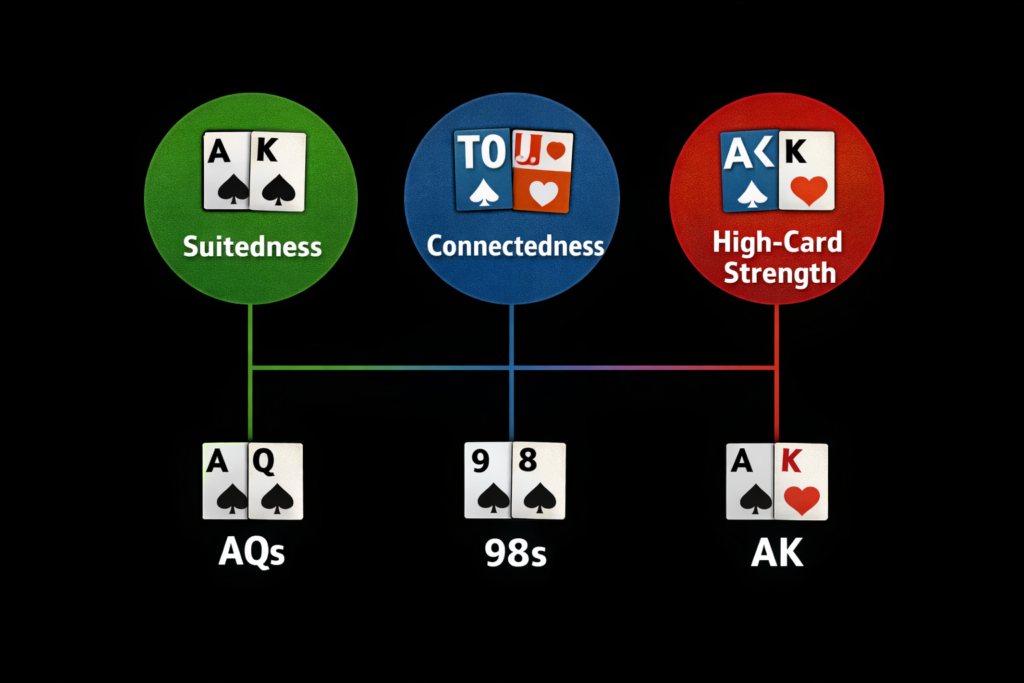
The Three Criteria Framework
Distinguishing playable hands requires meeting at least TWO of three criteria:
Criterion #1: High Card Strength
- Both cards 10 or higher (K♣ Q♦, J♠ T♥)
- Ace with any card (A♠ 2♦ through A♣ K♦)
- Examples: KJ, QJ, JT, AT, AQ, AK, etc.
Criterion #2: Suitedness
- Both cards identical suit (7♠ 5♠, K♦ Q♦, 9♣ 3♣)
- Increases flush probability dramatically
- Typically increases hand value 3-5% compared to unsuited equivalent
Criterion #3: Connectedness
- Sequential cards (7♠ 6♦, T♣ 9♠, K♦ Q♠)
- Creates straight and flush draw possibilities
- Adjacent ranks essential; wide gaps reduce value
Playable Examples Meeting Two+ Criteria
Suited connectors (Criteria 1, 2, 3):
- JTs, T9s, 98s (all three criteria)
- 87s, 76s, 65s (two criteria)
Suited broadway (Criteria 1, 2):
- KJs, QJs, ATs, A9s, A8s (high cards + suitedness)
Connected broadway (Criteria 1, 3):
- KQ, QJ, JT (high cards + connectedness)
Pocket Pairs: The Special Exception
All pocket pairs (22-AA) create a fourth criterion: set potential (hitting three-of-a-kind on the flop).
Premium pairs (JJ+): Always play from any position
Mid-tier pairs (99, TT): Strong from most positions
Lower pairs (22-88): Position-dependent, often for “set mining” only
Hands to Avoid: The Trash Category
Weak, Unconnected, Unsuited Combinations
Critical rule: Avoid these combinations entirely except in specific free-flop situations (big blind with no raise):
Garbage hands:
- 72o (seven-deuce offsuit, the absolute worst)
- 83o, 92o, T4o, J3o (weak, disconnected, unsuited)
- Any two cards separated by multiple ranks without suitedness or high-card strength
Why avoid: These hands have negative expected value—they lose more over time than they win. Even when “just checking” to see flops, the cost accumulates destructively.
Position-Adjusted Starting Hand Selection
Early Position Constraints
From UTG (first position): Play only premium hands (AA, KK, AK, AKs)
From UTG+1: Slightly wider—add QQ, AQ, AQs
Rationale: Multiple players behind mean higher probability someone has premium holdings; passive play required without positional advantage
Middle Position Expansion
From middle position: Add JJ, TT, AJ, AJs, KQ, KQs
Reasoning: Fewer players behind; more chances of winning pots uncontested or with good position
Late Position Freedom
From button, cutoff, hijack: Open 40-50% of hands—premium + strong + many playable hands
From small blind: Tight play despite positional advantage; big blind behind requires strong holdings
Rationale: Positional advantage postflop justifies wider preflop ranges; fewer players behind reduces confrontation probability
Conclusion: Building Your Starting Hand Foundation
Mastering poker starting hand selection transforms your play from leak-prone to fundamentally sound. Which hands to play depends on position, opponents, and bankroll depth—but core principles remain constant.
Action framework:
- Always play: AA, KK, QQ, AK, AKs (any position)
- Usually play: JJ, TT, AQ, AJ, AJs, KQ, KQs (most positions)
- Conditionally play: Lower pairs, suited connectors (position-dependent)
- Never play: Weak, disconnected, unsuited hands (except big blind free)
- Adjust aggressively: Late position enables wider ranges; early position requires tightness
With these frameworks internalized, you’ll make mathematically sound starting hand selections, setting yourself up for profitability regardless of opponents’ skill levels.