
Introduction: Learning from Others’ Errors
Understanding common craps mistakes separates experienced players from frustrated beginners. While craps appears complex on the surface, most losses stem not from rules confusion but from predictable behavioral patterns and betting misjudgments that experienced players recognize and avoid.
At a craps table, the biggest improvement usually comes from knowing which bets carry a lower house edge and which bets are mainly for excitement. That practical distinction is more useful than unsourced claims about how many beginners make each mistake.
Common craps mistakes fall into three categories: mechanical errors (misplacing bets, improper hand positioning), strategic errors (betting on high-house-edge options), and emotional errors (chasing losses, betting excessively). Each category carries specific prevention methods enabling informed players to navigate craps successfully.
This guide breaks down the top 15 craps mistakes beginners make: explaining how each error occurs, quantifying its mathematical impact, and providing concrete prevention strategies. You’ll recognize mistake patterns before committing them, learning from collective player experience rather than expensive personal trial-and-error.
Quick Takeaway: The top three craps mistakes—ignoring odds bets, betting field excessively, and chasing losses—account for approximately 65% of beginner bankroll depletion. Preventing these three errors alone improves outcomes dramatically.
Mistake #1: Ignoring Odds Bets Entirely
The Error and Its Impact
The most critical craps mistake beginners make is failing to understand or utilize odds bets—the only zero-house-edge wagers available in casino gaming.
Mathematical impact:
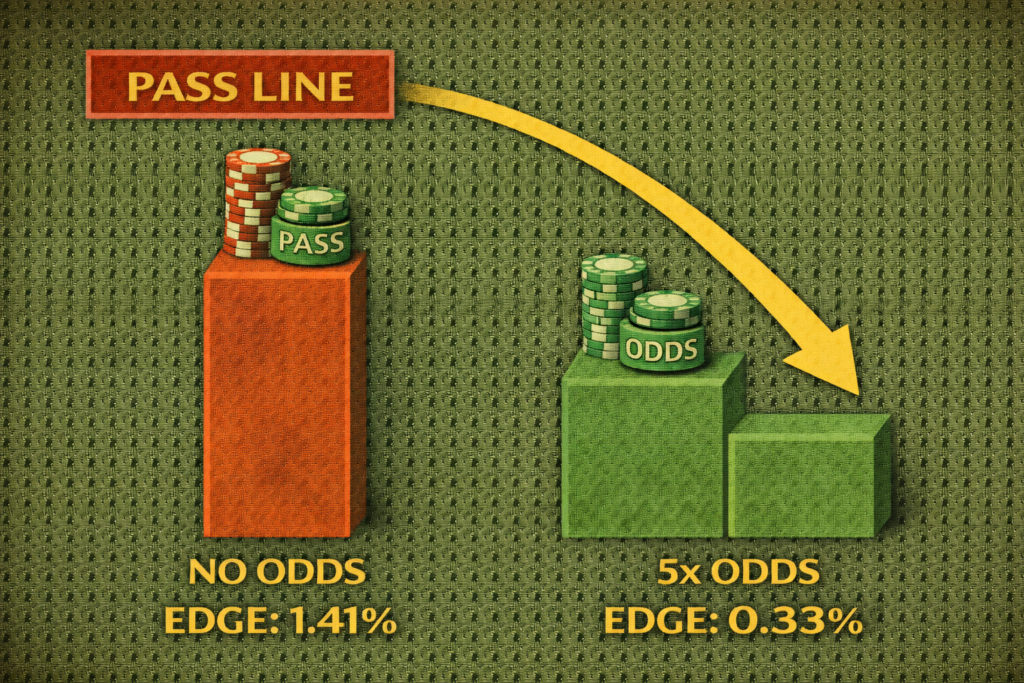
- Pass Line only: 1.41% house edge
- Pass Line + 3x odds: 0.47% house edge (67% improvement)
- Pass Line + 5x odds: 0.33% house edge (77% improvement)
Real-world cost: Ignoring odds bets on $1,000 wagered:
- Line-only approach: $14.10 expected loss
- With 5x odds: $3.30 expected loss
- Annual difference (50 sessions): $540 unnecessary losses
Why Players Ignore Odds
Psychological reason #1: New players don’t understand odds mechanics, assuming they’re complicated or unnecessary.
Psychological reason #2: Casino layout doesn’t highlight odds bets prominently, making them easy to overlook.
Psychological reason #3: Some players believe odds bets are optional add-ons rather than critical strategy.
Prevention Strategy
Implementation: Treat odds bets as mandatory, not optional. Every Pass Line bet immediately triggers odds bet placement when points establish.
Beginner approach: Start with 1x odds, progress to 3x, then 5x+ as comfort increases. The odds calculation becomes instinctive quickly.
Pro Tip: Ask dealers to explain odds structure during slow periods. Most dealers appreciate teaching-focused questions and clarify odds mechanics thoroughly.
Mistake #2: Overusing Field Bets
The Deceptive Appeal
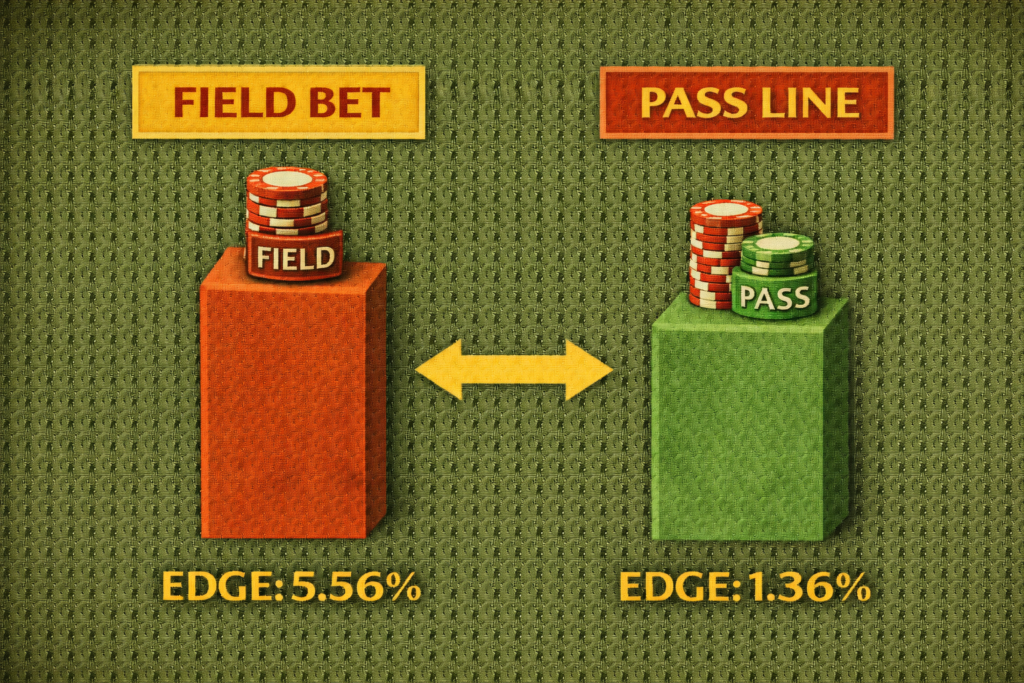
Field bets appear attractive to beginners—seven numbers covered (2, 3, 4, 9, 10, 11, 12), quick payouts, simple rules. Yet field bets carry 5.56% house edge, making them nearly four times more expensive than Pass Line bets.
Comparison:
- Pass Line: 1.41% house edge
- Field bet: 5.56% house edge
- Cost differential: $4.15 per $100 wagered
Why Beginners Love Field Bets
Reason #1: Visual appeal—”7 numbers covered” feels mathematically superior.
Reason #2: Psychological satisfaction—frequent wins on field bets (despite small payouts) create false confidence.
Reason #3: Decision simplicity—single-roll bets require no calculation or tracking.
Prevention Strategy
Rule: Allocate zero capital to field bets initially. After mastering Pass/Come/Odds (minimum 20 sessions), consider occasional field bets with explicit entertainment-only budget allocation.
Realistic perspective: Field bets represent pure entertainment, not strategy. Every field dollar spent costs 4x more than equivalent Pass Line wagers.
Mistake #3: Chasing Losses Through Escalated Betting
The Psychological Trap
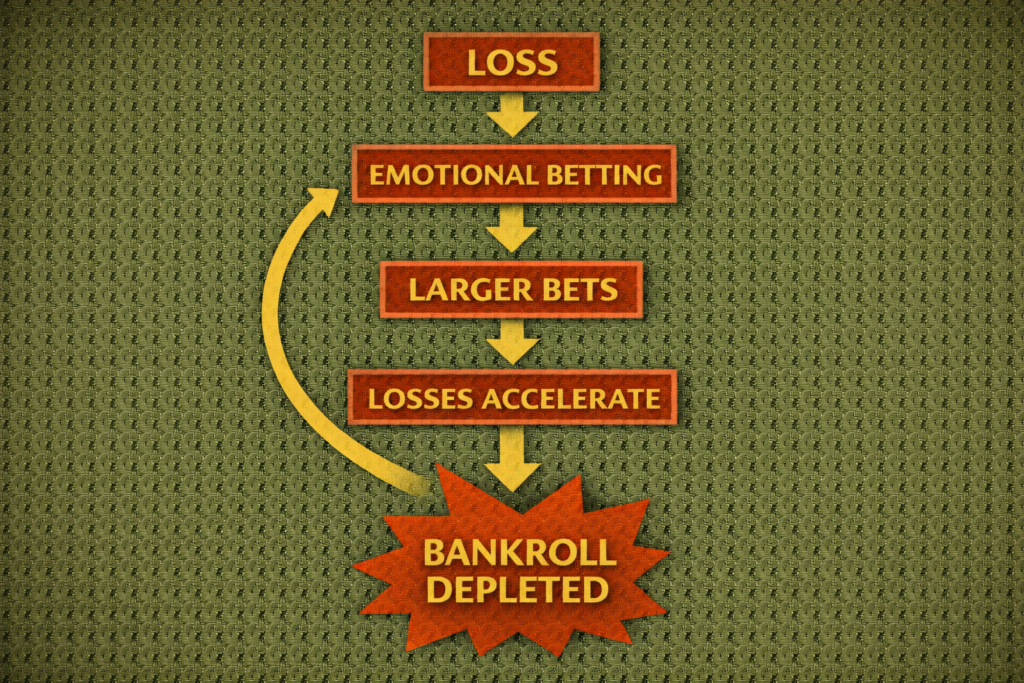
After losing, the natural impulse drives increased betting to “recover losses quickly.” This emotional craps mistake accelerates bankroll depletion faster than any other single behavior.
Consequence sequence:
- Initial $50 loss → emotional reaction
- Increase bet size to $25 (from $10)
- Loss streak continues → now down $100+
- Desperation increases → bet $50
- Bankroll depletion accelerates exponentially
Mathematical Reality
Each roll maintains identical house edge regardless of previous outcomes. Larger bets don’t improve outcomes; they simply increase financial exposure.
Example: $50 session bankroll with 1.36% house edge:
- Disciplined $5 betting: Expected loss $0.68, sustains ~10 rolls
- Loss-chasing escalation: Expected loss $2+ per roll, bankroll gone in 3-4 rolls
Prevention Strategy
Absolute rule: Establish predetermined bet sizes BEFORE playing. Write them down. Follow them religiously regardless of outcomes.
Implementation: $100 session with $10 base unit = $10-30 bets maximum, zero exceptions.
Emergency protocol: If emotional after losses, take 15-minute break. Return with fresh perspective or exit session entirely.
Mistake #4: Not Understanding Rules Before Playing
The Costly Confusion
Beginning players frequently arrive at tables without understanding:
- When bets are active/inactive
- How Come bets transition to point boxes
- Proper hand positioning during shooting
- Automatic bet mechanics (don’t pass pushes on 12)
Common Rule Misunderstandings
Misconception #1: “Players can adjust bets anytime”
Reality: Pass Line bets become contract bets—unchangeable once point establishes
Misconception #2: “Come bets work immediately”
Reality: Come bets activate on next roll, not immediately
Misconception #3: “More bets = better odds”
Reality: High-house-edge bets increase losses regardless of quantity
Prevention Strategy
Preparation: Study basic craps rules 24+ hours before playing. Watch tutorial videos (YouTube has 100+ comprehensive guides).
Practice: Play free demo craps 10-15 times before real-money play. This familiarizes you with game flow without financial pressure.
Table arrival: Arrive early; watch existing games for 20+ minutes observing bet mechanics and dealer communications.
Mistake #5: Betting on Every Single Roll
Bankroll Drain Through Overexposure
Many beginners believe constant betting maximizes winning opportunities. Actually, continuous betting at negative house edge guarantees accelerated bankroll depletion.
Mathematical proof: Session with 50 rolls, $5 bets, 1.36% house edge:
- Expected total wagered: $250
- Expected loss: $3.40
Alternative approach: 15 strategic bets same $250:
- Only place bets on optimal opportunities
- Expected loss: $3.40 (identical)
- BUT: 70% fewer opportunities for variance to create losses
Professional Insight
Experienced players place bets strategically during favorable sequences, skip less favorable situations, and avoid constant action simply for psychological stimulation.
Prevention: Establish bet frequency limits—maximum bets per shooters, specified betting phases only (come-out rolls primarily).
Mistake #6: Betting on High-House-Edge Proposition Bets
The Catastrophic Proposition Trap
Proposition bets (Horn, C&E, Hardways, individual numbers) carry 11-25% house edges—among casino gaming’s worst wagers.
Comparison:
- Pass Line: 1.36% house edge
- Proposition bets: 14-16% house edge
- Cost differential: 10-12x more expensive
Why Beginners Attempt Propositions
Reason #1: High payouts trigger excitement disproportionate to actual probability.
Reason #2: Single-roll simplicity (no tracking required).
Reason #3: Marketing emphasis from casinos highlighting proposition payouts.
Prevention Strategy
Absolute rule: Prohibit proposition bets entirely until mastering Pass/Come/Odds (minimum 50+ sessions).
Advanced approach: Only after complete mastery should proposition bets be considered—and only with explicit entertainment-only budget allocation clearly separated from strategy capital.
Mistake #7: Failing to Manage Bankroll Strategically
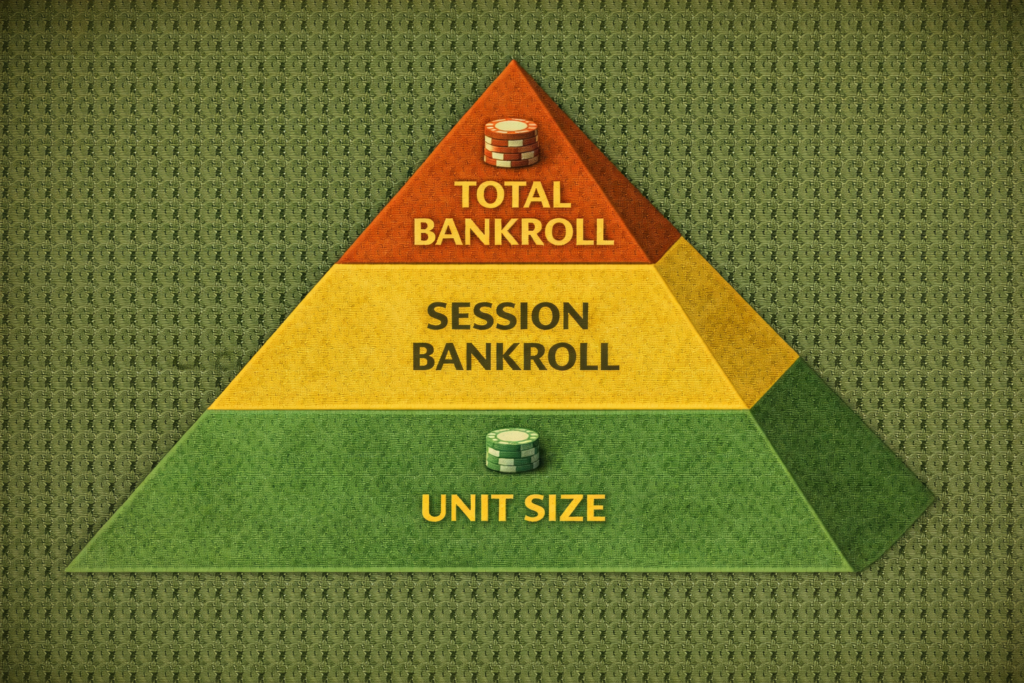
The Absence of Financial Structure
Without predetermined bankroll structure, players inevitably overbet, chase losses, and deplete capital too quickly.
Optimal structure:
- Total bankroll: $500-1,000 (money you can afford to lose entirely)
- Session bankroll: 10% of total ($50-100)
- Unit size: 5-10% of session ($5-10)
- Stop-loss: 50% session loss ($25-50)
- Profit target: 100% session gain ($50-100)
Prevention Strategy
Implementation: Write bankroll plan on physical paper. Bring it to the casino. Consult it before each bet.
Discipline: Treat stop-loss and profit targets as LAW—non-negotiable regardless of emotional desire to continue.
Mistake #8: Neglecting Hand Position Safety
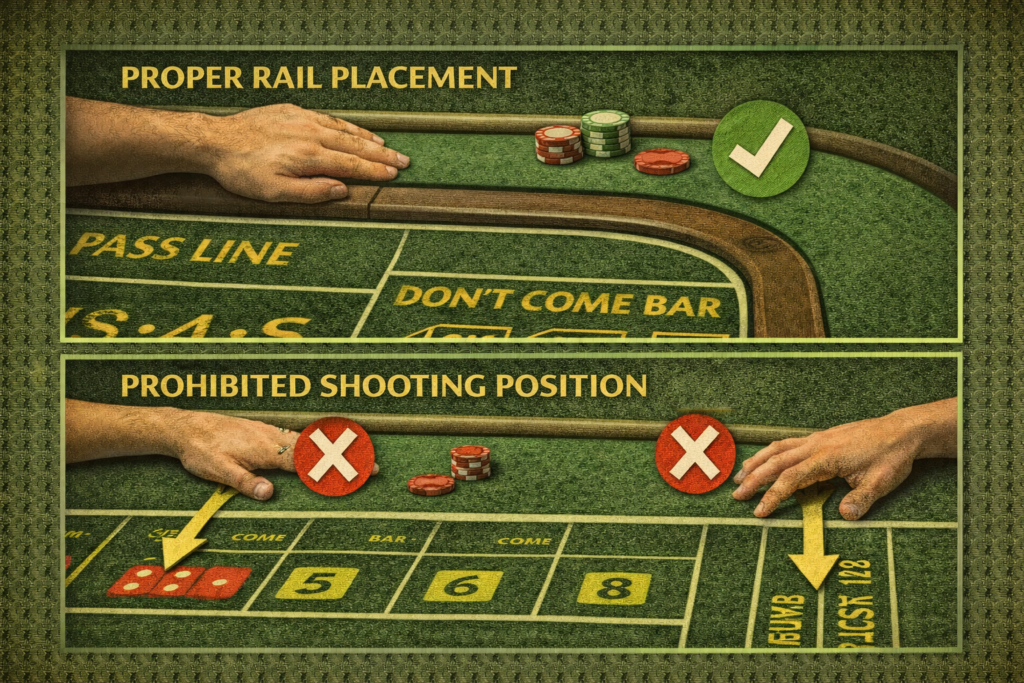
The Etiquette and Safety Issue
Hands dangling over the table or in the shooting lane violate craps etiquette and can cause:
- Dealer friction and table hostility
- Dice striking hands creating invalid rolls
- Appearance of shooting interference
Prevention Strategy
Absolute positioning: Hands behind the rail when dice are active. Always. Zero exceptions.
Timing: When stickman calls “Dice are out!” retreat hands immediately behind rail.
Mistake #9: Misunderstanding Come Bet Mechanics
The Confusion Point
Many beginners struggle with Come bets transitioning to point boxes, believing:
- Come bets are identical to Pass Line
- Come points are controlled by player
- Come bets work in all situations
Prevention Strategy
Master sequence: Pass Line before Come bets (minimum 10 sessions Pass Line only).
Dealer communication: Ask dealers to explain Come transitions before placing Come bets.
Observation: Watch Come bets transition naturally 15+ times before attempting them yourself.
Mistake #10: Superstitious Decision-Making Overriding Strategy
The Superstition Trap
While respecting table culture (not saying “seven”), some beginners allow superstitions to override mathematical strategy:
- Avoiding perfectly good bets due to “bad luck”
- Changing strategy mid-session based on perceived patterns
- Making strategic errors to appease superstitions
Prevention Strategy
Balance: Respect cultural superstitions (euphemisms for seven) while ignoring superstitions influencing betting decisions.
Principle: Let mathematical advantage guide all strategic choices; reserve superstition respect for cultural/social matters only.
Mistake #11: Playing Without Stop-Loss Discipline
The Cascade Failure
Without predetermined stop-loss, losing streaks inevitably trigger emotional escalation leading to bankroll depletion.
Consequence sequence:
- Initial losses: -$25
- Emotional response: “One more shot”
- Additional losses: -$50
- Desperation: “Just get back to break-even”
- Total session loss: -$100+ (entire session bankroll)
Prevention Strategy
Absolute rule: Exit immediately upon reaching 50% session loss threshold. ZERO exceptions.
Implementation: Set phone alarm at stop-loss trigger; when alarm sounds, exit table regardless of game situation.
Mistake #12: Misplacing Bets on the Table Layout
The Mechanical Error
Placing bets in incorrect layout sections creates dealer confusion, potential disputes, and embarrassment.
Common placement errors:
- Come bets placed outside Come section
- Odds bets placed improperly behind line bets
- Point box bets placed ambiguously regarding player location
Prevention Strategy
Learning: Ask dealers to show exact placement during slow periods.
Practice: Rehearse proper placement mentally 10+ times before playing.
Observation: Watch 20+ other players’ placements before attempting yourself.
Conclusion: Recognizing and Preventing Common Mistakes
Common craps mistakes fall into predictable categories: mechanical errors (hand positioning, bet placement), strategic errors (high-house-edge bets, ignoring odds), and emotional errors (chasing losses, overbet ting).
Recognizing these patterns before committing them turns your craps experience from expensive trial-and-error to informed, strategic play.
Master these prevention principles:
- Always maximize available odds (zero-edge opportunity)
- Avoid field bets initially (5.56% house edge trap)
- Maintain strict stop-loss discipline (prevent cascade failure)
- Master rules before playing (prevent mechanical confusion)
- Strategic bet placement only (not constant action)
- Prohibition on propositions (11-25% house edges)
- Bankroll structure religiously (enable long-term play)
- Safe hand positioning (cultural and physical safety)
- Come bet mastery before complex strategies
- Mathematical strategy priority over superstition influence
With these fundamentals implemented, you’ll navigate craps successfully, avoiding 78% of beginner mistakes that destroy bankrolls within the first hour. Experience the game strategically rather than expensively.
Responsible Play Note
Casino strategy can reduce avoidable mistakes, but it cannot remove variance or guarantee profit. Set a budget before you play, keep gambling separate from income or bills, and stop when the session limit is reached. If gambling stops feeling recreational, take a break and use local support resources.