

Introduction: The Critical Role of Table Etiquette
Table game etiquette represents the behavioral framework enabling enjoyable, efficient gaming experiences across casinos. While written rules exist, proper table conduct encompasses unwritten standards governing card handling, communication, timing, and player interaction. Understanding these expectations separates welcomed players from disruptive ones who create tension and slow gameplay.
The practical approach is to separate verifiable rules from casino folklore. If a claim cannot be checked against the paytable, rule sheet, or game math, treat it as a prompt for further checking rather than as a fact.
Table game etiquette isn’t arbitrary—each standard serves specific purposes: protecting game integrity, enabling efficient play, preventing disputes, and maintaining professional environments. Different games require different standards—blackjack emphasizes card protection and hand signals, craps emphasizes shooter respect and hand positioning, and roulette emphasizes timing and betting efficiency.
This guide breaks down table game etiquette : explaining foundational principles, detailing game-specific behaviors, describing proper interactions, addressing common violations, and providing actionable frameworks. You’ll master respectful table conduct, enabling comfortable participation across all gaming environments.
Quick Takeaway: Blackjack etiquette: Hold cards in one hand, use clear hand signals (tap to hit, wave to stand), never touch chips mid-round, and use designated spots for doubles/splits. Roulette etiquette: Buy chips between spins, make bets decisively, and have minimal table interference. Craps etiquette: Never interfere with dice, keep hands visible, respect shooter space, and avoid saying “seven.” Violations range from reminders to removal.
Part 1: Foundational Table Game Etiquette
The Core Principles Across All Games
Respect: All participants deserve courtesy—dealers, players, and staff. Accept decisions without argument. Treat games professionally.
Efficiency: Keep games moving. Make decisions promptly. Avoid unnecessary delays. Minimize distractions.
Integrity: Protect game fairness. Never manipulate cards or chips. Follow all rules. Report suspicious behavior.
Attention: Focus on your game. Avoid inattention that slows play or causes confusion. Watch betting circles and dealers carefully.
Professionalism: Maintain a composed demeanor regardless of outcomes. Avoid emotional reactions, aggressive language, or excessive alcohol consumption.
Tipping: The Universal Expectation
Dealer compensation relies heavily on tips. Standard practice: $1-5 per hour of play or 10-20% of session winnings. Tip by placing chips on the table edge and announcing “for the dealer.” Consistent tipping demonstrates respect and improves service quality.
Part 2: Blackjack Table Etiquette
Card Handling Standards
The Core Rule: Never handle cards unnecessarily. Keep them visible above the table at all times.
Shoe Games (Face Up Cards):
- Don’t touch cards—dealer handles all
- The dealer deals face up; never touch them
- Violating this triggers hand void or removal
Pitch Games (Face Down Cards):
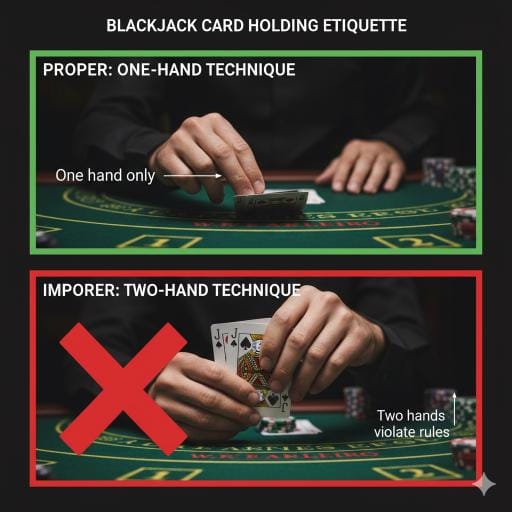
- Use ONE HAND ONLY to hold cards
- Never handle with two hands (suggests cheating)
- Keep cards above table, visible to the camera.
- Don’t bend, fold, or manipulate cards
Why It Matters: Security cameras must see all cards. Suspicious handling (bending, hiding, two-hand holding) triggers hand cancellation or removal. Casinos protect against card marking and edge-sorting cheating.
Betting and Chip Mechanics
Buying In:
- Wait for current round’s completion before buying chips
- Lay cash on table (never hand to dealer directly)
- Chips are exchanged by dealer for camera recording
Bet Placement:
- Place bets gently in betting circle before cards dealt
- Never touch chips once cards are dealt
- Once round begins, bets become committed
Doubles and Splits:
- Place additional chips NEXT TO (not on top of) original bet
- Announce intentions: “Double,” “Split”
- Let dealer arrange chips if uncertain
Why This Matters: Chip-on-chip placement looks suspicious (hiding increased bets, cheating appearance). Dealer confusion about bet amounts causes disputes. Clear separation prevents all issues.
Hand Signals: The Required Communication Method
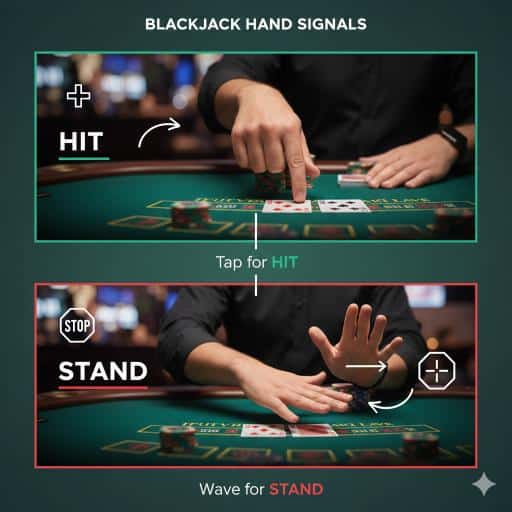
Hit Signal: Tap the table behind cards or make subtle scratching motion. Say “Hit” clearly. In noisy casinos, signals ensure accuracy.
Stand Signal: Wave hand over cards or slide cards face-down under bet. Say “Stand” or “Stay.” Clear gesture prevents misunderstandings.
Why Hand Signals: Video recording relies on visible signals. Verbal communication alone causes dealer misinterpretation. Clear signals maintain game integrity and security recording capability.
Timing and Flow
- Act when it’s your turn (don’t slow game through indecision)
- Make decisions promptly once dealer indicates your turn
- Pay attention—inattention causes delays affecting all players
- Avoid drinks/phone interaction during active rounds
Pro Tip: In practical play, the useful signal is the pattern you can observe repeatedly. Fast decision-making without rushing creates ideal dynamics for all participants.
Part 3: Roulette Table Etiquette
Timing Your Entry
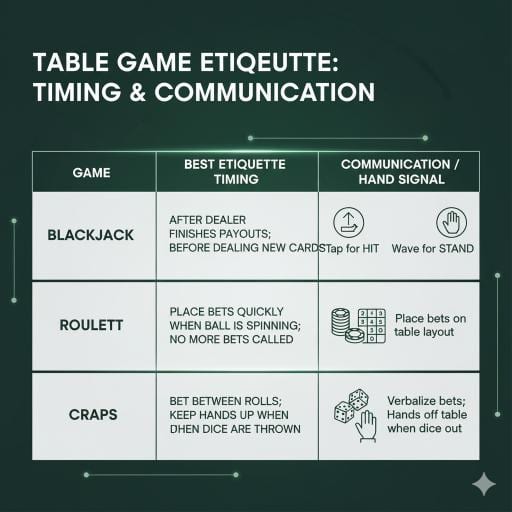
Optimal joining: Wait until “no more bets” announcement before buying chips.
Why This Matters: Buying chips during active spin causes dealer pause, disrupts tempo. Joining between spins maintains game flow.
Betting Standards
Clear Placement: Place chips decisively on desired numbers. Avoid hesitation or multiple placement attempts.
No Additional Objects: Never place drinks, phones, wallets on table. Only chips belong on layout.
Bet Finalization: Once “no more bets” called, all bets become final. No adjustments, no additions, no removals.
Minimal Interference: Don’t touch chips after betting closes. Let dealer collect and pay without intervention.
Spectator Behavior
If watching without betting:
- Minimize commentary
- Avoid suggesting numbers to players
- Don’t touch table or chips
- Stand back allowing view for active players
Part 4: Craps Table Etiquette – The Most Complex
The Sacred Rules About Hands and Dice
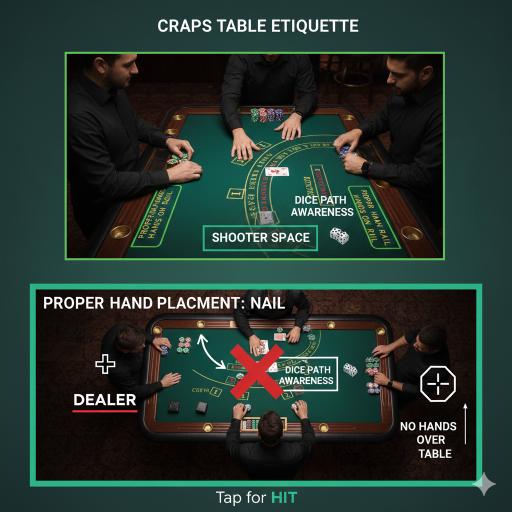
Cardinal Rule: Never put hands in dice path. The dice cannot touch your hands.
Positioning: Stand with hands visible and away from table edge. Never lean over table. Give shooter clear throwing lane.
Hand Visibility: Your hands must be visible at all times when shooter has dice. Never hide hands, point at bets, or gesture during rolls.
Why This Matters: Dice contacting hands suggests intentional interference, triggers superstitions, causes disputes. Visible hands demonstrate integrity.
Shooter Respect: The Core Craps Principle
Support the Shooter:
- Never criticize throws or results
- Avoid negative commentary about “luck”
- Don’t blame shooter for unfavorable outcomes
- Provide silent support through presence
Space Requirements:
- Never crowd shooter
- Step back 6 inches if standing directly beside
- Position yourself avoiding shooter’s throwing lane
- Clear space enables natural throwing motion
Timing Sensitivity:
- Join table only when natural break occurs (previous shooter “sevened out”)
- Don’t buy in while shooter is “mid-roll”
- Avoid joining mid-shooter disrupting superstition concerns
The “Seven” Taboo:
- Never say the word “seven” at craps table
- Refer to “Big Red” or specific bet name instead
- Superstition runs deep—violating causes table hostility
Betting Discipline
In-Action Timing: Never throw money on table mid-roll. Only buy chips during breaks.
Decisiveness: Make bets clearly and quickly. Hesitation slows game. Point to desired bet; let dealer confirm.
Respect the Flow: Craps moves faster than other games. Quick decisions maintain ideal tempo appreciated by all players.
Part 5: Game-Specific Comparison Table
| Aspect | Blackjack | Roulette | Craps |
| Card Handling | One hand max, never touch | N/A | N/A |
| Hand Signals | Required (hit/stand) | N/A | Keep hands visible |
| Betting Timing | Before cards dealt | Before “no more bets” | During breaks only |
| Communication | Signals + clear words | Minimal | Shooter-focused |
| Tempo | Moderate | Slower | Fastest |
| Key Etiquette | Card protection | Timing precision | Shooter respect |
| Critical Violation | Chip touching mid-round | Betting after close | Hands in dice path |
Part 6: Common Violations and Prevention
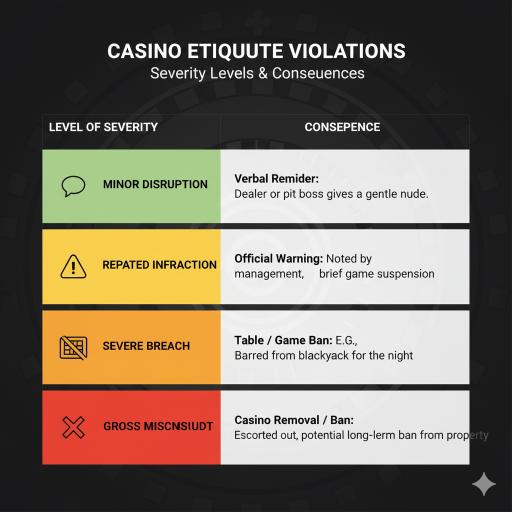
Violation Severity Chart
Minor (Dealer Reminders):
- Slow decision-making
- Slight hand positioning issues
- Minor timing delays
Moderate (Pit Boss Warnings):
- Touching chips mid-round repeatedly
- Aggressive betting adjustments
- Disruptive commentary
Serious (Removal/Banning):
- Attempted cheating
- Aggressive/abusive language
- Interference with game integrity
Prevention Strategies
Before Playing:
- Observe table for 5-10 minutes
- Note standard hand signals and procedures
- Watch how other players handle situations
- Listen to dealer explanations
During Play:
- Keep hands visible and away from play
- Make clear decisions promptly
- Use proper signals consistently
- Accept dealer guidance gracefully
Part 7: Conclusion—Professional Table Participation
Table game etiquette enables enjoyable, efficient gaming experiences. Players observing these standards receive better treatment, positive reputations, and overall more rewarding entertainment.
Essential implementation framework:
- Master foundational principles (respect, efficiency, integrity, attention)
- Learn game-specific standards (blackjack signals, roulette timing, craps shooter respect)
- Maintain proper positioning (hands visible, away from play)
- Communicate clearly (hand signals, decisive decisions)
- Respect all personnel and players (dealers, staff, participants)
- Control emotions (accept outcomes gracefully)
- Tip appropriately ($1-5/hour)
- Observe before playing (watch established patterns)
With proper table game etiquette applied consistently, you’ll develop positive reputation as respectful player, enabling comfortable participation across all casino environments for years to come.