

Intro – Split, Double, Surrender: Why the “Big-Three” Decisions Cut the House Edge in Half
Blackjack split double surrender decisions are where most players leak money, because they guess when to use each move instead of following the math. Sit at any blackjack table and you’ll see three moments that separate tourists from pros: pair splitting, doubling down, and surrendering. Each choice appears only a few times per shoe, yet together they account for more edge swing than every glamorous side bet combined.
Get them right: you trim 0.6 % off the house edge. Botch them: the casino scoops an extra 1 %–2 % of every dollar you bet.
By the end of this guide you’ll know:
- The exact hand-by-hand chart behind every split, double, or surrender decision.
- How rule sets (3 : 2 vs. 6 : 5, S17 vs. H17) change those decisions.
- A five-step mental framework that lets you respond in under three seconds—without peeking at a cheat card.
Copy the chart to your phone, practise the drills, and never again wonder, “Should I split these 7s?”
1. What Do “Split,” “Double Down,” and “Surrender” Actually Mean?
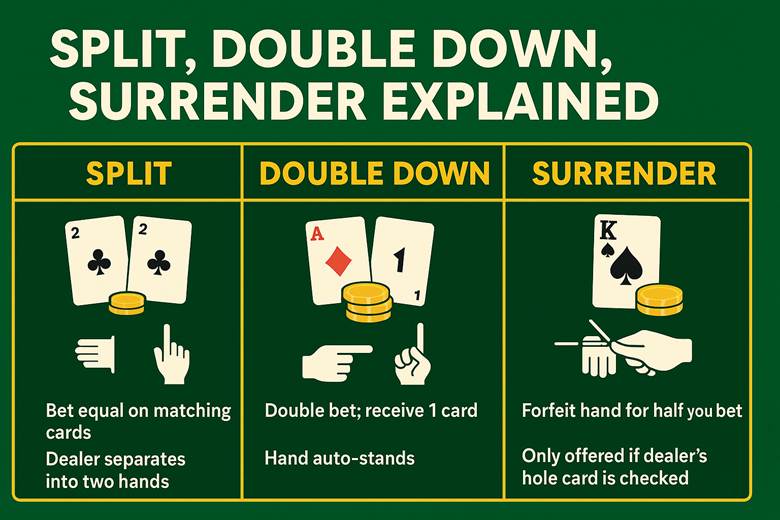
| Term | Dealer Signal / Gesture | What Happens |
| Split | Add an equal stack next to original bet; hold up index and middle fingers. | Dealer separates your identical cards into two hands; you play each separately, paying for the new hand. |
| Double Down | Slide a chip stack equal to original bet next to the circle; point with one finger. | You receive exactly one additional card; bet is doubled, hand auto-stands. |
| Surrender | Draw an imaginary line behind bet (or say “surrender” quickly). | You forfeit half your wager and end the hand immediately. Available only as late surrender in most casinos. |
Etiquette tip: place chips neatly inside the betting circle; sloppy stacks invite mis-pays and floor calls.
2. How These Three Moves Change the Math
- Perfect basic strategy without split/double/surrender → house edge ≈ 1.2 %
- Add correct splitting & doubling → edge drops to 0.5–0.6 %
- Add correct late surrender (LS) → edge drops another 0.08–0.1 %
- Make errors on any of the big three → edge climbs by 0.3–0.8 % per 100 hands
The stakes: a $50 flat bettor playing 400 hands can either lose $100 (perfect decisions) or $300 (sloppy decisions) in statistical expectation.
3. Pair-Splitting Strategy (H2)
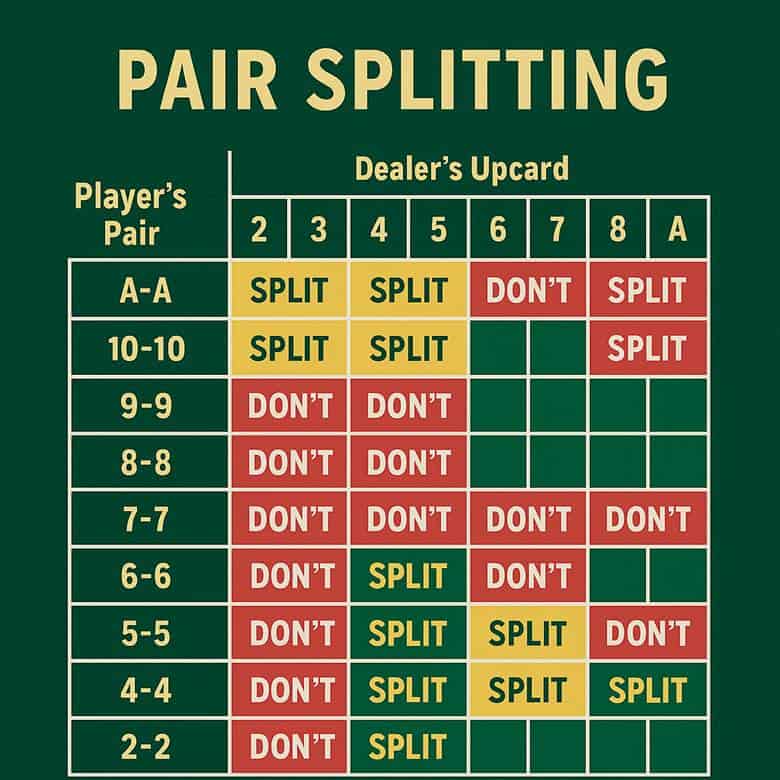
Unlike Hollywood clichés, you do not split every pair. You split to convert lousy or high-variance hands into two profitable ones.
3.1 The Golden Pairs – Always Split (H3)
| Pair | Why Always Split? |
| A-A | Turning one unplayable 2 or 12 into two soft 11s; each can draw a ten for blackjack (EV +0.51 per hand). |
| 8-8 | Hard 16 is the player’s worst stiff. Splitting flips EV from –0.54 to –0.19 versus dealer 10. |
3.2 Conditional Pairs (H3)
| Pair | Split If Dealer Shows… | Never Split If… |
| 2-2 / 3-3 | 2–7 (shoe), 2–8 (double-deck) | 8-A (shoe) |
| 6-6 | 2–6 (shoe); 2–7 (double-deck) | 7-A (shoe) |
| 7-7 | 2–7 (shoe) | 8-A |
| 9-9 | 2–6, 8, 9 | 7, 10, A |
Mnemonic: “2-3-6-7 split small vs. small; nines skip the seven call.”
3.3 Never Split Pairs (H3)
- 5-5 – Treat as hard 10; double instead. Splitting converts a +EV double to two –EV hard 5s.
- 10-10 – Hard 20 is already a powerhouse; splitting risks two weaker 10s.
- 4-4 – Split only versus 5 or 6 in single/deck; otherwise hit.
3.4 Single-Deck & Rule Exceptions (H3)
Fewer decks slightly favor splitting lower pairs (2-2 vs. dealer 8 in single deck) because of higher natural frequency. Consult the single-deck chart before you buy into the “vintage” pit.
4. Doubling Down Strategy (H2)
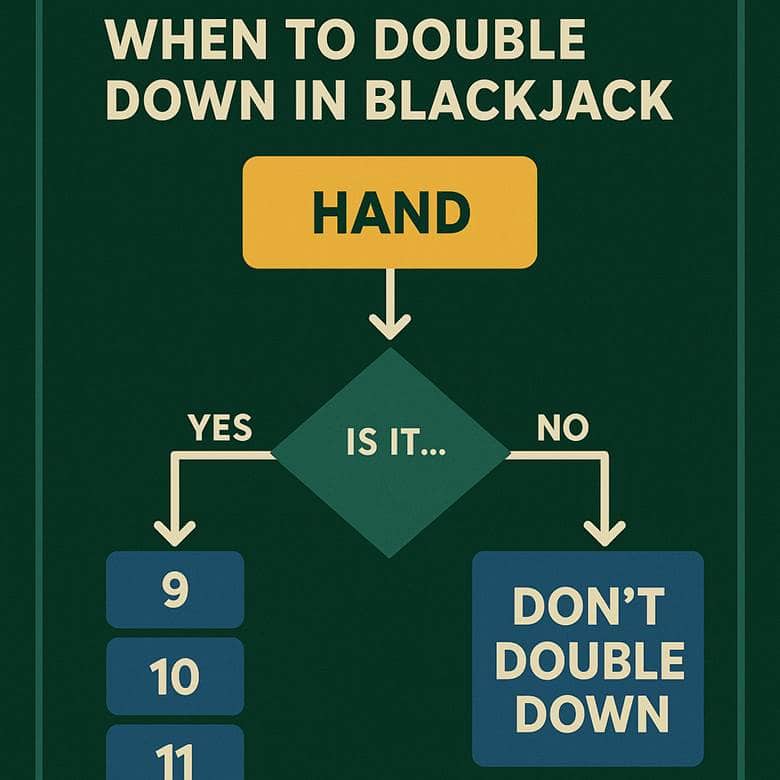
Doubling converts marginal wins into premium wins by leveraging the dealer’s bust odds. But over-doubling torches bankroll faster than any other mistake.
4.1 Core Double-Down Chart (6-Deck, S17) (H3)
| Your Hand | Double Against | Why |
| Hard 9 | 3–6 | Dealer bust odds > your bust odds + hit EV. |
| Hard 10 | 2–9 | You’re favorite to draw ten; dealer can’t hit blackjack (except A). |
| Hard 11 | 2–10 (hit vs. A) | Highest EV hand in blackjack. |
| Soft 13-18 (A-2 … A-7) | Dealer 4–6 (A-3 doubles vs. 5-6 only) | Soft hands can’t bust on one card. |
4.2 H17 and Double-After-Split Tweaks (H3)
- Dealer hits soft 17? Double soft 18 vs. dealer 2 (EV gain +0.02).
- No DAS? Never double soft splits—cannot double after splitting A-A or 8-8.
4.3 Composition-Dependent Doubles (H3)
Hard 10 comprised of 5-5 should double against dealer 9, but 6-4 should hit—five-card compositions slightly affect hit probabilities. Most players ignore; high-level counters adjust.
5. When (and Why) to Surrender (H2)
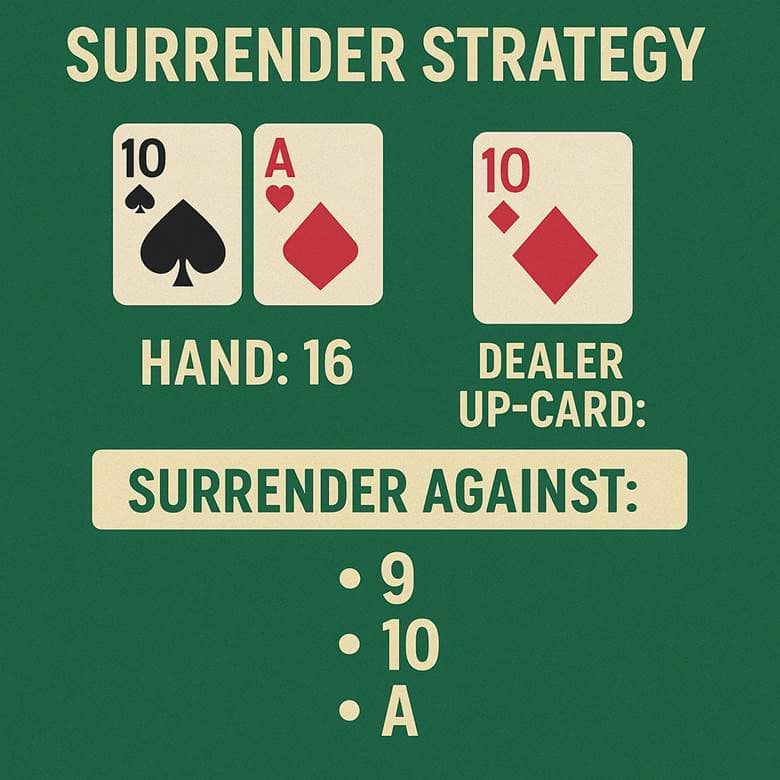
Late surrender (LS) lets you forfeit half your wager after the dealer checks for blackjack. Use it sparingly—only on the worst negative-EV hands.
5.1 Top Three Surrender Hands (H3)
| Player Hand | Dealer Up-card | EV if Play | EV if Surrender | Correct Move |
| Hard 16 (NOT 8-8) | 9, 10, A | –0.54 | –0.50 | Surrender |
| Hard 15 | 10 | –0.54 | –0.50 | Surrender |
| Pair 7-7 (post-split restriction) | Dealer 10 | –0.54 | –0.50 | Surrender (if split not allowed) |
5.2 Early Surrender Jackpot (H3)
Rarely, casinos offer early surrender (before dealer checks for blackjack). Always surrender hard 16 vs. Ace and hard 15 vs. Ace, plus any hand vs. dealer A in single-deck.
6. Advanced Factors: Deck Count, Penetration & True-Count Deviations (H2)
Counting slightly modifies big-three moves.
| Play | Basic Rule | Deviation Trigger (Hi-Lo True Count) |
| Split 10-10 vs. dealer 5 | Never split | Split at TC ≥ +5 |
| Stand 16 vs. 10 | Hit | Stand at TC ≥ 0 |
| Surrender 15 vs. 9 | Don’t surrender | Surrender at TC ≤ –1 (shoe disadvantage) |
| Double 10 vs. 10 | Hit | Double at TC ≥ +4 |
Penetration affects how often you see profitable triggers—75 % shoe depth doubles the number of positive deviations vs. 50 %.
7. Five-Step Decision Framework in < 3 Seconds (H2)
- Identify Hand Type – Hard, soft, or pair?
- Note Dealer Up-card Group – Weak (2-6) or strong (7-A).
- Consult Mental Cue:
Pairs → Golden / Conditional / Never?
Hard/Soft → Double chart?
Stiff vs. strong dealer → Surrender? - Check Count Deviation – Only if TC triggers.
- Signal Confidently – Chips placed, hand gesture clear.
8. Most Expensive Misplays and How to Avoid Them (H2)
| Misplay | EV Loss /100 Hands | Fix |
| Standing on Hard 16 vs. Dealer 10 (didn’t surrender) | –0.20 × bet | Hit or surrender if offered. |
| Splitting 5-5 vs. Dealer 10 | –0.25 × bet | Double instead. |
| Doubling Soft 18 vs. Dealer 9 | –0.15 × bet | Hit, not double. |
| Failing to Split A-A vs. Dealer 9 | –0.31 × bet | Always split aces. |
A session with just five such mistakes can double the house edge.
9. Drills & Memory Aids to Burn the Chart (H2)
- Flash-Card App: 200 random hands per day until accuracy ≥ 98 %.
- 10-Hand Bathroom Drill: Grab any deck, deal ten hands, practise decisions aloud.
- Countdown w/ Metronome: Start at 0, add +1/–1 per card every 0.8 s; goal = zero error after 52 cards.
- Laminated Wallet Card: Glance mid-shoe only during shuffles (to avoid heat).
10. Online vs. Live Blackjack: Do Split/Double/Surrender Rules Change? (H2)
- Continuous Shuffle Machines online eliminate penetration—count deviations rarely trigger; stick to base chart.
- Many RNG games lack surrender—edge rises +0.08 %.
- Some live-dealer streams allow double on any two cards (even after hit)—adjust by doubling more soft hands.
- Mobile UI often hides split until pair appears; be ready to tap instantly.
11. FAQ – People Also Ask (H2)
Should I split 9-9 against dealer 7?
No. Stand; EV of split is –0.07 vs. stand +0.01.
Is it ever correct to surrender 14?
Almost never; only early surrender vs. dealer Ace in single deck.
Can you double after splitting?
Only if the felt or placard says “DAS”. Otherwise, doubles on split hands are prohibited.
Does card counting change surrender decisions?
Yes—high negative counts (TC ≤ –2) warrant surrendering more hands (e.g., 15 vs. 9).
12. Conclusion – Turn Every Pair, Ten, or Sixteen into the Lowest-Edge Move (H2)
The next time you stare at two 8s, a hard 11, or a miserable 16 vs. 10, you’ll know exactly which of the big-three power plays—split, double down, or surrender—will pull the house edge in your favor.
- Memorise the golden and conditional pair rules.
- Double hard 9/10/11 and soft A-2–A-7 vs. weak dealers.
- Surrender hard 16 (not 8-8) vs. 9-A and hard 15 vs. 10.
- Practise until the choice is reflex, not debate.
- Layer counting deviations and rule scouting to drive edge below zero.